
When Steel Meets Speed: What a Gateway Incident Reminds Us About Racing’s Tech Frontier
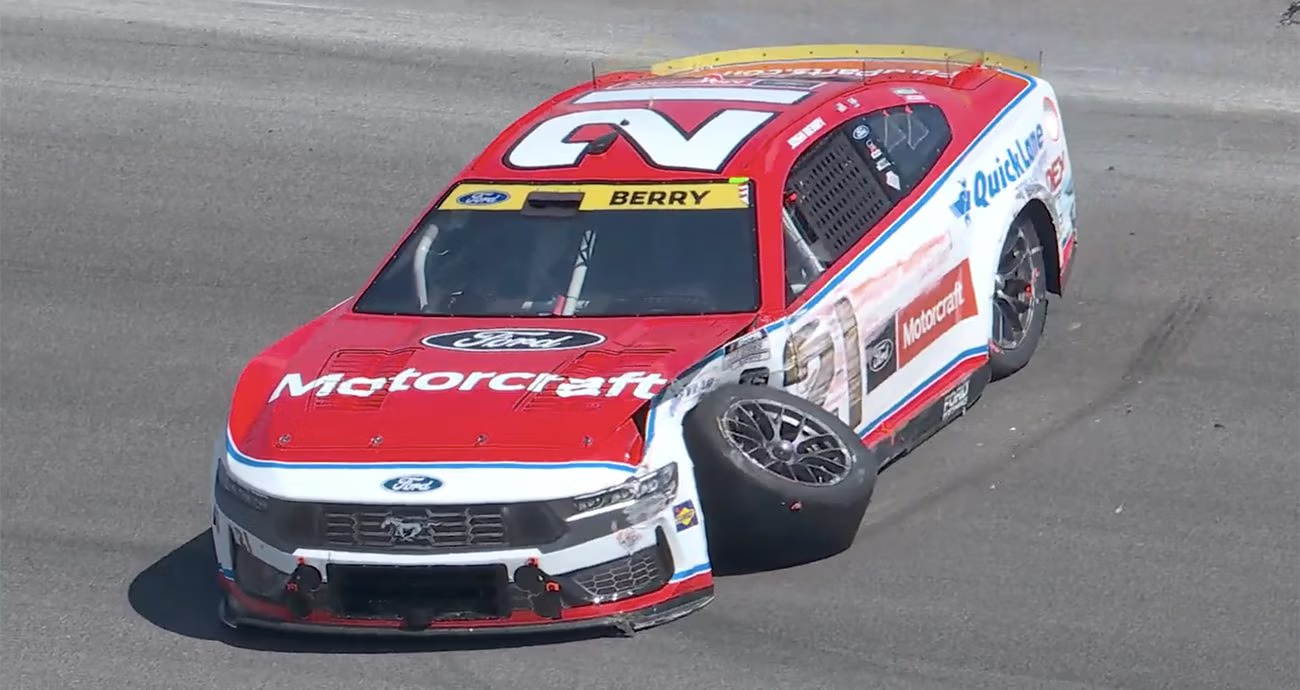
NASCAR is a sport of breathtaking speed, audacious skill, and, occasionally, brutal reality checks. The recent incident involving Josh Berry at Gateway, where contact with Chase Elliott sent Berry’s car into a significant, race-ending impact, serves as a stark reminder of the razor’s edge on which these athletes compete. While the headlines rightly focus on the immediate drama and the unfortunate end to Berry’s day, for those of us tracking the intersection of performance and progress, such moments are invaluable, albeit painful, lessons in the relentless pursuit of motorsport safety and technological advancement.
This wasn’t just another bump and grind; it was a violent disruption of momentum, a testament to the immense kinetic energy at play when high-speed racing machines collide. Berry’s car sustained substantial damage, forcing him out of contention and highlighting the destructive forces that engineers strive to mitigate. The immediate concern is always for driver safety, and thankfully, Berry emerged from the incident largely unharmed, a testament to decades of safety innovations.

But beyond the immediate competitive impact, what does an incident like this truly signify for the future of motorsport, especially through a tech-focused lens? These crashes are not merely unfortunate events; they are involuntary, high-stakes experiments that push the limits of current design and materials, providing crucial data for the next generation of race car development and safety protocols. They represent a dynamic, real-world laboratory where theory meets brutal reality, guiding the evolution of racing technology.
Key Takeaways: Data Points in a High-Stakes Lab
Safety is a Relentless Pursuit
Every significant crash in NASCAR, from a minor scrape that sends a driver to the garage to a full-blown, multi-car impact, is meticulously analyzed and processed as a critical data point for engineers. NASCAR’s Next Gen car, introduced with considerable fanfare and designed with significantly enhanced safety features over its predecessors, is constantly being tested in the most extreme real-world conditions imaginable on track. An incident like Josh Berry’s at Gateway provides a treasure trove of crucial telemetry, impact force data, and visual evidence that feeds directly into ongoing research and development efforts.
This data informs the iterative design process for chassis construction, energy absorption structures, and driver containment systems. Sensors embedded throughout the vehicle capture invaluable information about deceleration rates, G-forces experienced by the driver, and structural deformation. This detailed feedback loop reinforces a fundamental truth in motorsport: safety is not a finite destination to be reached, but an iterative, never-ending journey of continuous improvement. Each incident, however unfortunate, becomes a building block for making the sport safer for drivers and track personnel alike.
The commitment to driver safety extends beyond the car itself, influencing track design and barrier technology. Engineers and safety experts constantly review incidents to identify areas where improvements can be made, whether through subtle tweaks to car components or more significant overhauls based on new materials or design philosophies. The goal is always to evolve, ensuring that as cars become faster and more powerful, the protective measures keep pace, or ideally, stay one step ahead.
The Unseen Science of Impact Absorption
When spectators witness a race car crumple in a violent impact, it’s easy to perceive it simply as destruction. However, for engineers, this crumpling is a demonstration of highly controlled energy dissipation at work. Modern race cars are meticulously engineered to manage and distribute immense crash forces away from the driver’s compartment. The goal is to absorb as much kinetic energy as possible through the deformation of sacrificial structures, preventing it from reaching the driver.
An event like Berry’s crash allows engineers to conduct a detailed post-mortem analysis of how various components performed under extreme duress. Questions arise: Where did the energy go? Which parts of the front and rear clips deformed as designed? How effective were the side intrusion panels in preventing cabin compromise? What held up beyond expectations, and what areas showed potential for improvement? This detailed analysis is absolutely critical for future design iterations.
Understanding the exact failure modes and energy pathways helps engineers refine material choices, optimize structural geometries, and innovate with new composite materials and bonding techniques. The ultimate aim is to ensure that drivers can walk away from increasingly severe impacts with minimal injury. This scientific approach to impact absorption is a testament to the sophistication of modern motorsport engineering, transforming chaotic collisions into invaluable lessons for continued progress in high-performance vehicle safety.
Human Element Meets Machine Limits
Even with all the computational fluid dynamics, advanced materials science, meticulous engineering, and sophisticated predictive models, racing remains at its core a profoundly human endeavor. The performance of these incredible machines is inextricably linked to the decisions, reactions, and physical capabilities of the driver behind the wheel. Split-second decisions, tiny miscalculations in a tight pack, or unforeseen contact with another competitor can instantly escalate into a major incident, regardless of how robust the car’s safety features are.
This crash, initiated by contact between two cars, powerfully underscores the incredible precision and control required to pilot a 3,400-pound stock car at speeds exceeding 180 mph. It highlights how even seemingly minor interactions in a high-speed, high-stress environment can have massive, machine-testing consequences. The human factor introduces an element of unpredictability that no amount of engineering can fully eliminate, which is part of what makes racing so thrilling and dangerous.
Engineers design cars to be forgiving within limits, but those limits are often pushed to their absolute maximum by the competitive nature of the sport and the sheer audacity of the drivers. Understanding this dynamic interplay between human skill and machine capability is crucial. It drives not only improvements in vehicle safety but also in driver training, awareness, and the implementation of technologies that assist drivers without diminishing their role as the primary controller of the vehicle. The resilience of both the machine and the human driver is constantly being tested and refined through such intense experiences.
What This Means for the Future
The Gateway incident, like all such events in the high-octane world of professional motorsport, will undoubtedly contribute significantly to the ongoing evolution of racing safety. These aren’t just isolated occurrences; they are critical data points in a continuous feedback loop that drives innovation. We can anticipate several key areas of development and refinement as a direct result of lessons learned from incidents like Berry’s crash.
Further Refinements in Car Design
Expect to see continued tweaks and innovations in material science and structural engineering aimed at enhancing crashworthiness. This might involve the integration of new composite materials, such as advanced carbon fiber weaves or unique metallic alloys, that offer superior strength-to-weight ratios and improved energy absorption characteristics. Chassis integrity will likely see ongoing development, with engineers exploring ways to create stronger, more resilient structures that better withstand multi-directional impacts.
Furthermore, we could see the incorporation of even more sophisticated energy-absorbing elements within the car’s structure. These might include crushable foam inserts in strategic locations, sacrificial panel designs, or modular components that are designed to deform and dissipate energy in a controlled manner, further protecting the driver’s survival cell. The relentless pursuit of optimizing every gram for performance while simultaneously maximizing safety is a core challenge that will continue to drive innovation in NASCAR’s Next Gen car design.
Smarter Monitoring and Predictive Analytics
The vast amount of telemetry data collected from race cars isn’t just for optimizing performance on the track; it’s also a goldmine for safety. Future advancements could see the deployment of even more sophisticated real-time monitoring systems capable of assessing car integrity during a race. Imagine sensors that can detect minute structural changes or micro-fractures in the chassis after minor contact.
Building on this, predictive models could be developed that flag potential structural vulnerabilities after even seemingly innocuous bumps, allowing teams to make more informed and proactive pit stop decisions regarding car damage. This capability could prevent a minor incident from escalating into a major one, or alert teams to latent damage that could compromise safety down the line. Such smart monitoring would merge cutting-edge sensor technology with advanced artificial intelligence to provide an unprecedented level of real-time safety assessment.
Enhanced Barrier Technology
While much of the focus is on the race car itself, its interaction with trackside barriers is equally critical in determining the outcome of a high-speed incident. Every crash provides invaluable feedback on how well existing barriers are performing and where improvements can be made. This could lead to innovations in energy-absorbing materials used in track barriers, such as new types of foams, deformable plastics, or even advancements in the design of SAFER (Steel and Foam Energy Reduction) barriers.
Engineers and track operators constantly analyze impact angles, forces, and car deceleration profiles against barriers. This data informs research into optimizing barrier placement, height, and material composition to maximize energy dissipation and minimize rebound effects. The goal is to create a dynamic safety system where the car and the track infrastructure work in concert to protect the driver, ensuring that advances in car safety are matched by equivalent advancements in trackside protection.
The Pursuit of the Unbreakable Machine (and Driver)
The overarching vision in motorsport safety is not to eliminate crashes entirely, as they are an inherent and often thrilling part of the sport’s high-speed, competitive nature. Instead, the relentless pursuit is to make every crash survivable and to minimize driver injury to the greatest extent possible. This ongoing quest is significantly fueled by incidents like Josh Berry’s at Gateway, which serve as stark reminders of the inherent risks and powerful catalysts for innovation.
Engineers are continually pushed to innovate and redefine the limits of what’s possible in high-performance safety. This includes not only external vehicle structures but also internal driver containment systems, helmet technology, seat design, and fire suppression. The ultimate aim is to create a symbiotic relationship between the driver and their machine, where advanced engineering provides an unparalleled cocoon of safety, allowing drivers to push boundaries with the confidence that their equipment offers maximum protection. The pursuit of the unbreakable machine and, by extension, the uninjured driver, remains the driving force behind the technological frontier of motorsport safety.
Ultimately, while unfortunate, incidents like the one at Gateway are a stark reminder of the inherent risks of pushing boundaries at speed. They are also powerful catalysts for innovation, driving the relentless pursuit of engineering excellence and unparalleled safety that continues to define the cutting edge of motorsport. These moments, though painful, teach us invaluable lessons that safeguard the future of the sport.
Read the original story at NASCAR.
What are your thoughts on the balance between pushing technological limits for performance and ensuring maximum safety in racing? Share your perspective in the comments below!