
When Duty Calls: Unpacking the Viral Moment of National Guard Trash Collection
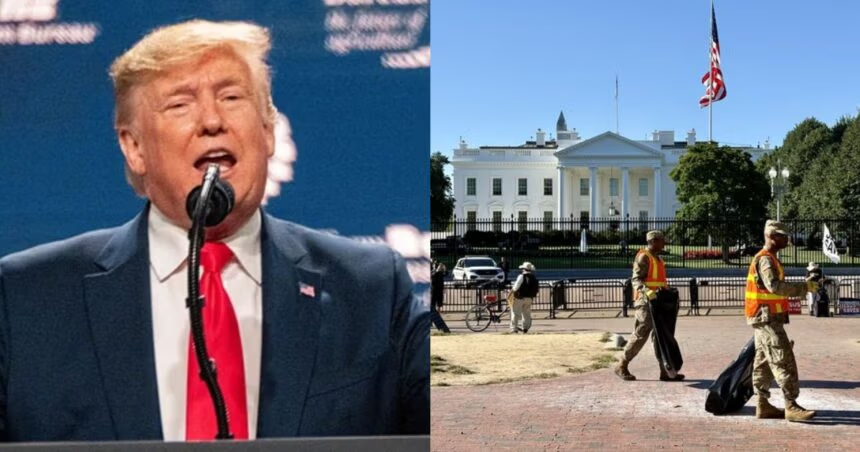
In an age where every moment can become a global talking point, a recent viral video sent ripples of incredulity and outrage across the internet. The scene? Not a combat zone, nor a disaster relief effort, but the pristine environs near the White House. The protagonists? Uniformed National Guard troops. Their mission? Collecting trash.
The immediate shock wasn’t just at the sight itself, but at the stark incongruity. These are individuals trained for complex security operations, emergency response, and defense. To see them engaged in what is, by all measures, a civilian municipal task, immediately begs the question: Why? It’s a powerful visual metaphor for a potential misallocation of valuable, highly specialized human resources. It speaks to a blurring of lines, raising concerns about efficiency, respect for service, and the very definition of their operational mandate.

This incident, like so many others today, owes its widespread impact to the unforgiving lens of social media. A quick smartphone recording, uploaded and shared, transformed a localized event into a national debate. Netizens, quick to express their collective disbelief and anger, amplified the narrative, demanding answers and accountability. This isn’t just about public shaming; it’s about the democratization of oversight. In an instant, the public becomes a powerful auditing force, holding institutions to account in ways unimaginable just a couple of decades ago. It highlights the critical role of citizen journalism and the speed at which discrepancies can be exposed.
The Discrepancy: Military Training vs. Municipal Tasks – A Costly Misallocation
The fundamental issue at play is the stark contrast between the National Guard’s primary purpose and the task they were reportedly performing. The National Guard is a crucial component of the United States military, with units trained for a broad spectrum of missions including combat, disaster relief, domestic security, and support for civil authorities during emergencies. Their rigorous training involves significant investment in time, taxpayer dollars, and specialized equipment, preparing them for high-stakes scenarios such as complex logistical operations, engineering tasks, medical support in austere environments, and direct combat. Deploying such highly trained personnel for trash collection not only appears inefficient but also raises serious questions about the strategic utilization of taxpayer-funded assets.
While the National Guard frequently assists civilian authorities, their role is typically to augment capabilities during genuine crises – think natural disasters, large-scale protests requiring crowd control, or securing critical infrastructure after an attack. Sanitation, by contrast, is a core responsibility of city and county public works departments, a task for which civilian personnel and equipment are specifically procured and trained. The visible gap in civilian services that necessitated military intervention, even for a seemingly minor task, points to a potential systemic failure or misjudgment in resource planning. This misallocation carries not only a financial cost but also an opportunity cost, diverting service members from essential readiness training or other critical duties where their specialized skills are genuinely needed.
Social Media’s Double-Edged Sword: Instant Scrutiny and Narrative Control
The incident’s rapid ascent to viral status underscores the immense power of social media in shaping public discourse. A single video clip, captured on a smartphone, bypassed traditional media gatekeepers and landed directly in the feeds of millions within hours. This phenomenon, often referred to as citizen journalism, empowers ordinary individuals to act as watchdogs, providing real-time, unfiltered glimpses into events that might otherwise go unnoticed or be downplayed by official channels. For institutions, this means an unprecedented level of public scrutiny and immediate accountability demands, where images and videos often speak louder than official statements.
However, the rapid virality also presents inherent challenges. While it can expose inefficiencies and injustices, it can also lead to incomplete narratives, speculation, and misinterpretations without full context. The initial outrage might stem from a perception that lacks the complete operational picture, or the nuances of a complex situation. Nevertheless, the public’s instantaneous and widespread reaction serves as a powerful indicator of what resonates, what causes concern, and what standards citizens expect from their government and military. It forces organizations to be not only transparent but also proactive in managing their public image and communicating their actions effectively in the digital age.
Beyond the Bin: Systemic Challenges and the Erosion of Civilian-Military Lines
Beyond the immediate visual shock, this viral moment sparks more profound questions for the future of resource management, especially during periods of civil unrest or heightened security in domestic settings. Are we effectively utilizing the incredible skills and dedication of our military personnel, or are we sometimes defaulting to them as a catch-all solution for gaps in civilian services? This ‘military as a last resort’ mentality, when applied to non-emergency civic duties, can erode public confidence in the efficiency and preparedness of government operations as a whole.
The blurring of lines between military and civilian roles in domestic settings carries significant weight. Historically, the Posse Comitatus Act, though primarily applicable to federal active-duty forces, underpins a broader principle of limiting military involvement in civilian law enforcement and other civil affairs. While the National Guard operates under state authority in many domestic deployments, the spirit of this separation is crucial for maintaining democratic principles and preventing the militarization of routine civilian tasks. Such deployments can desensitize the public to the true nature of military intervention and potentially normalize the use of uniformed troops for tasks that should be handled by non-military agencies, creating a dangerous precedent for mission creep.
The underlying causes for such a scenario often include budget cuts to civilian public works departments, a perceived lack of readiness or available personnel within municipal services, or simply the rapid availability and logistical capability of the National Guard during an immediate need. However, relying on the military as a default solution for civilian shortcomings points to deeper systemic challenges in how we fund, plan, and execute public services. It raises questions about long-term sustainability and the appropriateness of military personnel filling roles that could and should be handled by civilian workers.
The Human Cost: Morale, Public Perception, and the Future of Service
For the National Guard members themselves, deployments for tasks far removed from their core mission can have a tangible impact on morale and the public perception of their crucial role. Service members join to serve their country, often envisioning roles in defense, humanitarian aid, or emergency response that utilize their specialized training and contribute significantly to national security. Being assigned tasks that might be perceived as menial, repetitive, or demeaning, especially when performed in uniform and under public scrutiny, can lead to profound feelings of frustration, underutilization, and a sense of disrespect for their service and expertise.
Furthermore, if the public’s primary image of the National Guard becomes associated with tasks like domestic trash collection rather than their critical contributions to national security, disaster relief, and specialized emergency response, what does that mean for recruitment and retention? Maintaining a strong, motivated, and highly skilled volunteer force depends heavily on a positive public image, clear mission clarity, and a sense of purpose. Leaders must consider the psychological toll on their troops and the long-term implications for the Guard’s identity, its appeal to prospective members, and the sustained willingness of current members to continue their service when faced with deployments that seem to undervalue their extensive training.
A Call to Action for Leadership: Reaffirming Roles and Bolstering Civilian Infrastructure
Looking ahead, this incident serves as a potent reminder for leadership to critically examine deployment protocols and decision-making processes across all levels of government. It forces a conversation about clear boundaries between military and civilian roles, especially in domestic settings. The future demands more thoughtful, strategic approaches that respect the specialized training and sacrifices of our service members while simultaneously ensuring our civilian infrastructure is robust enough to handle its own responsibilities, even during times of heightened security or public events.
This includes advocating for and investing in the proper funding and staffing of civilian agencies responsible for public works, sanitation, emergency management, and large-scale event logistics. Developing clear, transparent guidelines for when and how military assistance is requested and deployed for non-security, non-emergency tasks is paramount. Such protocols should prioritize the appropriate use of resources, minimize the impact on service member morale, and maintain public trust in both military and civilian institutions. Enhanced inter-agency communication, proactive planning, and training for civilian personnel to handle surge demands would significantly reduce the need for military intervention in routine civic matters.
Ultimately, the image of soldiers collecting trash isn’t just a quirky anomaly; it’s a stark symbol of deeper systemic challenges and the amplified scrutiny of the digital age. It’s a call for reflection on how we deploy our most valuable resources and how we honor the service of those dedicated to protecting us, ensuring their efforts are always aligned with their true purpose. The National Guard, a force of unparalleled dedication and skill, deserves to be utilized in a manner that truly reflects their invaluable contribution to national and domestic security, allowing them to focus on the missions they are uniquely trained and equipped to perform.
What are your thoughts on the appropriate roles for the National Guard in domestic situations, especially when it comes to tasks traditionally handled by civilian services?