Ninja’s Newest Opponent? The Ghost of His Own Success.
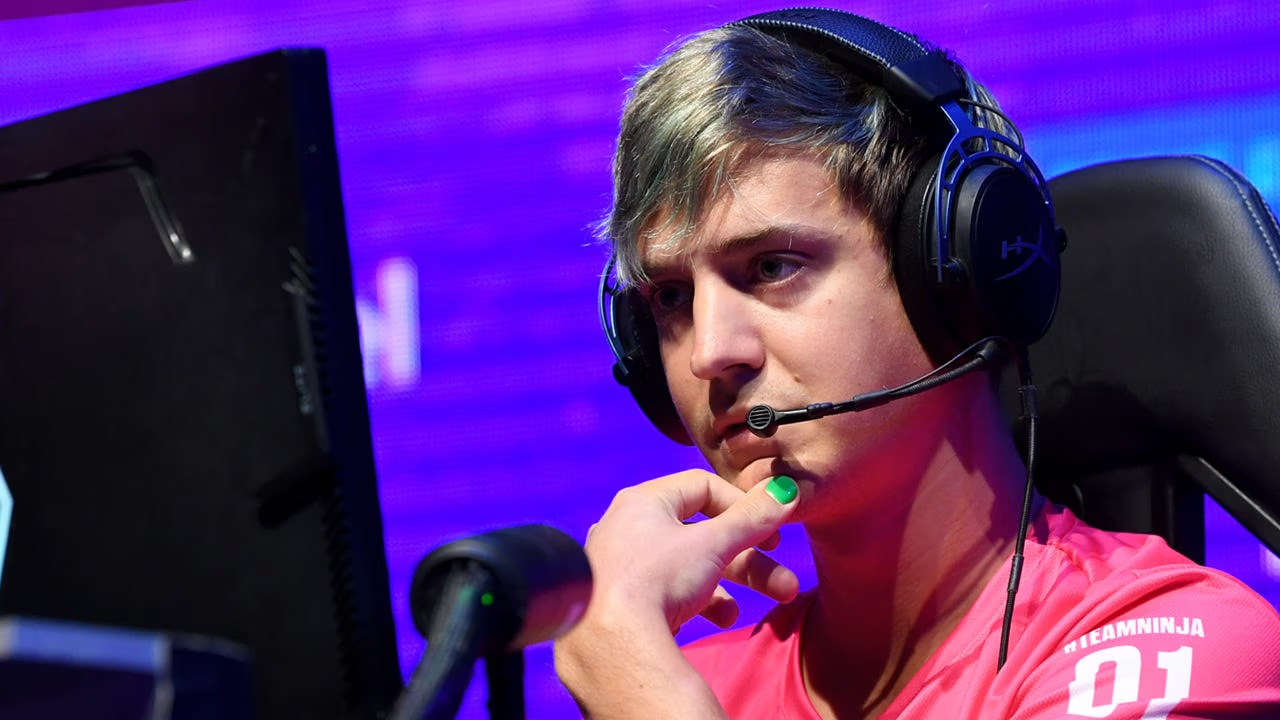
Remember 2018? For many, it feels like a lifetime ago, yet its cultural impact on the burgeoning world of online content creation remains indelible. If you were even remotely connected to the internet, you undoubtedly remember the phenomenon that was Tyler “Ninja” Blevins. With his iconic blue hair, an almost supernatural wellspring of energy, and the groundbreaking Drake stream that shattered records, Ninja briefly transcended the gaming sphere, uniting it with mainstream pop culture in an unprecedented way. He wasn’t just playing Fortnite; he was the undisputed king of a digital kingdom he had not only helped to build but also aggressively expanded, regularly commanding an audience of hundreds of thousands of concurrent viewers. For a moment in time, as the game’s popularity soared and his star burned brightest, he was, in every sense of the word, untouchable.
Fast forward a few years, and the internet’s memory, while long in its archives, can be brutally short in its present focus. Its metrics are relentless, serving as a constant, unforgiving scoreboard. In a recent, remarkably candid and vulnerable moment, Ninja opened up about the profound psychological weight of maintaining that stratospheric peak, telling IGN that “the last couple of years have been rough.” The reason behind this struggle? The constant, daily barrage of negativity and mocking from trolls in his live chat, who fixate on the one thing he ultimately can’t control: he’s no longer pulling the astronomical 2018 viewer numbers.

“You fell off.” “Look at your viewers.” Comments laden with schadenfreude like these, he explains, are an almost daily occurrence. And while it might be tempting for some to dismiss this as merely a “rich person problem” – a celebrity complaining about internet comments – to do so is to miss the crucial, deeply human story unfolding at the very apex of the global creator economy. Ninja’s struggle isn’t simply about battling anonymous internet trolls; it’s a profound, universal look at the unwinnable war against the ghost of your own success, a benchmark so high it becomes a constant tormentor.
The Impossible Benchmark: Chasing a Phantom Peak
The first, and perhaps most crucial, takeaway from Ninja’s experience is that he is not merely being compared to his peers, or even to the natural ebb and flow of a typical career. He is being relentlessly benchmarked against an anomaly—a historical event in internet culture. His Fortnite peak in 2018 wasn’t just a successful period; it was a perfect storm, a confluence of rare circumstances that are unlikely to ever be precisely replicated. It was the right personality, with an undeniable magnetism and infectious energy, on the right platform, Twitch, at the exact moment a generational game, Fortnite, exploded into the cultural zeitgeist. This alignment of stars created a truly unique phenomenon, an instance of lightning in a bottle. Expecting anyone, including Blevins himself, to sustain that level of explosive, unprecedented growth is not just unrealistic; it’s akin to expecting a blockbuster movie to have the biggest opening weekend in history every single weekend, or a chart-topping song to remain at number one indefinitely. Such expectations defy the very nature of virality and peak performance.
The insidious nature of these “you fell off” comments is that the trolls aren’t comparing him to other successful streamers who consistently pull strong numbers; they’re comparing him to an almost mythical version of himself that existed under once-in-a-generation, non-replicable conditions. This sets an impossible standard, not just for Ninja, but for any creator, influencer, or public figure who experiences a moment of truly viral, overwhelming fame. It creates a digital scoreboard where the only winning move is to somehow beat your all-time high, day after day, week after week. This relentless pressure can be psychologically devastating, transforming past glories into future burdens, and turning sustained success into a perceived failure simply because it isn’t a continuous ascent to an already reached zenith.
The Shifting Tides of Streaming: Beyond the One-Game God
Ninja’s experience is also a significant symptom of a much broader, fundamental shift occurring within the dynamic streaming landscape. The era of the “one-game god” – a single personality who dominates an entire platform primarily through exceptional skill at one trending game – is definitively fading. While mastery of a specific game can still draw an audience, it’s no longer the sole, or even primary, pathway to sustained top-tier success in the way it once was.
Today, the upper echelons of Twitch and other streaming platforms comprise a far more diverse and complex ecosystem. Personalities like Kai Cenat and xQc now reign supreme, but their appeal often stems from a broader, more eclectic approach. Their content frequently features variety gaming, expansive “Just Chatting” segments where direct interaction with viewers is paramount, and innovative, community-driven events that transcend singular gameplay skill. These streamers are less about showcasing technical prowess in one title and more about cultivating a vibrant, engaging personality and fostering a strong sense of community.
The platform itself has matured considerably. Viewers are no longer just tuning in to watch the absolute best Fortnite player or the most skilled *League of Legends* pro; they’re increasingly looking for broader entertainment, deeper community connections, and authentic personalities they can genuinely connect with across a variety of experiences. This shift requires immense adaptability from creators. Ninja is still, by any reasonable metric, one of the most successful and recognizable streamers in the entire world. However, he’s now a veteran star navigating a league that has fundamentally changed its rules of engagement and its definition of peak performance. His candid story serves as a powerful signal that the future of top-tier streaming isn’t solely about mastering one game to perfection, but rather about building a versatile, resilient brand that can deftly surf the unpredictable waves of changing trends and viewer preferences.
The Future is Sustainable, Not Just Viral
So, what profound implications does this evolution hold for Ninja, and for the creator economy as a whole? For Ninja, it seems to represent a conscious and courageous pivot from relentlessly chasing ephemeral numbers and regaining his 2018 peak, to instead pursuing personal fulfillment and long-term career satisfaction. By focusing on the content he genuinely enjoys creating and the community he cherishes, he is actively building a sustainable career that is no longer solely dependent on being the flavor of the month, or constantly trying to recapture a lightning-in-a-bottle moment. This strategic shift represents a vital blueprint for the “post-peak” creator: effectively leveraging a legendary past and a recognizable brand to construct a stable, robust, and long-term future. He is transitioning, with considerable grace and introspection, from being a fleeting viral phenomenon into an established, enduring institution within the digital entertainment landscape.
For the wider creator economy, this is an absolutely vital lesson that transcends individual success stories. The relentless, often unhealthy, pursuit of exponential growth at all costs – an endless chase for the next viral hit or the highest possible viewer count – inevitably leads to profound burnout, mental health challenges, and a pervasive sense of failure, even amidst what objectively appears to be incredible success. The real, enduring goal for creators and entrepreneurs in this space shouldn’t be to capture lightning in a bottle once, or even repeatedly, but rather to build a resilient business and cultivate a loyal, engaged community that can not only survive but truly thrive long after the initial storm of viral fame has passed. This involves diversification, authentic engagement, strategic partnerships, and a focus on intrinsic motivation over external validation.
Ninja’s recent vulnerability isn’t a confession of failure, nor is it merely a lament about negative comments. Instead, it’s an incredibly candid, behind-the-curtain look at the very real, very human cost of living on a metric-driven pedestal, where every performance is instantly judged against an impossible ideal. And in admitting that the fight is “rough,” that the pressure is immense, and that the internal struggle is ongoing, he’s offering a far more valuable and relatable insight into the realities of modern digital celebrity than any high-kill-count Victory Royale or record-breaking stream ever could. It’s a powerful reminder that behind every screen name and every massive follower count, there’s a human being navigating unprecedented pressures.
Read the original story at IGN.
What are your thoughts on the pressure creators face to constantly outdo their past successes, and how do you think the creator economy can foster more sustainable growth models for talent?