The Virtual Boy Precedent: Why Nintendo Must Bring Back the DS to Switch Online
Of all the ghosts in Nintendo’s hardware graveyard, the Virtual Boy is arguably the most infamous. A commercial catastrophe wrapped in a headache-inducing crimson nightmare, it’s a system most thought Nintendo would prefer to forget forever. And yet, here we are. Nintendo just announced that Virtual Boy classics are coming to the Nintendo Switch Online service.
If you just did a double-take, you’re not alone. This is the kind of move that feels less like a corporate strategy and more like a fever dream. But once the initial shock wears off, a much more important question emerges: If Nintendo is willing to resurrect its most notorious failure, what’s stopping them from bringing back one of their greatest triumphs?

I’m talking, of course, about the Nintendo DS.
The Precedent Has Been Set: From Niche Failure to World-Conquering Juggernaut
Let’s be clear: the effort to emulate the Virtual Boy’s stereoscopic 3D on the Nintendo Switch is not trivial. It’s a niche, historically unpopular platform with a notoriously difficult and unique visual output. Yet, Nintendo dedicated significant resources to preserving this weird, red-and-black piece of its history for a modern audience, suggesting a new era of digital preservation and retro gaming ambition.
The Virtual Boy, with its monochromatic red LED display and specific stereoscopic effect, presented unique and daunting emulation hurdles. Replicating that exact visual experience, including its infamous capacity for eye strain, for a modern single-screen console like the Switch requires not just technical prowess but also a genuine willingness to invest in a platform known primarily for its commercial failure and limited, albeit quirky, library. This move isn’t primarily about generating massive new revenue; it’s a statement about acknowledging a peculiar, ill-fated chapter of Nintendo’s storied hardware development.
Now, juxtapose that commitment with the Nintendo DS and its highly successful successor, the Nintendo 3DS. This family of systems wasn’t a niche failure; it was a world-conquering juggernaut that collectively sold over 154 million units across its various iterations (DS, DS Lite, DSi, 3DS, New 3DS, 2DS). Its library isn’t a handful of curiosities; it’s a sprawling treasure trove of genre-defining classics that captivated millions of players worldwide and fundamentally changed how many people approached portable gaming.
Games like The Legend of Zelda: Phantom Hourglass and Spirit Tracks reinvented touch-based adventure, offering innovative controls that felt revolutionary and perfectly suited to the dual-screen setup. Nintendogs tapped into the casual market with unprecedented success, becoming a cultural phenomenon and a key driver of DS sales. The Professor Layton series delivered engaging puzzle-solving narratives that combined charming animation with brain-teasing challenges, appealing to a broad demographic. Ghost Trick: Phantom Detective showcased brilliant storytelling and unique, time-manipulating mechanics that leveraged the dual screens for dramatic effect. And for core gamers, titles like Metroid Prime Hunters pushed the boundaries of first-person shooters on a handheld, demonstrating the DS’s surprising versatility. These aren’t just fondly remembered—they are masterpieces that are currently trapped on aging hardware, slowly succumbing to battery degradation, screen yellowing, and the inevitable march of technological obsolescence.
By reviving the Virtual Boy, Nintendo has effectively dismantled its own best argument against a DS revival. The excuse that a platform is too old, too weird, or too technically difficult to emulate now rings hollow. They just resurrected the king of weird and difficult, proving that with enough ingenuity, resource allocation, and a commitment to preserving its history, almost any historical platform can be brought into the modern gaming era.
Solving the Dual-Screen Dilemma: Innovative Solutions for a Modern Handheld
The obvious technical hurdle, the elephant in the room that has long been cited as the primary obstacle, has always been the DS’s iconic dual-screen setup. The Nintendo Switch is, at its core, a single-screen console, whether it’s docked to a television or used in its portable handheld mode. How could you possibly replicate an experience built fundamentally around two distinct displays, one of which was a resistive touchscreen crucial for many gameplay mechanics and user interfaces?
For years, this has been the go-to reason for why a DS revival was deemed impossible or simply too impractical to pursue. Critics argued that the unique interaction between the two screens, often with critical gameplay elements, maps, inventories, or puzzles split strategically between them, could not be faithfully translated to a singular display without severely compromising the original game experience. However, the Virtual Boy’s return proves that Nintendo is willing to get creative, even unconventional, to solve complex emulation challenges. And frankly, the solutions for the DS are not only possible and well within Nintendo’s technical capabilities, they’ve already been extensively prototyped and refined by the dedicated fan emulation community for years on platforms with similar display limitations, demonstrating their viability.
Creative Display Modes for TV and Handheld Play
Imagine a straightforward side-by-side display on your TV when your Switch is docked. The two DS screens could be presented horizontally adjacent, allowing players to see both simultaneously. While this might necessitate a slight reduction in the individual screen sizes to fit within a modern widescreen TV’s aspect ratio, today’s high-definition televisions offer ample resolution to make this a perfectly viable and readable option for a vast majority of games, especially those where constant, precise touch input isn’t the primary gameplay mechanic. Menus and maps would be clearly visible, and gameplay flow would remain intact.
In handheld mode, where screen real estate is naturally more constrained, a dynamic picture-in-picture layout could work wonders. The primary gameplay screen (often, though not always, the top DS screen) would take center stage, occupying the majority of the Switch’s display. The secondary screen (usually the touch screen) would then appear as a smaller, unobtrusive overlay in a corner of the main display. Players could then intuitively tap a dedicated button or use a simple, designated gesture on the Switch’s own touchscreen to seamlessly swap focus between the top and bottom screens, bringing the secondary display to full size for required interactions, whether it’s drawing on a map, managing inventory, or performing a specific touch-based action. This fluid switching mechanism would maintain the core gameplay loop without significant compromise, offering flexibility to the player.
Furthermore, the Switch’s own capacitive touchscreen is a marvel of modern display technology—far more advanced, responsive, and precise than the DS’s older resistive touch panel. This means that touch interactions in DS games would not only be replicated but potentially enhanced, making activities like writing notes in Brain Age, performing surgeries in Trauma Center, or navigating intricate menus even more precise and enjoyable. Many DS games relied heavily on stylus input, and the Switch’s touch capabilities, perhaps even paired with a precise stylus accessory, are more than capable of handling these inputs, offering a superior, modern interaction.
The “Tate Mode” Masterstroke: A Vertical Revelation
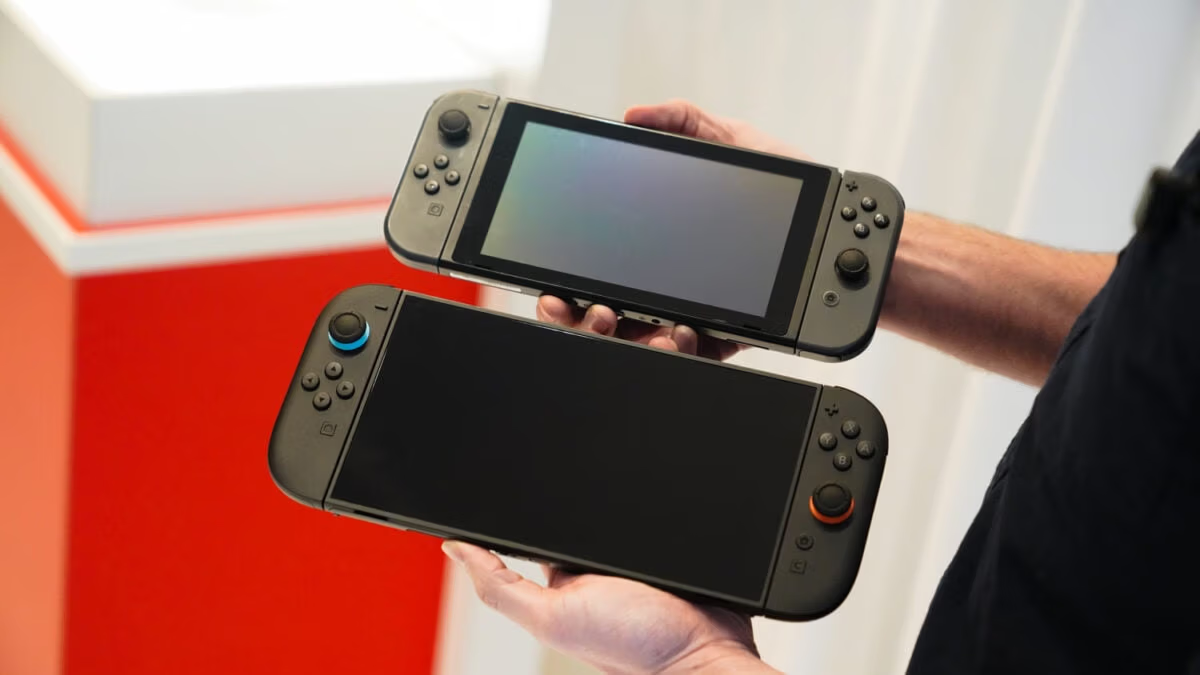
The most elegant solution, however, might be the most creative and truly authentic to the original DS experience: “Tate mode.” This ingenious concept involves simply turning the Nintendo Switch console on its side. With the Joy-Cons detached from the main unit and held either individually in each hand or affixed to a comfortable grip accessory, the Switch’s widescreen becomes a perfect canvas for a vertical, top-and-bottom screen layout, almost exactly mimicking the physical form factor of the original Nintendo DS. This isn’t a new or experimental concept for Nintendo; this “Tate mode” (derived from the Japanese word *tate*, meaning vertical) is already an established feature used for some classic arcade shooters on the eShop, allowing players to experience games like Pac-Man or Galaga in their original vertical aspect ratios, perfectly filling the screen. For the DS, it would be a brilliant, existing solution just waiting to be implemented into an emulation framework.
In this “Tate mode” orientation, the Switch’s impressive 6.2-inch screen (or the even larger 7-inch OLED model) can comfortably display both DS screens stacked vertically, with the bottom screen fully touch-enabled for direct interaction. This configuration provides an incredibly authentic visual and interactive experience, replicating the original DS layout with minimal, if any, compromise to the developer’s original intent. The detached Joy-Cons would handle all traditional button inputs (D-pad, face buttons, shoulder buttons), freeing up the central screen entirely for pure touch interaction, precisely as players experienced on the DS with their stylus. This innovative approach would allow the vast library of DS games to shine on the Switch, preserving their intended design, gameplay mechanics, and offering a truly unique and immersive retro gaming experience that feels both familiar and refreshingly modern.
What This Means for the Future: Unlocking Nintendo’s Treasure Trove
The arrival of the Virtual Boy on Switch, whether viewed as a curious novelty or a genuine act of preservation, is more than just a quirky retro drop. It’s a powerful signal. It signals that the doors to Nintendo’s vast and storied hardware vault are wider open than we ever thought. No piece of hardware, no matter how commercially unsuccessful, technically challenging, or historically controversial, is truly off the table for potential preservation and revival. This significant shift in philosophy opens up exciting possibilities for fans of Nintendo’s incredibly diverse history, suggesting that even more niche systems or unique, peripheral-driven experiences could eventually find their way to modern platforms, enriching the Nintendo Switch Online service for years to come.
This development puts the ball squarely and emphatically in Nintendo’s court. The demand for a “DS on Switch” or even a “3DS on Switch” service is immense, bordering on clamorous. Dedicated forums, vibrant social media communities, and legions of retro gaming enthusiasts have been vocal about this desire for years, recognizing the unparalleled quality and volume of the DS library. Bringing that monumental library, filled with hundreds of beloved and critically acclaimed titles, to the Nintendo Switch Online subscription would be an unprecedented value-add, arguably more significant and impactful than the additions of the Nintendo 64 or Game Boy Advance libraries, simply due to the sheer volume of games and the innovative, unique nature of the DS platform.
It would unlock an entire generation of innovative and imaginative games for millions of new players who might have missed the original DS era entirely. Imagine a new wave of fans discovering the undeniable charm of Nintendogs, the strategic depth of Advance Wars: Dual Strike, the captivating narrative and distinct art style of Hotel Dusk: Room 215, or the sheer joy of playing Mario Kart DS with online multiplayer. Concurrently, it would allow veterans to revisit their cherished classics on a modern, accessible, and portable platform, enjoying them with improved screen quality, often better battery life, and the inherent convenience of the Nintendo Switch ecosystem.
Nintendo has already done the hardest part: they proved they’re willing to get weird, tackle incredibly complex emulation challenges, and dig deep into their past to preserve even their most notorious failures. Now it’s time to apply that same innovative energy, unwavering commitment, and formidable technical prowess not to a forgotten misstep, but to one of the most beloved, successful, and critically acclaimed platforms in the history of gaming. The phantom hourglass is ticking, and the time for a Nintendo DS revival on Switch is unequivocally now.
Read the original story at Gizmodo.com.
Given Nintendo’s recent bold move with the Virtual Boy, which Nintendo DS or 3DS game would you most want to see resurrected on the Nintendo Switch Online service, and what unique feature of that game makes it a must-have?