
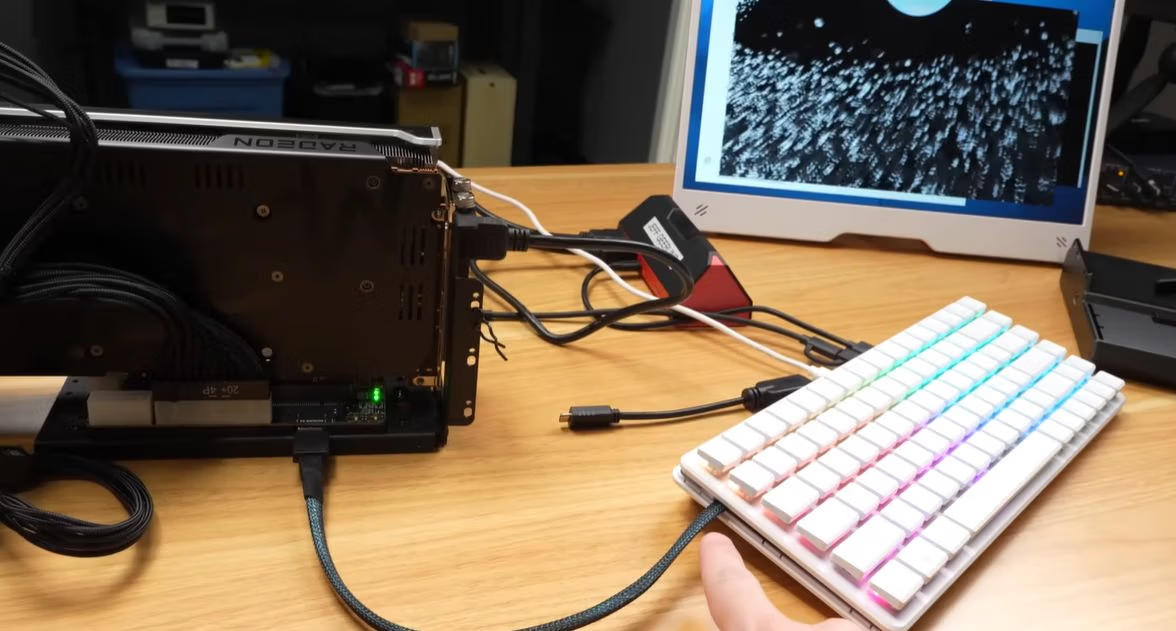
The Raspberry Pi 500+ Arrives: A Gamer’s Dream and a Maker’s Delight
Remember the Raspberry Pi 400? It was a stroke of genius—a complete, capable computer tucked inside a neat little keyboard. For education, for kids, for anyone needing a simple, low-cost desktop, it was nearly perfect. Its compact form factor, integrated keyboard, and robust connectivity made it an instant hit, democratizing access to computing and fostering early interest in programming and digital creation with a user-friendly experience.
But for the tinkerers and performance-seekers in the ardent Raspberry Pi community, there was always a “but.” The gaming performance, while acceptable for truly retro titles, often left much to be desired when tackling more demanding emulation. Furthermore, accessing the GPIO for hardware projects, while technically possible, felt like performing keyhole surgery with cumbersome ribbon cables and breakout boards, hindering rapid prototyping and elegant integrations for serious maker projects.

Well, it seems the Raspberry Pi Foundation has been listening intently to this valuable feedback. The just-announced Raspberry Pi 500+ isn’t merely an incremental update; it’s a direct and emphatic response to the community’s biggest wishes, transforming the beloved keyboard computer from a charming novelty into a formidable powerhouse for both immersive play and sophisticated hardware creation. This new iteration promises to redefine expectations for what a low-cost, all-in-one Raspberry Pi device can truly achieve, pushing the boundaries of performance and accessibility in an unprecedented way.
The Performance Leap: Gaming is No Longer an Afterthought
Let’s get straight to the headline feature: “Better Gaming.” For years, the Raspberry Pi has been the heart of countless retro gaming projects, powering iconic arcade cabinets, handheld emulators, and living room consoles. However, it always hit a performance ceiling that limited its appeal for more demanding systems. While it could effortlessly handle 8-bit and 16-bit classics like the NES, SNES, SEGA Genesis, and arcade MAME titles, more demanding systems from the 5th and 6th generations—such as the Nintendo 64, SEGA Dreamcast, Sony PlayStation Portable (PSP), and even some early PlayStation 1 titles—were often a frustrating mix of dropped frames, audio glitches, visual artifacts, and an overall inconsistent experience. Emulating these systems reliably required significant compromises, often sacrificing resolution or relying on frame skipping, which seriously detracted from the authentic nostalgic journey.
The Raspberry Pi 500+ changes that conversation entirely and definitively. By integrating the more powerful silicon expected from a Pi 5-era device, we’re not just looking at marginally smoother emulation; we’re on the cusp of a truly new era for Pi-based gaming. This means a substantial upgrade to the core processing unit, likely featuring a quad-core 64-bit ARM Cortex-A76 processor clocked at a significantly higher frequency (e.g., 2.4GHz+), paired with a much more capable VideoCore VII GPU with enhanced Vulkan support. This formidable combination delivers a dramatic leap in computational and graphical horsepower, crucial for demanding emulators and a growing library of modern Linux-native games. The improved memory bandwidth and potentially more RAM options (8GB or even 16GB) will further ensure that even memory-intensive titles run without a hitch, allowing for seamless multitasking and robust application performance.
Imagine Nintendo 64 and Dreamcast titles not just running, but truly flying at full speed with enhanced resolutions, delivering crisp visuals and perfectly synchronized audio. Think of iconic titles like The Legend of Zelda: Ocarina of Time, Mario Kart 64, Super Mario 64, F-Zero X, Crazy Taxi, Jet Set Radio, and Shenmue playing exactly as they were intended, creating a truly seamless and authentic retro console experience. This increased power could even open the door to reliably emulating more complex systems that were previously out of reach, such as select PlayStation 2 or Nintendo GameCube titles, albeit perhaps at lower resolutions or with specific game compatibility. Furthermore, for modern gamers, the Pi 500+ will provide a much-improved platform for a growing library of indie games available on platforms like Steam (via Proton/Wine) or native Linux ports, making this all-in-one keyboard into a genuine, no-compromise living room console that you can also effortlessly use to browse the web, tackle productivity tasks, and check your email with enhanced responsiveness and multitasking capabilities.
This isn’t just about a faster processor; it’s a fundamental shift in what a Raspberry Pi is capable of out of the box. The improved I/O, including potentially faster USB 3.0 ports, dual HDMI 4K video output, and enhanced storage options (like NVMe SSD support via an internal M.2 slot), will also contribute to snappier load times, smoother video playback, and a more responsive overall user experience. This positions the Raspberry Pi 500+ as a legitimate, low-cost alternative to dedicated mini PCs for a wide range of applications, from high-end retro emulation and light modern gaming to robust general desktop computing and media consumption. It’s a game-changer for anyone who’s ever wished their Pi could just… do a little more when it comes to entertainment and everyday tasks, all within a familiar, integrated form factor.
For the Makers: The Soldering Iron Can Stay in the Drawer
While the gaming boost is undeniably thrilling for a significant segment of the community, the second major takeaway from the announcement—“Less Soldering Required”—is arguably even more important for the longevity and future growth of the platform’s vibrant hacking and making scene. The Raspberry Pi 400’s design, while elegant for a desktop computer, featured a single, rear-facing GPIO header. This was a design choice that prioritized neatness and a streamlined aesthetic over immediate accessibility for hardware projects. If you wanted to build anything beyond the simplest software-only application, you were often left grappling with cumbersome ribbon cables snaking across your desk, requiring breakout boards, and invariably adding complexity and clutter to your workspace. This setup, while functional, presented a higher barrier to entry for beginners and even seasoned makers seeking a more fluid and integrated prototyping experience, often leading to frustration and abandoned projects.
The Raspberry Pi 500+ addresses this critical feedback head-on with a fundamental rethinking of its input/output (I/O) architecture. While specific implementations are still emerging, this likely means not just more easily accessible GPIO pins – perhaps relocated to a more convenient side or top edge, or even multiple, clearly labeled headers – but potentially the inclusion of modern, plug-and-play connectors that have become staples in the maker world. We could see integrated Qwiic (SparkFun) or Stemma QT (Adafruit) connectors directly on the board, simplifying connections to a vast ecosystem of hundreds of sensors, displays, and actuators with just a single, standardized cable. Imagine connecting an OLED screen, environmental sensor, GPS module, or even a small motor driver with nothing more than a click – no breadboard, no jumper wires, and most importantly, no soldering necessary for basic functionality. This small, yet profound, change has massive implications for rapid prototyping and project development, truly lowering the barrier to entry for more ambitious and cleaner builds, from simple blinky lights to complex data loggers.
Suddenly, building a custom cyberdeck with integrated biometric sensors and a custom UI, a smart home dashboard that interacts directly with real-world inputs, an autonomous robotics controller that requires multiple sensor inputs, or an intricate interactive art installation becomes dramatically simpler and faster to assemble. You can now harness the full, robust power of the Pi’s hardware capabilities – including I2C, SPI, UART, and PWM – without needing a degree in electronics, a perfectly steady soldering hand, or a deep understanding of circuit design just to get started. This strategic move directly enables more people to dive into physical computing and innovation, fostering a new wave of creativity across various domains. It’s a powerful statement that respects the “computer science” half of the Pi’s mission—empowering users to understand and manipulate computing at a fundamental level—just as much as it respects the “plug-and-play” side, making the magic accessible to everyone regardless of their prior electronics experience.
Furthermore, improved internal routing and potentially dedicated internal headers might allow for more advanced add-ons, perhaps even a dedicated internal camera connector, a display connector, or an M.2 slot for NVMe storage or AI acceleration modules. This transforms the Pi 500+ into a truly versatile platform for edge computing, advanced robotics, and sophisticated embedded applications, all while maintaining the elegant form factor of a keyboard. The focus here is on empowering creativity by removing traditional roadblocks, fostering an environment where innovative ideas can come to life with unprecedented ease and elegance, pushing the boundaries of what’s possible with a compact, integrated computer solution for the global maker community.
What This Means for the Future
The Raspberry Pi 500+ represents nothing less than the maturation of the all-in-one keyboard computer concept, elevating it from a niche educational tool to a truly versatile personal computer. It’s no longer a device of charming compromises, where accessibility came at the cost of raw performance or expandability. Instead, it’s a meticulously engineered machine that confidently declares you can have it all: a powerful, accessible learning tool for students of all ages, a high-performance retro gaming console capable of challenging demanding systems, and a sophisticated hardware development platform—all seamlessly integrated into one elegant, affordable, and highly portable package. This convergence of dramatically enhanced capabilities within a single, familiar form factor is precisely what the community, from educators to advanced makers, has been passionately requesting and eagerly anticipating.
This is the device that can finally deliver on the long-held promise of being the only computer a tinkerer, a student, a hobbyist, or even a casual user might truly need. For educational institutions globally, it offers an unparalleled blend of cost-effectiveness, robustness, and versatility, enabling hands-on learning in programming, electronics, digital literacy, and even AI/ML basics without significant infrastructure investment. For enthusiasts and makers, it unlocks new possibilities for elaborate custom builds, portable computing solutions, and seamless entertainment experiences without cluttering up the desk with multiple devices or requiring extensive wiring. Its increased processing power and vastly improved I/O mean it’s powerful enough for serious fun, capable of tackling light professional tasks, and open enough for serious, innovative work, effectively bridging the gap between playful exploration and practical application in one cohesive unit.
The era of choosing between convenience and capability is emphatically over. With the Raspberry Pi 500+, you get both in spades, packaged in a device that fits comfortably into any home or classroom environment. It’s a testament to the Raspberry Pi Foundation’s unwavering commitment to continuous innovation and their keen ear for community feedback. This new iteration solidifies the Pi’s position not just as a niche device for enthusiasts, but as a mainstream contender in the world of personal computing, offering an incredibly compelling value proposition against other mini-PCs and entry-level desktops. It’s a computer designed for discovery, designed for creation, and designed for pure enjoyment, all while maintaining the fundamental ethos of accessibility that has defined the Raspberry Pi since its inception. This could very well be the ultimate entry point into the world of computing for millions, offering a complete, powerful, and hackable system right out of the box.
Read the original story and delve deeper into the technical specifications at Hackaday.
What are your thoughts on the new Raspberry Pi 500+? What project are you most excited to build or what game are you most looking forward to playing on this new powerhouse keyboard computer?