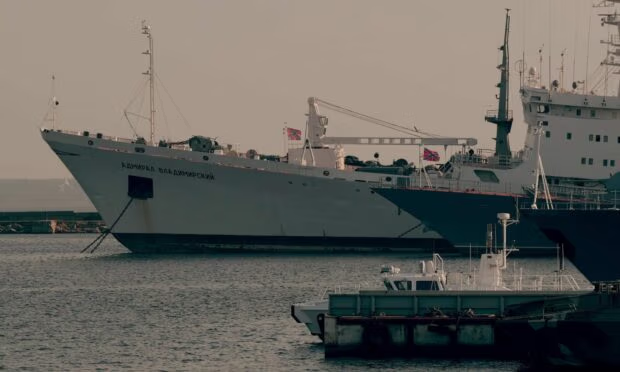
The Arctic’s Icy Veil Thins, Revealing a New Cold War Front
For decades, the High North was largely perceived as a pristine, remote wilderness, a region defined by its forbidding landscape and a fragile, post-Cold War consensus of scientific cooperation. This era fostered an illusion of the Arctic as a zone of peaceful exception, where international collaboration trumped geopolitical rivalries. However, as the polar ice melts at an alarming rate, that consensus is not merely cracking; it’s shattering, revealing the stark, metallic glint of military hardware underneath. The once-frozen frontier is now a rapidly thawing stage for geopolitical competition, and the message from defence experts is chillingly clear: the Arctic is rapidly becoming a new front in the tense standoff between Russia and the West, and Europe, in particular, is dangerously behind the curve in recognizing and responding to this critical shift.
The strategic importance of the Arctic is no longer a theoretical debate among climate scientists and policy wonks; it is a live and evolving geopolitical reality. The receding ice cap is not only opening up new shipping lanes and exposing vast reserves of natural resources but also creating new avenues for military projection and influence. This transformation mandates a fundamental rethink of security paradigms for nations bordering the Arctic, as well as for global powers with strategic interests in maintaining stability and freedom of navigation across the world’s oceans. The traditional focus on scientific research and environmental protection, while still vital, is now irrevocably intertwined with hard-nosed security concerns.

While the world’s attention remains predominantly fixed on the grinding war in Ukraine, diverting resources and diplomatic energy, Moscow has been methodically executing a comprehensive, long-term strategy in the Arctic Circle, largely unhindered by international sanctions or condemnation regarding its other aggressions. According to Magnus Håkenstad, a a senior fellow at the Norwegian Institute for Defence Studies, this isn’t just rhetoric or a show of force; it’s a tangible and substantial buildup designed to assert dominance. Russia is not merely modernizing its existing infrastructure; it is reopening and upgrading numerous Soviet-era military bases, many of which had been dormant for decades. These reactivated outposts, stretching across its vast Arctic coastline, are being equipped with advanced weaponry, including state-of-the-art air defense systems, radar installations, and long-range surveillance capabilities. Furthermore, Moscow is deploying advanced hypersonic missiles to the region, systems capable of evading most existing missile defenses, thereby dramatically increasing the strategic threat perception for its neighbours. This military modernization is complemented by a consistent and aggressive flexing of its naval muscle, with increasing frequency of exercises, patrols, and submarine deployments, signaling Russia’s intent to control access and project power across the Arctic Ocean.
Russia’s Methodical Arctic Buildup: Reasserting Dominance in the High North
Russia’s strategic pivot to the Arctic is underpinned by a deep-seated belief in the region’s historical and future importance to its national security and economic prosperity. The scale of its military investment is unprecedented since the Cold War. Key examples of this strategic buildup include:
- Reopening and Modernizing Soviet-Era Bases: Facilities such as Nagurskoye on Franz Josef Land, Rogachevo on Novaya Zemlya, and Tiksi on the Laptev Sea have been transformed into modern, all-weather military complexes. These bases are not just refitted; they are expanded to include hardened aircraft shelters, new runways capable of accommodating heavy bombers, sophisticated radar installations, and advanced missile defense systems. These outposts serve as critical forward operating locations, extending Russia’s reach and surveillance capabilities across the Arctic.
- Deployment of Advanced Missile Systems: The deployment of advanced hypersonic missiles, such as the Kinzhal (air-launched) and the Tsirkon (naval-launched), represents a significant escalation. These weapons, known for their extreme speed and maneuverability, are designed to penetrate advanced air defense systems, posing a substantial threat to Western naval assets and strategic targets. Their presence in the Arctic underscores Russia’s intent to establish a formidable anti-access/area denial (A2/AD) bubble over key parts of the region.
- Enhanced Naval Presence and Capabilities: Russia’s Northern Fleet, headquartered in Murmansk, is the largest and most powerful of its four fleets and forms the bedrock of its Arctic strategy. It has received substantial investment in new ice-capable warships, submarines, and strategic nuclear submarines. The development of advanced nuclear-powered icebreakers, like the “Arktika” class, gives Russia unparalleled access and operational capacity in the icy waters, facilitating military movements and resource exploitation year-round. These vessels are crucial for maintaining the navigability of the Northern Sea Route, which Russia increasingly views as its exclusive domain.
The Campaign of Active Disruption: Grey Zone Tactics in the Arctic
This isn’t merely a theoretical threat or a distant military buildup; it’s a campaign of active disruption, testing the boundaries of international norms and probing for weaknesses. Reports of widespread GPS jamming across Finland and Norway, actions widely attributed to Russia, are far more than mere annoyances for civilian navigation. They are textbook examples of “grey zone” tactics—coercive actions that fall below the threshold of open warfare but are designed to test Western resolve, sow confusion, and assert dominance in a region where freedom of navigation is paramount. Such jamming incidents can disrupt air traffic, interfere with maritime operations, and pose significant risks to search and rescue missions, demonstrating a willingness to impose costs and create instability without direct military confrontation.
Moscow sees the melting Northern Sea Route (NSR), which hugs Russia’s vast northern coastline, not just as a future economic superhighway promising significantly reduced transit times between Europe and Asia. More crucially, it views it as a strategic corridor to be controlled. Russia has aggressively asserted sovereign rights over the NSR, requiring foreign vessels to seek permission, use Russian ice pilot services, and even pay transit fees. These actions challenge long-standing principles of freedom of navigation in international waters and choke points. By creating a de facto customs and security zone along the NSR, Russia aims to project unchallenged authority over Arctic shipping, securing its economic interests and bolstering its strategic depth for its Northern Fleet.
The Arctic’s Dual Strategic Imperative for Moscow
The strategic calculus underpinning Russia’s aggressive pivot to the Arctic is deeply rooted in both national security and long-term economic ambition. For the Kremlin, the region represents an indispensable component of its great power status and its future prosperity.
Securing the Nuclear Flank
First and foremost, the Arctic is home to Russia’s Northern Fleet, headquartered in Murmansk on the Kola Peninsula, and a significant portion of its strategic nuclear submarine deterrent. The vast, ice-covered Barents Sea is crucial for the deployment and protection of Russia’s ballistic missile submarines (SSBNs), which carry a significant portion of its nuclear arsenal. This “bastion defense” strategy relies on securing this flank to ensure the survivability and retaliatory capability of its nuclear forces. For the Kremlin, securing this critical strategic asset is non-negotiable, and the Arctic environment, with its unique challenges for detection and surveillance, provides a natural advantage for submarine operations. Any perceived threat to this bastion, whether from increased Western presence or technological advancements, prompts an immediate and robust military response from Moscow.
Unlocking Vast Resource Wealth
Second, as climate change irrevocably alters the Arctic landscape, it is unlocking untold reserves of oil, gas, and critical minerals. The region, once a frozen wasteland perceived only as strategically significant, is rapidly transforming into a treasure chest of economic opportunity. Geologists estimate that the Arctic holds approximately 13% of the world’s undiscovered conventional oil resources and 30% of its undiscovered conventional natural gas resources, along with vast deposits of critical minerals like rare earth elements, nickel, copper, and platinum group metals—all essential for modern technology and green energy transitions. For Russia, whose economy remains heavily reliant on hydrocarbon exports, military power is seen as the key to unlocking and controlling access to that chest. This vast untapped wealth offers not only a pathway to sustained economic growth but also a significant geopolitical leverage in a world increasingly hungry for energy and raw materials. Russia aims to establish itself as the dominant player in Arctic resource extraction and transport, further entrenching its influence in global energy markets.
A Radically Reshaped Security Map: NATO’s New Arctic Frontier
This escalating Russian presence and assertive posture has fundamentally reshaped the security map of the entire European continent and the High North. The historic accession of Finland and Sweden to NATO, an ironic twist directly driven by Russian aggression against Ukraine, has profoundly altered the regional balance of power. What was once a fragmented Nordic defense landscape now presents a more unified and formidable bloc, integrating two highly capable and strategically located military forces into the Alliance.
The implications are far-reaching: The Baltic Sea is now colloquially and accurately known as a “NATO lake,” with almost all its littoral states now members of the Alliance, dramatically simplifying NATO’s command and control, and defense planning across the region. Furthermore, NATO’s direct land border with Russia has more than doubled, extending thousands of kilometers through dense forests and vast Arctic wilderness. This new reality strengthens NATO’s northern flank, providing greater depth and flexibility for deterrence and defense. However, it also imposes new responsibilities and challenges, requiring significant investment in infrastructure, logistics, and interoperability to effectively secure this vastly expanded frontier in some of the world’s most extreme environments.
The Grave Danger of Miscalculation in the High North
Yet, this new reality, characterized by increased military activity and closer proximity of rival forces, brings with it a grave danger: miscalculation. As NATO and Russian forces operate in closer proximity, conducting rival exercises, surveillance missions, and patrols in the unforgiving and often unpredictable Arctic environment, the potential for an accidental clash grows exponentially. The “fog of war” in the Arctic is literal, with extreme weather conditions, vast distances, limited visibility, and communication challenges adding layers of complexity to military operations.
A jammed signal disrupting critical communications, a stray missile test veering off course, an aggressive fly-by by a fighter jet or bomber, or an unintended encounter between naval vessels—any of these could be the spark that ignites a much wider conflict. The unique operational challenges of the Arctic, coupled with heightened tensions and a lack of established de-escalation protocols for such close encounters, amplify the risk of an incident spiraling out of control. The severe environment also means that even minor technical malfunctions or human errors could have catastrophic consequences, not just militarily but also environmentally, given the fragile Arctic ecosystem.
Europe’s Urgent Imperative: A Robust Arctic Security Strategy
The core takeaway is that the era of viewing the Arctic as a pristine zone of peaceful exception is definitively over. It is now, unmistakably, a theatre of strategic competition, where military capabilities and geopolitical resolve will dictate future influence and access. Håkenstad’s warning that Europe “must do more” is not just a suggestion; it’s an urgent imperative, demanding immediate and sustained action.
This means a greater and more consistent naval and air presence in the High North, deploying ice-capable vessels, long-range maritime patrol aircraft, and advanced drones to monitor Russian activity and protect vital interests. It requires deeper intelligence sharing among allies, fostering a comprehensive and real-time understanding of Russian movements and intentions across the vast Arctic. Crucially, it demands a clear, unified strategy of deterrence, backed by credible military capabilities and a willingness to project power when necessary. This strategy must encompass combined exercises, investments in resilient infrastructure, and the development of technological superiority adapted to the unique Arctic environment.
The West must prove that its commitment to Arctic security is as solid and enduring as the permafrost once was, demonstrating unwavering resolve to protect freedom of navigation, sovereign territories, and the shared economic potential of the region. Otherwise, it risks ceding a strategically vital region to a revanchist Russia, with profound geopolitical, economic, and security consequences that will be felt far beyond the frozen north, potentially altering the global balance of power for decades to come.
The original story at Pressandjournal delves further into these critical developments.
As the Arctic transforms into a vital strategic theatre, what specific actions do you believe European nations and NATO should prioritize to ensure stability and deter aggression?