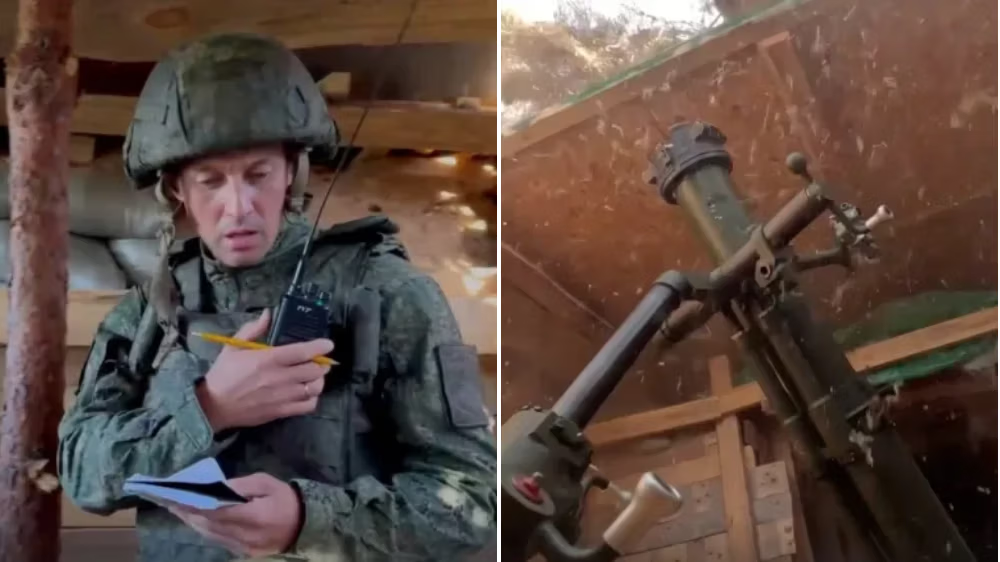
Saber-Rattling or Rehearsal? Decoding Russia’s High-Stakes Military Drills on NATO’s Frontier
In the tense theater of global geopolitics, some actions speak far louder than words. As the rumble of armor and the roar of fighter jets echo across Belarus, just a stone’s throw from NATO territory, the world is once again reminded that military exercises are never just exercises. They are a profound message, a critical test of capabilities, and a potent display of strategic intent. The latest round of joint “wargames” conducted by Russia and its steadfast ally Belarus is far more than a routine drill; it is a meticulously calculated piece of strategic communication aimed directly at the West, and it has undeniably set the nerve endings of the Atlantic alliance on edge, prompting urgent discussions in defense ministries from Washington to Warsaw.
Ostensibly, Moscow frames these large-scale military operations as purely defensive—a necessary and proportionate response to what it perceives as aggressive NATO expansion eastward, and a crucial opportunity to hone its collective ability to repel an invasion. This narrative is consistently pushed through state-controlled media, aiming to portray Russia as a victim reacting to external threats. However, for Western military analysts, intelligence agencies, and policymakers, the view from the other side of the border is far more ominous and frankly, alarming. The sheer scale, complexity, and frequency of these maneuvers, often involving tens of thousands of troops, state-of-the-art missile systems, advanced fighter jets, and integrated air and naval forces, paints a picture less of defense and more of a chilling dress rehearsal for a large-scale, multi-front offensive.

These elaborate military displays serve multiple purposes, from testing new hardware to enhancing interoperability between allied forces. Yet, their geopolitical impact far outweighs their technical objectives. They are designed to project power, influence perceptions, and alter the strategic calculus of potential adversaries. The implications for European security are profound, demanding a careful and considered response from NATO and its partners.
Key Takeaways from This High-Stakes Military Posturing
The recent Russia-Belarus military exercises, strategically positioned on NATO’s eastern flank, offer critical insights into Moscow’s strategic thinking and its long-term objectives. These maneuvers are not isolated incidents but rather integral components of a broader geopolitical strategy, signaling a recalibration of power and a direct challenge to the existing security architecture in Europe.
1. The Message is Deterrence, Wrapped in Intimidation
At its core, the primary objective of these massive military exercises is a sophisticated form of psychological warfare. By massing significant military power on Europe’s doorstep, Vladimir Putin is sending an unambiguous and forceful message to NATO member states: “We are here, we are prepared for any eventuality, and we are not intimidated by your policies or your rhetoric.” This overt display of force serves a critical dual purpose, meticulously crafted to achieve both deterrence and division within the Western alliance.
First, it aims to deter any further direct military support for Ukraine by showcasing the formidable and potentially overwhelming force NATO would invariably face in a direct confrontation with Russia. The sheer numbers of troops, the advanced capabilities of the weapon systems, and the simulated combat scenarios are all designed to underline the high costs and severe risks of deeper intervention. Moscow seeks to instill a sense of apprehension regarding the potential for escalation, thereby constraining Western nations’ willingness to provide more decisive military aid to Kyiv.
Second, these drills are a deliberate and calculated attempt to create anxiety and division within the Atlantic alliance itself. By raising the specter of direct conflict, Russia forces member states to confront and question the true costs and benefits of their current confrontational policies toward Moscow. This strategy exploits existing fault lines and differing national interests within NATO, aiming to weaken its collective resolve and undermine its unified front. The intimidation factor is not just about military capacity; it’s about sowing doubt and discord among allies, hoping to fragment their response and reduce their effectiveness. The historical memory of the Cold War and the threat of large-scale conventional warfare are potent psychological tools being leveraged by the Kremlin to shape public and political opinion across Europe.
2. Belarus: No Longer a Buffer, But a Launchpad
Perhaps the most significant and alarming long-term consequence of these repeated and increasingly integrated drills is the irreversible cementing of Belarus as a de facto Russian military district. Historically, Belarus functioned as a crucial buffer state, providing a strategic depth between Russia and the NATO alliance. However, under the increasingly dependent leadership of Alexander Lukashenko, Belarus has been almost fully absorbed into Moscow’s strategic orbit, effectively losing its independent security posture.
The permanent stationing of significant numbers of Russian troops, combined with the deployment of advanced weaponry—including potentially nuclear-capable systems such as Iskander-M missiles—fundamentally redraws the security map of Eastern Europe. This isn’t merely a temporary deployment for exercises; it represents a permanent, structural shift in the regional balance of power. For frontline NATO members such as Poland, Lithuania, and Latvia, whose borders now directly abut a militarized Belarus under Russian influence, the warning time for a potential conflict has shrunk dramatically. What was once a relatively distant threat has moved directly to their doorstep, creating an immediate and palpable sense of vulnerability.
This transformation of Belarus from a neutral buffer into a potential forward operating base and launchpad for Russian military operations profoundly alters NATO’s eastern flank defense planning. It necessitates a complete re-evaluation of force posture, intelligence gathering, and rapid response capabilities for the alliance, pushing the boundaries of what was previously considered acceptable risk. The geopolitical implications are vast, turning a historically stable frontier into a new, heavily militarized zone of potential flashpoints.
3. A Laboratory for the Future of War
Beyond the immediate political messaging and strategic posturing, these large-scale military exercises serve a crucial, often underappreciated, role as a practical laboratory for the Russian military. They provide an invaluable live environment to rigorously test new technologies, refine complex command-and-control structures, and integrate critical lessons learned from the brutal, ongoing conflict in Ukraine. The battlefield in Ukraine has become a proving ground for modern warfare tactics and technologies, and these drills offer Russia a controlled setting to adapt and evolve its doctrine based on real-world combat experience.
Western intelligence agencies will be watching these maneuvers with intense scrutiny, meticulously collecting data and seeking to understand how Russia is adapting its doctrine and improving its warfighting capabilities. Specific questions arise: Are they improving their combined arms coordination, a recognized weakness in earlier phases of the Ukraine conflict? Are they effectively integrating drone warfare, both for reconnaissance and offensive operations, and developing countermeasures against enemy drones? How are their electronic warfare capabilities evolving? Are their logistics and supply chains showing greater resilience and efficiency? The answers to these crucial questions will not only inform Western understanding of Russian military prowess but will also directly shape NATO’s own defensive strategies, technological investments, and training protocols for years, if not decades, to come.
These exercises allow Russia to simulate complex, multi-domain operations, including cyber warfare, anti-access/area denial (A2/AD) strategies, and the integration of precision-guided munitions. This continuous process of testing, evaluating, and refining is vital for any modern military, ensuring that lessons from current conflicts are swiftly integrated into future operational plans and force structures. It’s a dynamic process that demands constant vigilance from those who monitor Russian military developments.
Looking Ahead: A New Era of Confrontation
The future implications of these escalating military drills and the resulting geopolitical shifts are stark and unsettling. We are witnessing the solidification of a new, heavily militarized frontier in Europe, reminiscent of the Cold War era but with modern complexities. The risk of miscalculation or an accidental escalation is now perpetually heightened, a constant shadow hanging over the continent. The sheer proximity of advanced military hardware and large troop formations along a contested border significantly amplifies the potential for unforeseen incidents to spiral rapidly out of control.
Consider the potential scenarios: an errant missile crossing a national border, a mistaken border incursion by ground forces, or an airspace violation by military aircraft. In such a hyper-tense environment, any of these incidents, however unintentional, could quickly ignite a major international crisis with frightening speed and potentially catastrophic consequences. The established protocols for de-escalation and communication are under immense strain, and the margin for error has diminished to a dangerously thin line.
In response to this increasingly aggressive and unpredictable posture, NATO will be compelled to accelerate its own reinforcement of the eastern flank. This will entail a significant increase in allied military presence, strategic infrastructure development, and joint training exercises. Expect to see more frequent troop rotations from various member states, enhanced air policing missions to monitor airspace violations, and greater investment in cutting-edge surveillance and early-warning systems to provide real-time intelligence. This action-reaction cycle creates an unavoidable feedback loop of militarization, where each side perceives the other’s defensive measures as offensive provocations, thereby fueling further military build-ups. This cycle, unfortunately, will define European security for the foreseeable future.
Ultimately, these wargames are not a temporary spike in tensions that will soon subside; they represent the new, unsettling normal. They are a stark and persistent reminder that the specter of a great power conflict looms larger over the continent than at any time since the darkest days of the Cold War. Understanding their true purpose and implications is crucial for navigating this increasingly perilous geopolitical landscape.
Read the original story at Knowledia News.
How do you think NATO should balance deterrence with de-escalation in this new era of confrontation?