The Shifting Tides of Economic Warfare: Why Russia’s Energy Lifeline Endures
Years into the most ambitious economic siege in modern history, a stark and unsettling reality is taking hold in Western capitals: the financial war against Russia is not going to plan. The initial strategy was elegant in its simplicity—cut off the Kremlin’s energy revenues, starve its war machine, and force Vladimir Putin to the negotiating table. This was envisioned as a swift, decisive blow, leveraging the global financial system as an overwhelming weapon to bring about a rapid resolution to the conflict in Ukraine. The belief was that Russia, deeply integrated into the global economy, would be unable to withstand such concerted pressure.
The Western coalition, comprising the G7 nations and their allies, threw its full economic weight behind an unprecedented package of sanctions, coupled with a novel and complex price cap mechanism on Russian oil. On paper, these measures represented a knockout blow. Experts predicted a collapse of the Russian economy, a precipitous decline in its ability to fund its military, and widespread domestic unrest. The goal was not merely to hinder but to cripple Russia’s financial infrastructure, cutting off access to crucial imports and limiting its capacity to project power.

Yet, as we look at the state of play, Russia’s economic pulse, fueled by a relentless flow of oil and gas money, remains stubbornly strong. In practice, Moscow has proven to be a far more agile and resilient economic combatant than anyone anticipated. This isn’t just a failure of enforcement or minor loopholes being exploited; it’s a sobering lesson in the shifting dynamics of global power, revealing both the limitations of traditional economic statecraft and the emergence of new geopolitical realities. The expectation that Russia would simply buckle under pressure underestimated its capacity for adaptation and its ability to forge new alliances in a rapidly changing world order.
The Grand Rerouting: Permanently Altered Energy Flows
The first key takeaway from this economic conflict is that global energy flows have been permanently rerouted, a transformation with profound long-term implications. While Europe commendably weaned itself off Russian gas—an immense logistical and economic undertaking that saw countries scramble to secure alternative supplies and invest heavily in new infrastructure for LNG imports—Moscow did not simply face a dead end. Instead, it executed a strategic pivot, turning its vast network of pipelines and export ports eastward with remarkable speed and efficiency.
This pivot was not without its challenges, particularly for natural gas, which relies on fixed pipeline infrastructure. However, existing and planned pipelines, particularly the Power of Siberia routes to China, provided a foundation, and discussions for further expansion gained renewed urgency. For crude oil, the transition was arguably even smoother due to the inherent flexibility of seaborne trade. Nations like China and India, unencumbered by Western sanctions and perpetually hungry for discounted energy to fuel their burgeoning economies, stepped in to become Russia’s primary clients. They seized the opportunity to purchase oil and gas at significant discounts, securing crucial resources and deepening their economic ties with Moscow.
This isn’t merely a temporary workaround or a short-term response to an emergency; it’s the forging of a new economic axis, one that operates largely outside the West’s traditional financial sphere of influence. This burgeoning partnership between Russia and major Asian economies creates a parallel system of trade and finance, less reliant on the dollar and Western-dominated institutions. The Kremlin has successfully transformed what was intended as a debilitating crisis into a strategic pivot, cementing its economic future with the rising powers of Asia and diversifying its market away from unpredictable European demand. This strategic shift underscores a growing multipolar economic landscape.
The Shadow Fleet: Navigating the Gray Zones of Global Shipping
Secondly, the cat-and-mouse game of sanctions has revealed the limits of Western oversight on the high seas, exposing vulnerabilities in global maritime governance. The ambition of the G7 price cap was to allow Russian oil to flow, preventing a global supply shock, while simultaneously limiting the revenue Moscow could earn. The cap was enforced through Western-based insurance, shipping, and financing services, which underpin most of the world’s maritime trade. The assumption was that without these services, Russian oil could not reach international markets.
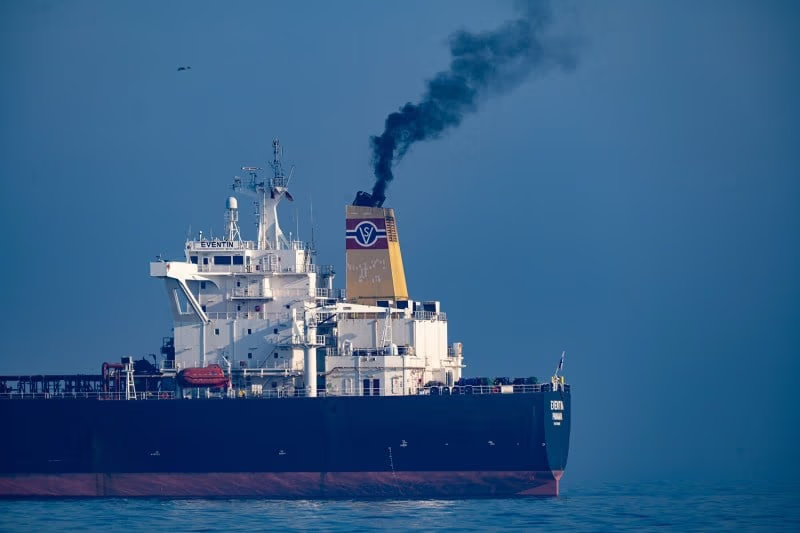
Russia, however, deftly assembled a “shadow fleet”—a sprawling, ghostly armada of aging tankers, often operating under obscure flags of convenience, their ownership buried in complex layers of shell companies. These vessels are frequently past their typical operational lifespan, posing environmental and safety risks, but their very opacity serves a strategic purpose. This network operates in the gray zones of international law, largely circumventing the G7 price cap by utilizing non-Western insurance, financing, and shipping providers, or by employing ship-to-ship transfers at sea to obscure the origin and destination of the cargo. This ensures that Russian crude reaches its new markets in Asia and elsewhere, albeit sometimes with longer transit times and higher logistical costs.
For every sanction imposed, Moscow has engineered a sophisticated countermeasure, turning the global shipping industry into a new front in the economic war. This has involved the rapid expansion of Russia’s own insurance and maritime service providers, the acquisition of older vessels from willing sellers, and the development of intricate trading networks that thrive on discretion. The existence and proliferation of this shadow fleet not only undermines the effectiveness of the price cap but also raises serious questions about transparency, accountability, and environmental safety within the international maritime sector. It highlights how non-state actors and sovereign nations can exploit the fragmentation of global governance to their strategic advantage.
Profound Implications for the Future of Sanctions
So, what does this sustained Russian economic resilience mean for the future of international relations and economic statecraft? The most profound implication is the undeniable blunting of the West’s most powerful non-military weapon: economic sanctions. For decades, the threat of financial exclusion and targeted economic pressure has been a cornerstone of Western foreign policy, often viewed as a low-cost, high-impact alternative to military intervention. The failure to cripple a G20 economy, despite an unprecedented level of coordinated sanctions, demonstrates that in an increasingly multipolar world, financial coercion is no longer the trump card it once was.
This will force a fundamental strategic rethink in Washington, Brussels, and other Western capitals. If sanctions of this magnitude, aimed at a major energy producer and military power, cannot achieve their primary objective of economic collapse or policy reversal, what leverage does the West truly have against other potential aggressors or nations challenging the established international order? Policymakers will need to re-evaluate the efficacy of these tools, consider their unintended consequences, and perhaps develop entirely new mechanisms for influencing state behavior. This rethink will likely include a deeper understanding of economic interdependencies, the role of non-Western financial systems, and the limits of Western jurisdiction.
Bankrolling a Prolonged Conflict and Shifting Burdens
Furthermore, Russia’s enduring economic resilience is directly bankrolling a prolonged conflict in Ukraine, fundamentally altering the calculus of the war. The continued, robust flow of petrodollars allows Moscow to sustain its military-industrial complex, replenish its forces, and settle in for a long war of attrition, largely insulated from the financial strain Western leaders had hoped to impose. These revenues fund the production of new armaments, the salaries of soldiers, the logistical networks necessary for a large-scale military operation, and the overall maintenance of a wartime economy.
The Kremlin has effectively insulated its war effort from Western economic pressure, demonstrating a capacity for wartime economic management that surprised many analysts. This insulation places the burden squarely back on the West to continue its costly military and financial support for Kyiv, a challenge that is creating significant political fissures on both sides of the Atlantic. As the conflict drags on, the financial commitment required from Western nations grows, leading to debates over resource allocation, national priorities, and the long-term sustainability of aid packages. This dynamic shifts the cost of the war from Russia to the supporting nations, testing their resolve and unity.
The economic war against Russia was meant to be a showcase of Western resolve, unity, and economic power—a demonstration that violations of international law would carry an unbearable financial cost. Instead, it has become a sobering exposé of its limitations in an interconnected yet fragmented global economy. The Kremlin’s energy riches continue to flow, not in spite of Western efforts, but by creatively adapting to them, forging new trade routes, and exploiting the seams of the global financial and maritime systems. The future of this conflict, and indeed the future of global economic statecraft, is being written in the tanker routes of the Indian Ocean, the bustling ports of Asia, and the boardrooms of Beijing, far from the halls of power where the sanctions were first conceived. This complex reality demands a fresh, pragmatic approach to international relations and economic strategy.
Read the original story at Foreign Policy.
Given Russia’s demonstrated economic resilience and the emergence of new global trade axes, how do you believe Western nations should adapt their strategies for promoting international stability and addressing future geopolitical challenges?