Russia Offers an Olive Branch Wrapped in a Warning: Deciphering the Kremlin’s Message at the UN
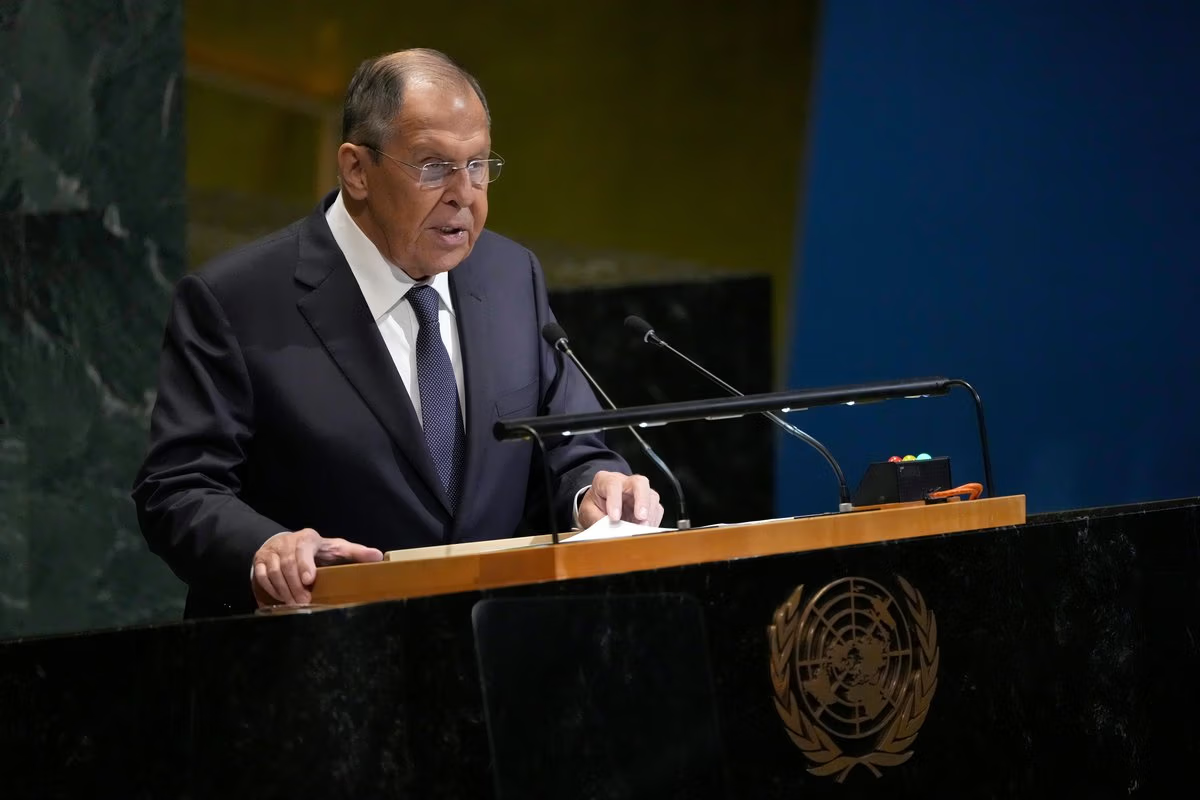
In the hallowed halls of the United Nations Security Council, where words are often weighed as heavily as weapons in the delicate balance of international diplomacy, Russia’s envoy recently delivered a message imbued with two distinctly contrasting faces. On one hand, it was a rare, direct, and seemingly reassuring assurance aimed squarely at a nervous Europe: Moscow unequivocally stated it has “no plans to attack any European country.” This pronouncement was undoubtedly intended to calm mounting anxieties across the continent regarding the potential for a wider conflict spilling beyond Ukraine’s borders. However, this diplomatic overture was immediately accompanied by a steely-eyed, unambiguous warning: any aggression against Russia or its vital allies, the Ambassador stressed, would be met with an unhesitating and “decisive response.”
This carefully choreographed diplomatic tightrope walk, performed by Ambassador Vasily Nebenzya before the world’s most powerful international security body, is far more than a simple statement of Russia’s immediate intentions. It represents a meticulously calculated piece of strategic communication, deliberately aimed at a global audience grappling with the rapidly escalating stakes of the ongoing war in Ukraine. To fully grasp the profound significance of this nuanced message, it is imperative to look beyond the immediate headlines and delve deeply into the intricate layers of subtext and underlying geopolitical strategy. This declaration is designed not just to inform, but to influence, deter, and potentially divide, shaping perceptions and actions on the global stage.

The Kremlin’s strategic communication often employs such dual messages, aiming to project both strength and a degree of restraint, depending on the target audience. This particular address at the UN Security Council served as a critical platform to articulate Russia’s perceived red lines while simultaneously attempting to recalibrate the international narrative surrounding its actions. It reflects a sophisticated understanding of how diplomatic rhetoric can be wielded as a powerful tool in modern hybrid warfare, influencing not only state-to-state relations but also public opinion and internal debates within allied nations. Understanding this intricate interplay is key to deciphering Russia’s long-term geopolitical objectives and predicting its next moves in the volatile landscape of Eastern Europe.
The De-escalation Gambit: Calming Fears and Reshaping Narratives
At its most superficial level, Ambassador Nebenzya’s declaration—that Russia harbors “no plans to attack any European country”—serves as a direct attempt to pour cold water on the simmering fears of a wider, continent-spanning European conflict. This assurance comes at a critical juncture, particularly as prominent Western leaders, notably French President Emmanuel Macron, have recently floated the once-unthinkable idea of potentially deploying NATO or European troops to Ukraine. By explicitly stating its non-expansionist intent towards Europe, the Kremlin is directly responding to these heightened anxieties and the escalating rhetoric from the West, aiming to mitigate panic and prevent further escalations driven by misperception.
However, this is not merely a benign statement of intent; it is a deliberate and calculated move to actively reframe the narrative surrounding Russia’s military posture and its objectives in the ongoing Ukraine conflict. For many months, Moscow has been consistently painted, both in Western media and by political leaders, as an inherently expansionist power, with its sights allegedly set on former Soviet bloc nations and potentially even further into NATO territory. By publicly denying these wider ambitions on the world stage, especially within the authoritative forum of the UN Security Council, Russia aims to achieve several strategic objectives. Primarily, it seeks to calm public anxiety in Western Europe, portraying itself as a rational actor rather than an unbridled aggressor. More strategically, this message is designed to sow division among NATO allies, particularly between those who advocate for stronger, more confrontational approaches and those who prioritize de-escalation and caution. The Kremlin is essentially telling European citizens and wavering politicians that the broader threat is not an inherent or inevitable consequence of Russia’s nature, but rather conditional on the actions and provocations of Western powers. This strategic messaging attempts to shift the burden of potential escalation squarely onto the shoulders of Kyiv’s partners, implying that any further widening of the conflict would be a direct result of Western overreach rather than Russian aggression, thereby attempting to erode Western unity and resolve.
Redrawing the Red Lines: A Decisive Warning to Western Aggression
While the first part of Russia’s UN message presents what appears to be an olive branch, it is undeniably accompanied by sharp, formidable thorns. Ambassador Nebenzya’s vow of a “decisive response” to any act of aggression against Russia or its allies forms the crucial, hardline core of the message. This is far from being a mere rhetorical flourish; it is a powerful reinforcement of Russia’s perceived “red lines” in a rapidly changing and increasingly volatile geopolitical landscape. It serves as a stark reminder that Moscow perceives certain actions as direct threats to its national security and is prepared to react forcefully.
The critical question that arises, and one that Russia deliberately leaves open for interpretation, is: what precisely constitutes “aggression” in Moscow’s view? In the Kremlin’s expanding interpretation, this term is becoming an increasingly broad and flexible category, designed to encompass a wide array of potential actions that extend far beyond a direct military assault on Russian soil. It almost certainly includes, but is not limited to, a direct NATO military intervention in Ukraine, particularly if it involves ground troops actively engaging Russian forces. However, its scope is far more expansive, likely encompassing the use of long-range Western missile systems (such as ATACMS or German Taurus missiles) to strike targets deep within internationally recognized Russian territory, including Crimea, or even infrastructure within Russia proper. Furthermore, any significant military buildup or forward deployment of NATO assets on the borders of Russia’s closest allies, such as Belarus, would likely be perceived as an act of aggression, threatening regional stability and Russia’s security perimeter. By leaving the term “aggression” deliberately vague while simultaneously making the consequence—a “decisive response”—sound absolute and inevitable, Russia constructs a powerful psychological deterrent. This ambiguity forces Western capitals into a constant state of deliberation and second-guessing, compelling them to meticulously weigh whether a new weapons package, an intelligence sharing agreement, or a tactical decision regarding troop movements might inadvertently cross an undefined, yet potentially catastrophic, tripwire. This strategic ambiguity is a calculated gambit to induce caution and self-restraint among Kyiv’s partners, attempting to slow down or even halt the pace and intensity of military aid to Ukraine.
What This Means for the Future: A Complex Challenge for Global Diplomacy
This statement delivered at the UN Security Council is a quintessential microcosm of Russia’s current geopolitical strategy: a sophisticated blend of tactical de-escalation in its public rhetoric, coupled with an unwavering, often uncompromising, strategic resolve concerning its core interests and objectives. It signals unequivocally that while Moscow may outwardly express a desire to contain the current conflict within its existing parameters, it remains absolutely undeterred from achieving its long-term strategic objectives in Ukraine. Moreover, it underscores Russia’s firm preparation for a direct confrontation if its fundamental security interests, as it defines them, are perceived to be fundamentally challenged or threatened by external actors. This dual approach aims to manage immediate tensions while preserving maximum leverage for future negotiations or military actions.
For the West, particularly the NATO alliance and its partners, this nuanced Russian declaration presents an extraordinarily complex and multifaceted challenge. The central dilemma revolves around how to interpret and react to this messaging. Do Western leaders take the assurance of “no plans to attack any European country” at face value, potentially leading to an easing of pressure, a reduction in military preparedness, or a softening of diplomatic stances? Or do they view it primarily as a calculated bluff, a strategic maneuver designed to weaken Western resolve, sow internal discord, or create openings for further Russian advancements under a veil of false reassurances? The stark reality is that both interpretations could hold elements of truth, making an optimal response incredibly difficult to formulate and execute. The risks associated with either underestimating or overreacting to Russia’s statements are substantial, with potentially profound consequences for regional and global security.
It is highly improbable that this latest declaration will fundamentally alter the core dynamics of international support for Ukraine, which remains robust among many Western nations committed to Kyiv’s sovereignty. However, what it will certainly achieve is to fuel the already intense and ongoing internal debate within the Western alliance regarding the precise limits and acceptable parameters of that support. This includes discussions on the types of advanced weaponry to supply, the geographical reach of those weapons, the potential for direct military training or presence in Ukraine, and the appropriate level of economic sanctions against Russia. The Kremlin’s message provides additional rhetorical ammunition for those within the West who advocate for caution, de-escalation, and a diplomatic resolution, potentially widening the philosophical divides between more hawkish and dovish members of the alliance. This internal Western dialogue, influenced by Russia’s strategic communication, is a critical battleground in itself.
Ultimately, this UN statement is a sophisticated maneuver designed to influence not just the decision-making processes of governments, but also, crucially, to shape public opinion across Europe and beyond. As the war in Ukraine tragically grinds on, becoming a protracted and attritional conflict, the battle of narratives will become just as critically important as the battle on the ground. This narrative contest centers on fundamental questions: who is truly the aggressor and who is the defender? Who is genuinely seeking a peaceful resolution, and who is actively risking a wider, more devastating war? By delivering this carefully calibrated message, Russia has just fired its latest, precisely aimed volley in that ongoing war of words, attempting to control the narrative, shift blame, and erode international consensus against its actions. The efficacy of this rhetorical strategy, and the West’s collective response to it, will play a significant role in shaping the geopolitical landscape for years to come.
Read the original story at The Japan News.
Given Russia’s dual message of reassurance and warning, how do you think Western nations should navigate this complex diplomatic landscape to avoid both appeasement and unintended escalation?