The Enduring Tapestry of Russian Oil: Sanctions’ Limits and a Shifting Global Order
The initial Western response to Russia’s full-scale invasion of Ukraine was swift and emphatic, spearheaded by a formidable economic weapon: sanctions aimed at choking off Moscow’s immense energy revenues. The goal was clear – to cripple the Kremlin’s war machine by starving it of the financial oxygen derived from its vast oil and gas exports. Policymakers in Europe and the United States harbored hopes that a sharp, decisive economic blow would quickly undermine Russia’s capacity to wage war, forcing a strategic retreat and a reconsideration of its aggressive posture. The expectation was that the interconnected global financial system, dominated by Western powers, could effectively isolate a major energy producer.
Yet, as time wears on, a sobering reality is emerging: the tapestry of Russian energy, far from being severed, has merely been rewoven, demonstrating a resilience that challenges the very efficacy of economic coercion. The envisioned economic strangulation has morphed into a strategic game of whack-a-mole, with Russia deftly pivoting its exports from historically dominant European markets to burgeoning economies in Asia, particularly India and China. This adaptation has not only blunted the intended impact of sanctions but has also exposed the limitations of economic warfare in a multipolar world.

This strategic redirection has been facilitated by a burgeoning “shadow fleet” of tankers operating outside Western regulatory oversight, along with sophisticated financial mechanisms that circumvent price caps and payment restrictions. The result? A continued, substantial flow of funds into Russia’s coffers, directly underwriting its protracted war effort in Ukraine. While Western consumers grapple with energy inflation and geopolitical instability, Russia’s state budget, though certainly strained, has not collapsed. It has, against many predictions, adapted.
The core takeaway from recent analysis is stark: Europe and the United States have not, in fact, succeeded in cutting off Russia’s energy riches. This isn’t for lack of trying, but rather a testament to the complex, interconnected nature of global energy markets and Moscow’s adeptness at finding new channels and partners. The initial optimism surrounding the “sanctions tsunami” has given way to a more pragmatic understanding of Russia’s ability to navigate and exploit the vast, often opaque, world of global energy trade. The sheer volume of Russian oil and gas, crucial for global supply, made a complete and immediate cut-off incredibly challenging without precipitating a worldwide energy crisis.
The Western Sanctions Offensive: An Initial Assessment
The suite of sanctions imposed by Western nations was comprehensive, targeting Russian banks, key individuals, critical technologies, and, most notably, its energy sector. Measures included a ban on imports of Russian crude oil and refined products into the U.S. and EU, as well as a G7-led price cap mechanism aimed at limiting the revenue Russia could earn from oil sales to third countries. The intention was to reduce Russia’s ability to fund its military by significantly depressing the price it received for its most valuable export. Financial sanctions, such as excluding major Russian banks from SWIFT, were designed to complicate transactions and increase the cost of doing business with Russia.
Initially, these measures did cause significant disruptions. European nations, historically reliant on Russian energy, scrambled to secure alternative supplies, leading to volatile price spikes and inflationary pressures across the continent. Russia, too, faced immediate challenges in rerouting its vast crude and gas flows, and the ruble experienced a sharp decline. However, the global nature of energy markets, coupled with Russia’s strategic flexibility, allowed for a relatively swift recovery and adaptation, proving that even a powerful coalition like the G7 faces formidable challenges when attempting to fundamentally alter the flow of a commodity as essential as oil.
Russia’s Strategic Pivot: Forging New Paths to Market
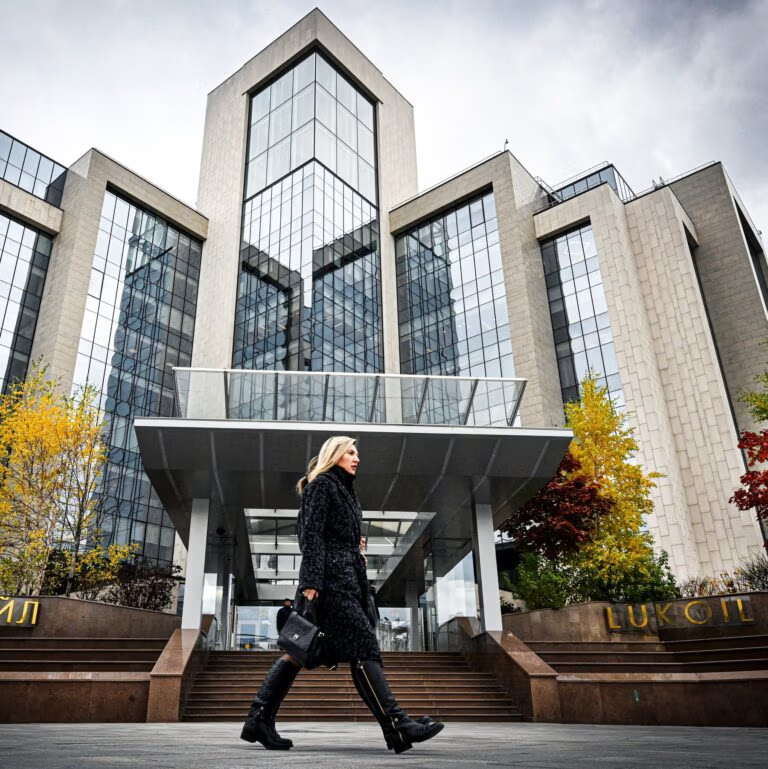
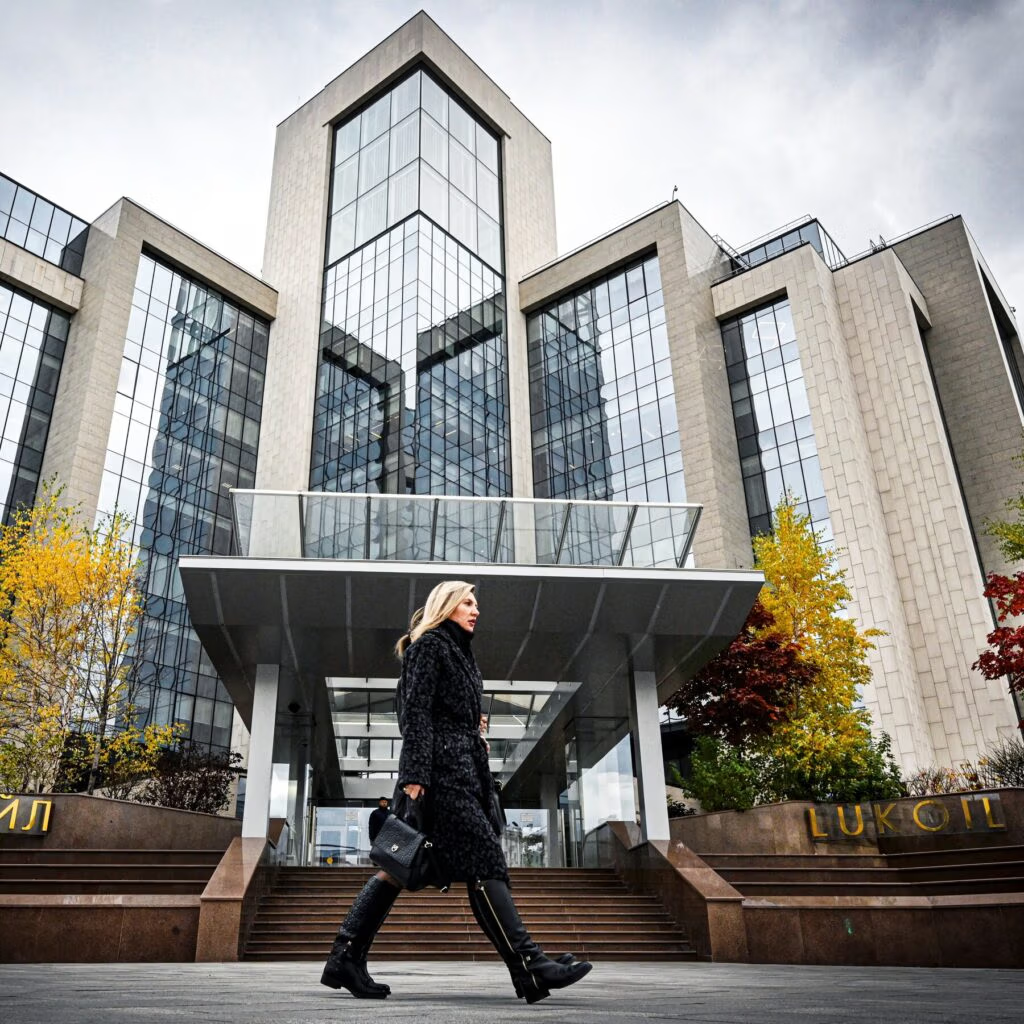
Faced with the closure of traditional European markets, Russia wasted no time in executing a massive strategic redirection of its energy exports. This pivot, primarily towards Asian markets, notably India and China, has been nothing short of transformative for global energy dynamics. Prior to the invasion, Europe was the primary destination for the vast majority of Russian oil and gas. Today, that picture is dramatically altered, with the bulk of Russian crude flowing eastward, often at discounted prices that are still lucrative enough for Moscow. India, in particular, has emerged as a surprisingly large buyer, dramatically increasing its imports of Russian oil, processing it, and sometimes even re-exporting refined products.
The Rise of the “Shadow Fleet” and Creative Financial Mechanisms
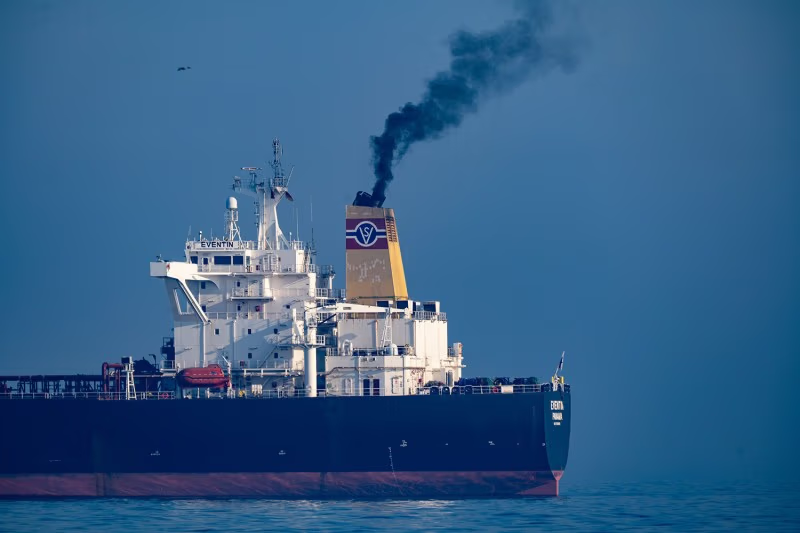
This dramatic reorientation has been made possible by the rapid expansion of a “shadow fleet” – an armada of older tankers, often operating under flags of convenience, with opaque ownership structures and less stringent safety and environmental regulations. These vessels operate outside the purview of Western insurance and shipping services, which are critical for adherence to the G7 price cap. Ship-to-ship transfers in international waters have become commonplace, further obscuring the origin and destination of the oil and making enforcement of sanctions incredibly difficult.
Complementing the shadow fleet are sophisticated financial mechanisms designed to circumvent Western payment restrictions and price caps. Transactions are increasingly settled in non-dollar currencies, such as the Indian Rupee or the Chinese Yuan, reducing reliance on the Western-dominated financial system. Additionally, Moscow has found ways to offer substantial discounts to buyers, enticing them with cheaper crude while still generating significant profits compared to its cost of extraction. These discounts are often sufficient to cover the higher costs associated with the shadow fleet’s logistics, ensuring that the net revenue to Russia remains substantial, allowing it to continue underwriting its war effort.
Implications for the Ukraine Conflict: A Prolonged Struggle
For Ukraine, the enduring flow of Russian energy revenues signals a prolonged and arduous struggle. As long as Russia can sustain its financial lifeline, its capacity to wage war, procure weaponry, maintain its military-industrial complex, and keep its economy relatively stable remains largely intact. This direct financial sustenance enables Moscow to absorb the costs of its military campaign, replenish its forces, and continue its aggression without facing an immediate, existential economic collapse. The initial hope for a swift economic strangulation in Moscow, forcing a strategic retreat or a change in leadership, appears increasingly distant, replaced by the grim reality of a protracted conflict.
The Burden on Western Nations: Sustaining Aid and Political Will
This sustained Russian capacity places an even greater burden on Western nations to provide consistent, robust military and financial aid to Ukraine. The commitment required pushes the limits of political will and domestic budgets in donor countries. As the war drags on, questions arise regarding the long-term sustainability of such high levels of aid, especially in the face of domestic economic challenges, inflationary pressures, and competing political priorities. Maintaining public support for aid packages becomes more challenging over time, increasing pressure on governments to demonstrate tangible results from their investments.
Furthermore, the need to continuously provide advanced weaponry, training, and financial assistance means that Western nations are deeply entangled in the conflict, bearing significant costs without a clear end in sight. The failure of sanctions to deliver a decisive economic blow to Russia shifts the focus squarely onto military and direct financial support for Kyiv, demanding a long-term commitment that tests the resilience and unity of the Western alliance.
Re-evaluating Western Sanctions Strategy: Limits of Economic Coercion
For the United States and Europe, the current reality necessitates a profound re-evaluation of sanctions strategy. The current approach, while impactful in some areas (such as technology transfers and some financial services), clearly hasn’t delivered the knockout blow intended for Russia’s energy sector. Policymakers must now confront uncomfortable questions: Are the current mechanisms sufficient to truly impede Russia’s energy exports, or are they inherently limited by global market dynamics and the willingness of certain nations to circumvent them? Can loopholes be truly closed without precipitating a global energy crisis that would severely harm the very economies imposing the sanctions?
The Dilemma of Global Energy Stability vs. Sanctions Efficacy
Perhaps most crucially, what are the limits of economic warfare when major non-aligned powers are willing to fill the void created by Western withdrawal? The rise of India and China as primary buyers of Russian oil demonstrates that the global energy market is not solely dictated by Western regulations and financial systems. This presents a fundamental dilemma: tightening sanctions excessively risks alienating key global partners and could lead to uncontrolled price spikes, ultimately undermining global economic stability.
The failure to fully choke off Russian energy risks diminishing the perceived leverage of Western sanctions as a tool for international policy. If sanctions can be effectively circumvented by a determined target and willing partners, their credibility as a potent deterrent or coercive instrument in future geopolitical crises could be severely weakened. This necessitates a strategic recalibration, perhaps moving towards more targeted measures or a deeper engagement with the non-aligned world, rather than relying solely on broad economic pressure. The effectiveness of sanctions is intrinsically linked to global cooperation, and when that cooperation is fractured, so too is the impact of the sanctions.
The New Global Energy Architecture: A Multipolar Future
The long-term implications for global energy markets are profound. The pre-war energy architecture, heavily reliant on Russian gas flowing westwards through pipelines to Europe, is permanently fractured. Projects like Nord Stream 2, once central to European energy strategy, are now relics of a bygone era. In its place, a new, more multipolar, and potentially less transparent system is emerging. This new landscape is characterized by diversified supply routes, a greater emphasis on energy independence for some nations, and a complex web of new trade relationships.
Asia’s Ascendance and Shifting Geopolitical Power Dynamics
Russia’s economic future is increasingly intertwined with Asia, fundamentally altering geopolitical power dynamics. Moscow’s pivot eastward is not merely a temporary adjustment but a long-term strategic reorientation. This shift strengthens Russia’s ties with China and India, creating a new axis of economic and, potentially, political influence that contrasts sharply with the Western-dominated order. For China, this provides a secure and discounted energy supply, bolstering its own energy security and industrial growth. For India, it offers economic benefits and increased diplomatic leverage.
This shift means more complex supply chains, as oil and gas travel longer distances, often via less secure or regulated routes. It also implies heightened price volatility, as geopolitical events in one region can have ripple effects across a more fragmented and less predictable market. For coordinated international responses to future energy crises or climate change initiatives, this new multipolar energy landscape poses a greater challenge. The era of a relatively stable, predictable global energy system, with clear lines of supply and demand, has given way to one defined by adaptability, strategic alliances, and the constant re-evaluation of risk and opportunity.
Conclusion: Understanding the Limits of Economic Power
The notion that Europe and the U.S. could easily decouple from, and thereby financially cripple, a major energy producer like Russia has proven to be a complex and fraught endeavor. The ongoing flow of Russian energy riches is not merely an economic footnote; it is a critical artery sustaining a conflict that continues to reshape the geopolitical landscape. The resilience of Russian oil exports, facilitated by a strategic pivot and the emergence of a shadow economy, highlights the intricate challenges of imposing comprehensive economic sanctions on a large, resource-rich nation with determined trading partners.
The challenge now for Western powers is not just to refine existing strategies, but to fundamentally understand the limits of economic power in an increasingly interconnected and fragmented world. The global order is no longer unipolar, and the efficacy of economic coercion hinges on a level of international consensus that is increasingly elusive. This requires a nuanced approach, combining traditional sanctions with diplomatic engagement, technological solutions, and a deeper understanding of the motivations and capabilities of non-aligned nations.
Read the original story at Foreign Policy.
What are your thoughts on the long-term effectiveness of economic sanctions in a multipolar world where major powers can easily circumvent them?