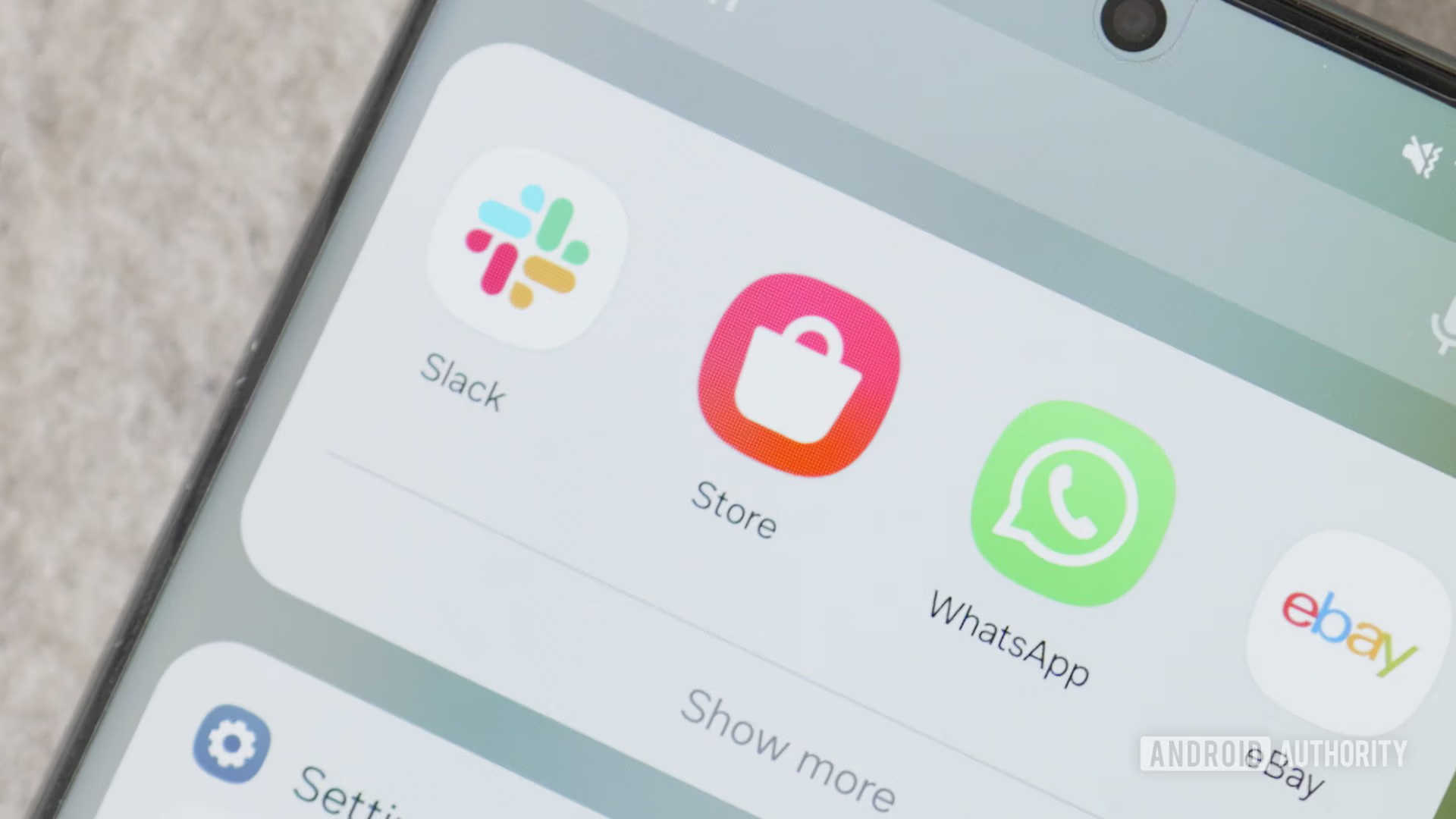
Streamlining the Galaxy: Why Samsung’s Second App Store Has Overstayed Its Welcome
In the sprawling cosmos of Android, where choice is king and customization a creed, there’s one particular constellation that has long baffled and, frankly, frustrated users: the dual app store dilemma. Most Android phone owners are perfectly content with the Google Play Store, the default galaxy of apps, games, and digital content. It serves as the primary hub for discovery, downloads, and crucial updates, offering a seamless and unified experience that users have come to expect and rely upon.
So why, then, does Samsung, the undisputed titan of Android hardware and a company celebrated for its innovative devices, insist on maintaining its own parallel universe, the Galaxy Store? This secondary storefront, pre-installed on every Samsung device, often duplicates functionality, creates confusion, and adds an unnecessary layer of complexity to an otherwise sleek operating system. For years, users have navigated this perplexing duality, often wondering about its true purpose and whether its benefits truly outweigh its drawbacks.

Recent discussions, highlighted by a compelling piece from Android Authority, suggest it’s high time for Samsung to consider a strategic retreat from this particular battlefront. The growing chorus of voices advocating for a single, unified app experience isn’t just about minor inconveniences; it points to a clearer, more user-centric future for Samsung and the wider Android ecosystem. Embracing this shift could unlock significant advantages for Samsung’s brand perception, resource allocation, and ultimately, its users’ satisfaction.
The Double-Edged Sword of Redundancy: Why Two App Stores Are One Too Many
At its core, the problem with Samsung’s Galaxy Store is fundamental redundancy. For the vast majority of users, the Galaxy Store functions as a secondary, often ignored, storefront that replicates services already perfectly handled by the Google Play Store. When users download an app like Facebook, Spotify, or Netflix, they instinctively turn to Google Play. These apps then update through Google Play. However, a significant number of apps, particularly those pre-installed by Samsung or deeply integrated into its One UI experience, sometimes insist on updating through their own proprietary store. This creates a messy, fragmented experience that can be frustrating and counterintuitive.
Imagine managing your entire digital library across two separate systems, each requiring individual attention and offering slightly different versions or update schedules. This is the reality for many Samsung users, leading to a host of avoidable issues that detract from the premium Android experience Samsung aims to deliver. From redundant notifications to delayed critical updates, the dual app store model presents more hurdles than it resolves, ultimately diminishing the overall usability of the device.
Notification Spam and Confusion
One of the most immediate and irritating consequences of having two active app stores is the inevitable notification spam. Users routinely receive update notifications from two different sources, often for the same core system apps or even for different components of the same feature. For instance, a Samsung-developed app might prompt an update from the Galaxy Store, while a Google app, or a third-party app, will notify from Google Play. This constant barrage clutters the notification shade, making it harder to discern truly important alerts from routine, often duplicate, app maintenance.
Beyond the sheer volume, there’s a significant element of confusion. Users are left wondering which store to prioritize, which notification to dismiss, and whether they’re truly keeping all their apps up-to-date. This ambiguity undermines the sense of control and clarity that modern smartphone interfaces strive to provide, forcing users to engage in an unnecessary mental process of deciding where to manage their applications. It’s a prime example of how an attempt at differentiation can inadvertently lead to user frustration and a degraded experience.
Slower and Fragmented Updates, Especially Security Patches
Perhaps even more critical than notification clutter is the issue of update timeliness. The Galaxy Store often lags behind the Google Play Store in delivering crucial app updates. This delay means Samsung users might miss out on immediate bug fixes that address glitches, new features that enhance functionality, or, most critically, vital security patches. In an era where cybersecurity threats are constantly evolving and new vulnerabilities are discovered daily, receiving timely updates is paramount to protecting user data and maintaining device integrity. Delays, even short ones, can expose users to unnecessary risks.
When an app developer pushes an update, it typically goes live on Google Play first, reaching millions of devices globally within hours. If that same app, or a Samsung-modified version of it, also exists on the Galaxy Store, the process for updating it there can introduce a significant delay. This fragmentation of updates can leave Samsung users vulnerable for longer periods or simply behind on the latest improvements, creating an inconsistent and less secure user experience across the Android ecosystem. A unified app distribution channel ensures all users receive updates simultaneously, enhancing both security and functionality for everyone.
Limited Selection and Variable Quality
While the Galaxy Store does offer some unique elements—such as exclusive themes, watch faces for Galaxy Watches, and occasional promotional deals on certain apps—its overall app selection is undeniably smaller and less diverse than Google Play’s. For the vast majority of applications that users download, from social media to productivity tools, Google Play remains the primary and most comprehensive destination. This makes the Galaxy Store a niche repository rather than a true competitor, diminishing its utility as a general app source and adding little value for most everyday users.
Furthermore, concerns have been raised regarding the vetting process for app quality and security on the Galaxy Store, which can feel less rigorous than Google Play’s. Google invests heavily in its Play Protect services and a robust review process to ensure apps meet strict security and quality standards, proactively scanning billions of apps daily. While Samsung undoubtedly has its own review mechanisms, the perceived difference can lead to a sense of unease among users, who generally trust Google Play as the safer and more reliable source for their digital content. Consolidating app distribution under Google Play would leverage this established trust and security framework for all applications, benefiting users with a more consistent and secure app environment.
Bloatware’s Enabler: Pushing Proprietary Apps
The Galaxy Store also provides Samsung with a convenient channel to push its own suite of apps and services directly to users, contributing significantly to the persistent “bloatware” criticism leveled against the company. While some of Samsung’s proprietary applications, such as Samsung Health, Samsung Notes, or Samsung Pay, are genuinely useful and well-integrated into the One UI experience, others are less so, often duplicating functionality already offered by Google’s excellent suite of apps (e.g., Samsung Internet vs. Chrome, Samsung Mail vs. Gmail, Samsung Calendar vs. Google Calendar).
By having its own app store, Samsung has a direct mechanism to promote and even force updates for these proprietary apps, regardless of user preference. This can lead to a cluttered app drawer, unnecessary background processes, and redundant apps consuming valuable storage space and system resources that could otherwise be used for user-preferred applications or improving device performance. While Samsung’s motivations—control over its ecosystem, a direct revenue stream, and the ability to differentiate its devices—are understandable from a business perspective, in practice, these benefits often come at the expense of a smooth, intuitive, and resource-efficient user experience. It’s an attempt to build a walled garden within an open field, and the walls are proving more cumbersome than protective for the average user.
What This Means for the Future: A Harmonious Android Experience
If Samsung were to embrace the suggestion and strategically sunset the Galaxy Store for general app distribution, the implications would be significant and overwhelmingly positive for several key stakeholders. This wouldn’t be a concession or a sign of weakness, but a strategic realignment that plays to Samsung’s core strengths and decisively prioritizes the end-user experience, a move that would likely be met with widespread acclaim from its vast user base.
For Samsung: Strategic Resource Reallocation and Enhanced Brand Perception
For Samsung, the immediate benefit would be a considerable freeing up of resources. Running and maintaining a global app store is an enormous undertaking, requiring significant investment in development teams, server infrastructure, content moderation, security protocols, and ongoing maintenance to keep it competitive and secure. By letting Google handle the complexities of app distribution, Samsung could reallocate these valuable engineering and financial resources into areas where it truly shines and where it can make a more meaningful impact on the user experience and its core product offerings.
Imagine these resources being poured directly into refining One UI, Samsung’s celebrated custom Android skin, making it even more fluid, feature-rich, and optimized for performance and battery life. They could be channeled into improving core services like Samsung DeX, enhancing the already impressive camera software, or accelerating innovation in hardware design and cutting-edge features beyond what competitors offer. Furthermore, a commitment to simplicity and user experience would resonate deeply with consumers. It would demonstrate a willingness to listen to feedback, prioritize user needs over proprietary control, and align more closely with the open, flexible ethos of Android itself. This move would undoubtedly enhance Samsung’s brand perception, cementing its reputation not just as a hardware leader, but as a company that genuinely prioritizes user satisfaction and streamlined functionality above all else, fostering greater loyalty and trust.
For Users: A Seamless, Secure, and Bloat-Reduced Experience
For the end-user, the benefits of a single app store would be immediately palpable and profoundly positive, transforming their daily interactions with their Samsung device. The most obvious gain would be a truly streamlined experience: a single, authoritative source for all app updates, drastically fewer redundant notifications, and a clearer, more intuitive path to discovering, downloading, and managing applications. This simplicity reduces cognitive load and removes a persistent point of friction from daily device interaction, making the phone feel more cohesive and responsive.
More importantly, relying solely on Google Play would mean faster access to critical security patches and a more consistent, reliable app experience. Users would no longer have to worry about whether a particular app update is available on both stores or if one is lagging behind, potentially leaving them vulnerable. This unification ensures everyone is on the latest, most secure version of their applications, enhancing overall device security and stability. While some core Samsung apps would likely remain pre-installed for essential device functionality, removing the secondary store could significantly reduce the incentive for Samsung to push less-used or duplicate applications, leading to a noticeable reduction in perceived bloatware and freeing up valuable storage space and system resources for the apps users truly want and choose to install.
For the Android Ecosystem: Reduced Fragmentation and a Stronger Google Play
Beyond Samsung and its vast user base, this strategic shift would have positive ripple effects across the entire Android ecosystem. Such a move from the biggest Android OEM would be a powerful statement against unnecessary fragmentation. It would set a precedent, demonstrating that even a company with the scale and ambition of Samsung sees the compelling benefits of a unified app distribution model. This could, in turn, inspire other Android manufacturers who maintain their own nascent or less-used app stores to reconsider their strategies, potentially leading to a more cohesive and less fragmented Android landscape overall, where developers can target a more unified platform.
A more unified ecosystem also makes Google Play an even more robust and reliable platform for both developers and users alike. Developers would have a single, primary target for their applications, simplifying development cycles, testing, and distribution efforts, allowing them to focus more on innovation. This concentration of effort and resources would allow Google to further refine Play Store services, enhance its already formidable security measures with Play Protect, and improve discovery mechanisms, ultimately benefiting every Android user, regardless of their device manufacturer, with a richer, safer, and more consistent app experience. The future of Android, particularly on devices as ubiquitous as Samsung’s, hinges on delivering seamless and intuitive experiences, and embracing a single app store is a monumental step in that direction for the entire platform.
The Galaxy Store, while born from an understandable desire for control and differentiation in a competitive market, has ultimately evolved into an unnecessary layer of complexity that detracts more than it adds to the user experience. Ditching it wouldn’t be a sign of weakness, but a bold, user-centric move towards a more harmonious, efficient, and truly unified Android future. It’s time for Samsung to let its users truly roam free in a single, unfragmented app galaxy, allowing them to fully enjoy their devices without the unnecessary clutter of dual app stores.
Read the original story at Android Authority.
What are your thoughts on Samsung’s Galaxy Store? Do you find it useful, or do you agree it’s time for a unified app experience under Google Play? Share your perspective in the comments below!