Beyond the Finish Line: Why Sonic Racing’s Switch 2 Delay Signals a Brighter Next-Gen Future
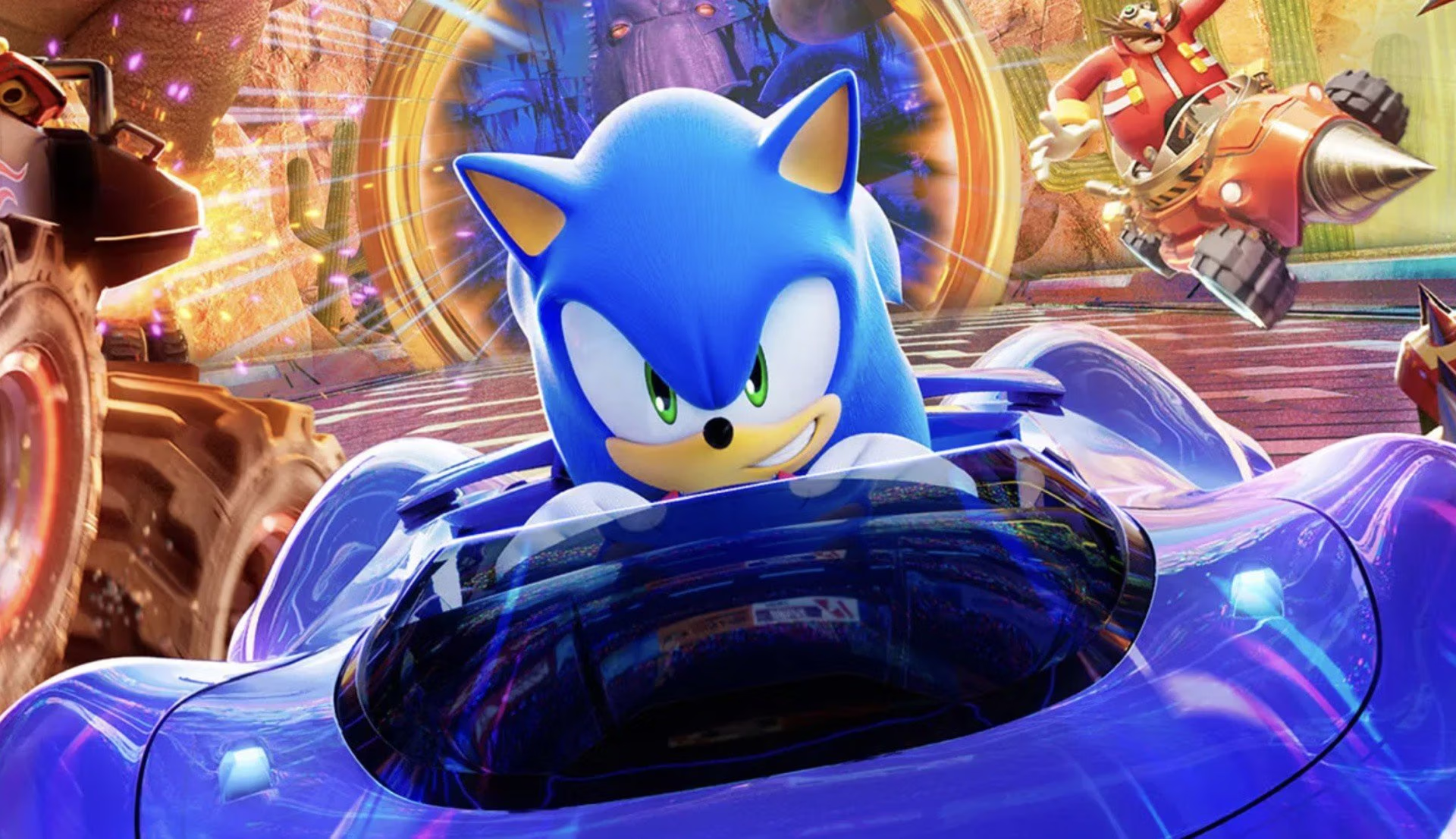
The world of gaming is no stranger to delays. Whether it’s to squash a few more bugs, refine intricate gameplay mechanics, or polish a visual effect to shimmering perfection, shifts in release dates have become a common, albeit often frustrating, occurrence across all platforms. Gamers have grown accustomed to the bittersweet announcements of postponed launches, often met with a collective sigh of “here we go again.” This sentiment was likely echoed when news broke that *Sonic Racing: CrossWorlds*, a highly anticipated title in the beloved blue blur’s racing franchise, would be taking a detour and arriving later on the Nintendo Switch 2.
However, what if this particular delay isn’t just another instance of ironing out kinks or navigating unforeseen development hurdles? What if it’s a profoundly proactive, strategic move that actually bodes incredibly well for the future of gaming on Nintendo’s next-generation console, signaling a new era of quality and commitment?

Takashi Iizuka, the esteemed head of Sonic Team and a veteran architect of Sonic’s legacy, has offered some much-needed clarity on the decision, and his insights paint a surprisingly optimistic picture. The core message emanating from this delay is crystal clear: this isn’t merely about hitting a deadline; it’s emphatically about hitting a demanding standard. The dedicated team behind *Sonic Racing: CrossWorlds* is not content with simply getting the game to run on the Switch 2; their unwavering mission is to ensure it truly, unequivocally shines on it, offering an experience that fully leverages the console’s advanced capabilities.
The Pursuit of Perfection on New Hardware
Iizuka’s explanation hints at a much deeper commitment than merely porting a game from one system to another with minimal adjustments. It strongly suggests a deliberate, meticulous effort to leverage the unique capabilities and significantly increased horsepower that the Nintendo Switch 2 is expected to offer. This isn’t just a race to get the game out the door; it’s a thoughtful, dedicated process aimed at crafting an optimal experience, one that comprehensively takes full advantage of what the new hardware has to offer from a technical and gameplay perspective.
Imagine a world where racing tracks burst with unprecedented detail. This could mean enhanced visuals with higher native resolutions, allowing for crisper textures on character models, environmental elements, and racing vehicles. Advanced lighting models could create dynamic shadows and realistic reflections on wet tracks or polished car surfaces, transforming the visual fidelity. Particle effects, like sparks from collisions or water spray, could be rendered with greater density and realism, adding to the immersion. These aren’t just minor bumps; these are fundamental shifts that elevate the entire aesthetic presentation of the game, making every race a vibrant spectacle.
Beyond visual splendor, consider the profound impact of smoother framerates. A consistent 60 frames per second (FPS) is the holy grail for racing games, crucial for precise controls and an immediate sense of responsiveness. On the Switch 2, this delay allows developers to engineer stable performance, potentially incorporating dynamic resolution scaling to maintain fluidity even during the most chaotic on-screen action. Such optimization eradicates the frustrating dips and stutters that can plague less polished cross-platform titles, ensuring a buttery-smooth gameplay experience that is vital for competitive racing.
Furthermore, faster load times, often a subtle yet significant improvement, would dramatically enhance the player experience. If the Switch 2 features faster internal storage, akin to modern SSDs in other consoles, developers can utilize this to reduce wait times between races, menu navigations, and initial game launches. This means less staring at loading screens and more time spent in the thrilling action, contributing significantly to overall player satisfaction and game flow.
But the pursuit of perfection goes beyond mere technical specifications. This delay could also be utilized to implement bespoke features unique to the Switch 2. While speculative, this might include more advanced haptic feedback, delivering nuanced vibrations that convey the rumble of the road, the impact of a collision, or the distinct feel of drifting through a corner. If the Switch 2 Joy-Cons evolve, they might offer adaptive triggers, providing variable resistance for acceleration or braking, adding another layer of tactile immersion. Unique control schemes that leverage new sensor capabilities or even enhanced local multiplayer options, capitalizing on improved wireless connectivity, could also be on the table. These are the kinds of innovations that genuinely make a game feel “next-gen,” not just a slightly better-looking version of its predecessor.
For us, the players, this meticulous dedication is nothing short of fantastic news. It’s a powerful signal that developers aren’t simply rushing to market with a minimal-effort port designed to hit an early window. Instead, they are being given — and wisely taking — the necessary time to truly understand, experiment with, and ultimately exploit the nuanced architecture of Nintendo’s upcoming console. This indicates a potential and very welcome trend for other early Switch 2 titles: a profound focus on quality and a steadfast dedication to delivering experiences that genuinely feel “next-gen,” rather than just slightly improved cross-platform releases that leave players wanting more. It speaks to a commitment to make *Sonic Racing: CrossWorlds* the definitive version of the game, a benchmark for what Switch 2 can achieve.
What This Means for the Switch 2 Ecosystem
This delay, originating from a prominent third-party title like *Sonic Racing: CrossWorlds*, offers a plethora of intriguing implications that extend far beyond just Sonic’s latest racing adventure. It paints a broader picture of the burgeoning Switch 2 ecosystem and the standards it aims to establish from day one.
1. Validation of Switch 2’s Capabilities: A Glimpse into Next-Gen Power
If developers need extra time to meticulously optimize for the Switch 2, it strongly suggests that the console boasts significant, tangible upgrades that genuinely warrant such dedicated effort. This isn’t merely a marginal bump in performance; it implies there’s a substantial difference to achieve, a new technical ceiling to reach. The necessity for optimization speaks volumes about the expected leap in graphics processing power, CPU capabilities, and memory bandwidth compared to the original Nintendo Switch. It suggests that the Switch 2 isn’t just an iteration, but a generational leap that requires a fresh approach from development teams.
This validation is crucial for both Nintendo and potential buyers. For Nintendo, it confirms that their investment in new hardware is translating into a platform capable of delivering experiences that challenge developers and excite consumers. For players, it’s an encouraging sign that their anticipation for a genuinely more powerful portable-hybrid console is well-founded. It suggests that the Switch 2 will be capable of hosting visually stunning games with complex physics and robust AI, allowing developers to unleash their creativity in ways previously constrained by the original Switch’s hardware. This validation builds confidence in the console’s long-term potential and its ability to attract and retain top-tier developers.
2. A Precedent for Quality: Elevating the Standard of Launch Titles
Sonic Team’s decision to delay for optimization sets a remarkably high bar for other developers preparing titles for the Switch 2 launch window and beyond. It demonstrates a clear, unequivocal commitment to delivering a polished, definitive version of a game, even if it means missing an initial launch window or requiring more development time. In an industry frequently criticized for buggy launches, rushed releases, and reliance on day-one patches, this approach is a breath of fresh air.
This commitment to quality could create a ripple effect, encouraging other developers to adopt a similar, player-centric approach. If early Switch 2 titles are known for their polish and optimized performance, it could foster an environment where quality takes precedence over speed-to-market. This isn’t just about avoiding bugs; it’s about maximizing the player experience, ensuring games are stable, performant, and visually impressive from the moment they are released. Such a precedent could significantly enhance the reputation of the Switch 2’s launch lineup and its overall game library, building consumer trust and satisfaction for years to come. It sends a message that Nintendo, and its partners, are serious about delivering a premium gaming experience.
3. Strong Developer Support from Nintendo: A Collaborative Future
For a major third-party game like *Sonic Racing: CrossWorlds* to delay specifically for optimization, it strongly implies that Nintendo is actively supporting developers in maximizing their games for the Switch 2. This isn’t a situation where a developer is left to struggle alone; it suggests a collaborative, supportive relationship. This active support could manifest in various ways: providing comprehensive dev kits early on, offering extensive technical documentation, holding direct workshops, and even providing dedicated engineering support from Nintendo’s own teams to help third parties unlock the console’s full potential.
This collaborative approach is absolutely crucial for building a strong and diverse launch lineup, and indeed, a thriving game library throughout the console’s lifecycle. Historically, Nintendo has sometimes faced challenges with consistent third-party support on certain consoles. However, this scenario suggests a concerted effort to foster positive developer relationships, ensuring that prominent studios feel empowered and supported to bring their best work to the Switch 2. Strong third-party backing is a cornerstone of any successful console, enriching the game catalog and appealing to a wider audience, and this delay is a positive indicator of Nintendo’s commitment to that principle.
4. Managing Expectations (and Excitement): The Virtue of Patience
While delays can undeniably be frustrating in the short term, they often serve a vital purpose in managing expectations. Knowing that a game is being held back for refinement, rather than being rushed out prematurely, ultimately builds greater, more sustained anticipation for a superior final product. It encourages patience from the player base, promising a significantly more rewarding and enjoyable experience in return for the wait.
This isn’t just about avoiding disappointment from a buggy launch; it’s about cultivating excitement for a truly exceptional game. When a developer explicitly states they are delaying for quality, it re-frames the narrative from “frustrating delay” to “exciting wait for perfection.” It reinforces the idea that the end product will be a definitive version, a game that performs as intended and looks as good as it can. This psychological shift is powerful. It ensures that when *Sonic Racing: CrossWorlds* does launch, it will be met with widespread enthusiasm, not trepidation. It creates an environment where players are genuinely excited to see what the Switch 2 can do, rather than cautiously optimistic. This approach, though initially disappointing for some, ultimately builds greater trust and appreciation, securing a positive first impression for both the game and the new console.
In an industry often criticized for buggy launches, performance issues, and rushed releases, Takashi Iizuka’s candid explanation regarding *Sonic Racing: CrossWorlds* provides a truly refreshing and optimistic perspective. The delay isn’t just a postponed finish line; it’s a profound promise. It’s a commitment that when Sonic and his friends finally hit the track on Switch 2, they won’t just be racing; they’ll be doing so at peak performance, showcasing exactly what Nintendo’s next console is capable of in its prime. For any tech enthusiast, dedicated gamer, and anyone invested in the future of immersive entertainment, that’s a future unequivocally worth waiting for, promising a truly next-gen experience. This intentional delay represents a critical stride towards a more polished, player-focused future for gaming on Nintendo’s innovative new hardware.
Given this proactive approach to quality and optimization, what kind of groundbreaking features or graphical fidelity are you most eager to see from *Sonic Racing: CrossWorlds* or other early Switch 2 titles?