The Scoundrel’s Tune-Up: What the First ‘Star Wars Outlaws’ Patch Really Tells Us About the Switch 2’s Future
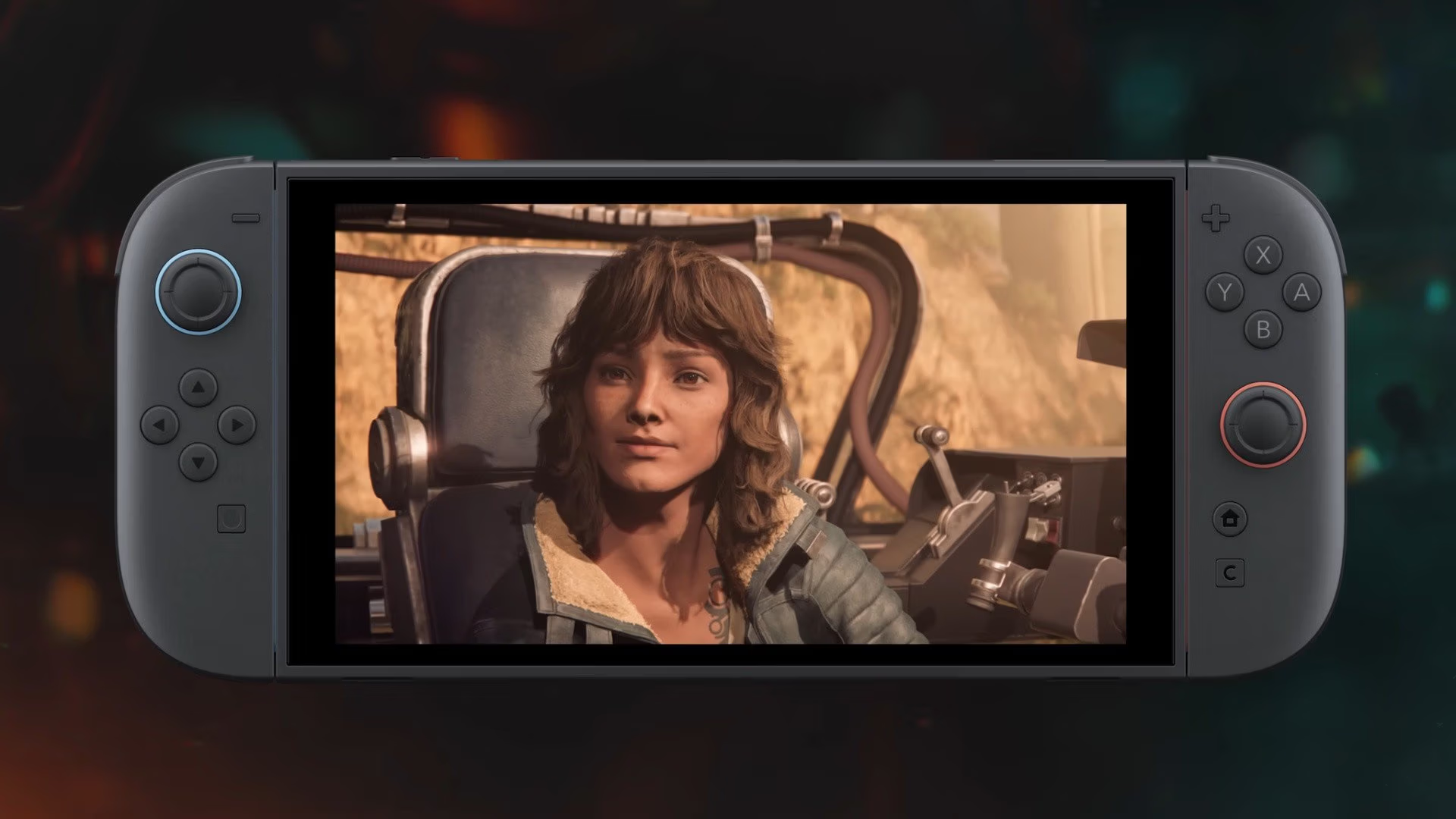
The launch of a new console is always a frantic, exciting time, a moment steeped in anticipation and the promise of groundbreaking experiences. We eagerly unbox the sleek new hardware, marvel at the updated user interface, and finally, boot up that first, long-awaited killer app. For a significant number of new Nintendo Switch 2 owners, that seminal game was none other than Star Wars Outlaws, the expansive open-world adventure set in a galaxy far, far away. And right on cue, as has become a predictable tradition in the modern gaming landscape, the first major title update for Kay Vess’s journey through the criminal underworld has just landed.
While it’s often easy for players to glance at a generic “Title Update 1.0.1” and simply dismiss it as a collection of routine bug fixes and minor adjustments, the inaugural patch for Star Wars Outlaws on the Switch 2 is far more significant than a mere tune-up. It represents our first real, tangible, and deeply insightful look at how a massive, third-party, open-world game is not just running, but truly settling into Nintendo’s powerful new hardware. Reading between the lines of these early patch notes, and understanding the implications of the fixes, gives us a fascinating and crucial glimpse into the immediate and long-term future of AAA gaming on the go, specifically for the millions who have invested in the Switch 2.

Beyond the Bugs: A Story of Optimization and the Switch 2’s Untapped Potential
The patch notes, as meticulously detailed by publications like Nintendo Life, contain a predictable array of entries: squashed progression bugs that might halt a player’s journey, fixes for minor graphical glitches that momentarily break immersion, and a general suite of stability improvements designed to smooth out the overall experience. This, frankly, is the new normal in an era of increasingly complex game development. Titles of the scale and ambition of Star Wars Outlaws are incredibly intricate beasts, juggling vast worlds, complex AI, and sophisticated physics systems.
Launching such a game on brand-new console architecture, even one as well-designed as the Switch 2, is akin to exploring uncharted space. It’s an immense undertaking, and no amount of pre-launch testing can fully replicate the myriad ways millions of players will interact with the game in the real world. Thus, a day-one or week-one patch is no longer a definitive sign of a broken or rushed game; instead, it’s a positive indication of developers actively monitoring, analyzing, and responding to real-world performance data gathered from their expansive player base. It signifies a living, evolving product.
What truly elevates this particular patch beyond the routine, however, are the performance-specific tweaks. The notes explicitly mention optimizations targeted at “densely populated urban areas” and “high-speed vehicle sequences.” This seemingly technical detail actually tells us two profound things about the Switch 2 and its capabilities. Firstly, it unequivocally demonstrates that the Switch 2 is clearly powerful enough to even *attempt* to render these complex scenarios – situations that would have been unequivocally impossible, or at best severely compromised, on its predecessor, the original Nintendo Switch. Think of the CPU cycles required for thousands of AI characters in a bustling marketplace, or the GPU power needed to stream textures and render draw distances at warp speed during a swoop bike chase, all while maintaining smooth performance and visual fidelity.
Secondly, and perhaps more importantly, these specific targets reveal precisely where developers are currently identifying the new performance bottlenecks on Nintendo’s latest console. Every piece of hardware has its limits and its quirks. Mastering a console’s unique architecture – understanding its CPU-GPU balance, its memory bandwidth, its custom APIs, and its thermal envelopes – takes time, iteration, and deep collaboration between hardware manufacturers and software developers. This first major patch is merely the initial chapter in a long and ongoing story of developers learning to squeeze every last drop of power and efficiency from Nintendo’s new machine. It’s an incredibly exciting prospect because it means the version of Star Wars Outlaws we are playing today is, in all likelihood, the “worst” it will ever run in terms of baseline performance. Future updates, armed with even more data and deeper understanding of the hardware, will only refine and enhance the experience further, potentially unlocking even more graphical polish and smoother gameplay as developers become more adept at leveraging the Switch 2’s full potential.
A Vote of Confidence: Redefining Third-Party Support for the Nintendo Switch 2
Perhaps the most significant takeaway from this entire situation has nothing directly to do with framerates, texture resolutions, or bug counts. Instead, it’s about the sheer speed and comprehensiveness of the patch itself. The fact that Ubisoft Massive, a major AAA developer, didn’t just ship a port of Star Wars Outlaws to the Switch 2 and then shift their focus entirely to other platforms is incredibly telling. They are actively supporting the Switch 2 version with the same urgency, dedication, and resource allocation as they are their releases on other high-profile consoles and PC. This parallel development and immediate post-launch attention signify a crucial shift.
Adding further weight to this commitment, the patch also reportedly introduces more granular options for features unique to the Nintendo platform, such as refined gyro-aiming sensitivity. This isn’t just about basic functionality; it’s about *optimizing* the unique interactive elements that define Nintendo’s hybrid console experience. It signals that developers are not merely porting, but thoughtfully integrating and enhancing the game for the Switch 2’s specific strengths, valuing the platform’s distinct gameplay possibilities rather than treating them as afterthoughts. Such attention to detail on platform-specific features demonstrates a genuine commitment to providing the best possible experience tailored for the Switch 2 player base.
This rapid, robust, and platform-aware patching strategy represents a massive vote of confidence from a top-tier publisher. For years, Nintendo fans have been understandably wary, even jaded, when it comes to third-party support. The history of Nintendo consoles is peppered with instances of late, often compromised, and visually downgraded ports of major titles that frequently received little to no post-launch attention. This historical pattern created a skepticism that has long hindered Nintendo’s ability to attract and retain certain segments of the gaming market, often leaving fans feeling like second-class citizens in the broader gaming ecosystem.
However, a timely and comprehensive patch for one of the year’s biggest releases, launching on new hardware, signals a fundamental and potentially enduring shift in this dynamic. It strongly suggests that major publishers, like Ubisoft, now perceive the Switch 2 not as a secondary, niche market for down-scaled ports, but as a premier, top-tier platform deserving of the same full development support and post-launch dedication as any other console. This isn’t just about technical capability; it’s about market strategy and financial commitment, indicating that publishers see a lucrative and growing audience on the Switch 2 that justifies significant investment in its long-term success and continued support.
This, then, is the promise of the Nintendo Switch 2 being realized in real-time before our very eyes. It’s no longer just about the exciting prospect of getting big, ambitious games on a hybrid console. Crucially, it’s about receiving the *best possible versions* of those games that can exist within the unique constraints and advantages of a portable-home console hybrid, fully backed by the extensive resources and ongoing attention of their developers. The road ahead for Kay Vess across the Outer Rim is vast and full of peril, but thanks to this early and decisive update, her journey on the Switch 2 is already looking significantly smoother, more stable, and is an incredibly promising sign of great things to come for the console’s entire library.
You can delve deeper into the specifics of the update and read the original story at Nintendo Life.
What do you think this early patch for Star Wars Outlaws on the Switch 2 signifies for the future of AAA third-party games on Nintendo’s new platform? Share your thoughts in the comments below!