
The Tipping Point: Super Ultrawide Monitors Enter the Mainstream
For years, the super ultrawide monitor has been the unicorn of PC setups. You’ve seen them on YouTube, dominating the desks of tech gurus and pro gamers—a sweeping, cinematic curve of pixels that promises to swallow your peripheral vision and banish the dreaded dual-monitor bezel forever. It was the dream setup, the ultimate desktop upgrade offering unparalleled immersion and productivity, but it came with a nightmare price tag, often soaring well north of $1,000, placing it firmly in the realm of luxury tech that was simply out of reach for most.
This aspirational piece of technology was something you’d dutifully add to a “someday” wishlist, perhaps alongside a custom-built PC with a top-tier GPU or a high-end ergonomic chair. It represented the pinnacle of desktop computing, an investment that few could justify. Well, for many, “someday” is starting to look a lot like today, as powerful market forces and significant manufacturing advancements converge to bring these colossal displays within reach of a broader audience, transforming them from extravagant luxuries into viable upgrades.

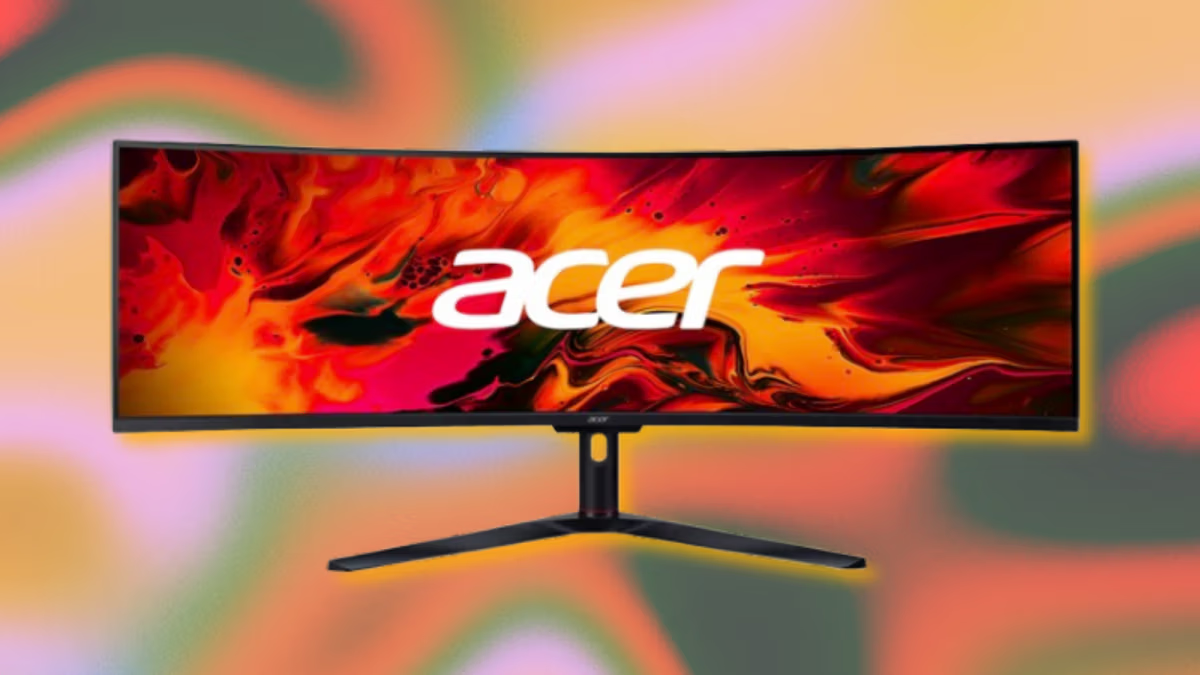
A recent deal spotted by Mashable on Acer’s 49-inch EI1 curved monitor isn’t just another temporary sale or a fleeting discount; it’s a significant bellwether for the entire super ultrawide monitor market. This particular display, a true behemoth that offers an expansive 5120 x 1440 resolution (effectively delivering the pixel density of two QHD monitors side-by-side) and a silky-smooth 120Hz refresh rate, has recently dropped to a price point that dramatically pulls it out of the stratosphere. It is now firmly within the realm of attainability for serious enthusiasts, productivity-focused professionals, and dedicated gamers alike. This isn’t just about one monitor getting a discount; it’s a resounding signal that the entire super ultrawide market is reaching a critical inflection point, ushering in an era of unprecedented accessibility for what was once an elite peripheral.
The Great Tech Trickle-Down: How High-End Displays Become Mainstream
What we’re witnessing with super ultrawide monitors is a classic and highly anticipated phenomenon in the technology world: the democratization of high-end technology. It’s a familiar narrative we’ve seen play out countless times before across various product categories. Think back to when the first 4K TVs hit the market, commanding exorbitant prices that only early adopters or luxury consumers could justify. Over time, as manufacturing scaled and competition intensified, 4K became the standard for most household televisions. Or recall the initial prohibitive cost of Solid State Drives (SSDs), which were once a premium upgrade but gradually became standard components even in budget-friendly laptops, revolutionizing system responsiveness. The same technological maturity cycle is now unfolding for super ultrawide displays, bringing their immense benefits to a wider demographic.
The complex manufacturing processes behind these massive, curved LCD or VA panels have been steadily improving over the past few years. Early production faced significant challenges related to panel yield rates, ensuring color uniformity across such a wide expanse, and the intricate bending required for the deep curves that define these displays. As fabrication techniques mature, and as major display manufacturers like Samsung Display and LG Display gain more experience and optimize their assembly lines, the cost per panel inevitably decreases. This improved efficiency, coupled with an increasingly competitive landscape among major brands such as Acer, Samsung, Dell, LG, HP, and others, creates a perfect storm for aggressive price reductions. Each brand strives to offer compelling features at competitive prices, pushing the entire market forward and ensuring that consumers benefit from this race to innovate and optimize.
The Acer EI1 serves as a brilliant microcosm of this larger trend. Its spec sheet hits a remarkable sweet spot that precisely appeals to the two largest and most eager groups eyeing these expansive displays. It deftly balances cutting-edge features—like its generous 49-inch size, high 5120×1440 resolution, and smooth 120Hz refresh rate—with a newly accessible price point. This combination makes it a benchmark for what consumers can now expect from this rapidly evolving category, proving that premium experiences don’t always have to come with a premium price tag.
1. The Productivity Powerhouse: Unleashing Unprecedented Workflow Efficiency
For the professional, knowledge worker, or creative, a 49-inch, 32:9 aspect ratio monitor isn’t merely a larger screen; it’s a fundamental reimagining of the digital workspace. Functionally, it’s akin to having two high-resolution 27-inch QHD monitors stitched together, but with the profound advantage of eliminating the jarring plastic divide in the middle. This seamless expanse fosters an environment of unparalleled focus, fluidity, and efficiency, allowing for dramatically improved window management and reduced cognitive load from constant alt-tabbing.
- Video Editors: Imagine an uninterrupted timeline stretching across nearly five feet of screen real estate. This allows for incredibly detailed cuts, the ability to view more of your sequence at once, and ample space for multiple panels—preview windows, effects controls, audio mixers, and asset bins—all open simultaneously without constant tab-switching or overlapping. The fluid movement of content across the screen enhances the creative flow, making complex projects like film editing, motion graphics, or podcast production feel more manageable and intuitive.
- Developers & Programmers: For coders and software developers, this monitor transforms the coding experience. You can comfortably display your integrated development environment (IDE) with multiple code files on one side, while dedicating the other side to a live preview of your application, extensive documentation, database interfaces, server logs, or debugging tools. No more alt-tabbing between code and browser; everything is immediately visible, fostering a more continuous and less fragmented thought process that can significantly boost productivity and reduce errors.
- Graphic Designers & Architects: Visualize expansive design canvases in Adobe Photoshop, Illustrator, or Figma, with all your toolbars, layers, and reference images neatly organized on the periphery, leaving a vast, unobstructed central space for your artwork. For architects or CAD professionals, the ability to view complex blueprints or 3D models with intricate detail, alongside specifications, material libraries, and render previews, can significantly accelerate design iterations and error detection, providing a true “workbench” feel.
- Data Analysts & Financial Traders: For those working with large datasets, financial markets, or complex analytics, this monitor is a game-changer. Spreadsheets, multiple dashboards, real-time market feeds, and analytical visualization tools can be spread out across the entire screen, allowing for immediate comparison of multiple data sets without scrolling or juggling windows. This provides a holistic view of critical information at a glance, which can be invaluable in fast-paced, data-intensive environments where every second counts.
- The Multitasking Professional: Beyond specialized tasks, for anyone who regularly juggles emails, multiple documents, extensive web research, and communication applications, the super ultrawide creates an ultimate command center. You can have your email client, a primary document, two or three browser tabs for research, and a chat application all open and easily accessible on a single, coherent display. This makes you feel like you’re truly commanding the Starship Enterprise of productivity, reducing cognitive load and maximizing output by keeping all your essential information in your immediate field of view.
2. The Immersive Gamer: A New Horizon for Digital Worlds
While esports professionals might still chase the dizzying heights of 360Hz refresh rates, the 120Hz on offer from monitors like the Acer EI1 is a massive, tangible upgrade from the standard 60Hz that most conventional monitors provide. This higher refresh rate delivers the fluid motion that makes games feel remarkably responsive, alive, and utterly captivating. But it’s the sheer width of the screen, combined with its gentle curve, that truly defines the gaming experience on a super ultrawide, creating an unparalleled sense of immersion that a standard monitor simply cannot replicate.
- Sprawling RPGs & Open-World Adventures: Games like *Cyberpunk 2077*, *The Witcher 3*, *Red Dead Redemption 2*, *Assassin’s Creed Valhalla*, or the upcoming *Starfield* truly shine. The expansive field of view pulls you deeper into their richly detailed worlds, allowing you to take in more of the environment, detect distant threats or points of interest in your peripheral vision, and generally feel more connected to the virtual landscape. The sheer scale of these digital realms becomes far more palpable.
- Racing and Flight Simulators: This is arguably where super ultrawides deliver their most transformative experience. The extended width creates a panoramic cockpit view, immersing you fully as if you’re actually in the driver’s seat of a Formula 1 car, the cockpit of an F-16, or navigating the vastness of space in *Star Citizen*. The enhanced sense of speed, spatial awareness, and the ability to track opponents or targets in your periphery is dramatically amplified, offering a significant experiential advantage for simulation enthusiasts.
- Strategy Games: For titles like *Civilization VI*, *StarCraft II*, *Age of Empires IV*, or *Total War: Warhammer*, the wider view means significantly more of the battlefield or world map can be displayed at once. This reduces the need to pan and zoom, allowing for better strategic oversight, faster decision-making, and a more comprehensive understanding of the tactical situation, giving you a near god-like perspective over your domain.
- First-Person Shooters (FPS): While some highly competitive players might still prefer standard aspect ratios for maximum frame rates and minimal visual distortion, for more casual or story-driven FPS titles, the wider field of view can be incredibly engaging, pulling you into the action with greater intensity. It offers a broader perspective on the combat zone, though it’s important to note that some older games might have limited 32:9 support or create a “stretched” effect, and performance demands on your GPU will be significantly higher.
The curving nature of these monitors further enhances immersion by wrapping the image around your field of vision, reducing distortion at the edges and maintaining a consistent focal distance across the entire display. This physical design element, combined with the expansive pixel count and high refresh rate, delivers a truly cinematic, visceral, and engaging gaming experience that is hard to go back from once you’ve tried it.
What This Means for the Future of Your Desk Setup
This recent price drop on the Acer EI1, and the growing number of similar deals appearing in the market, is far more than just a fleeting sale; it’s a clear signpost for where the market for high-performance displays is unequivocally heading. The sub-$1,000 super ultrawide monitor is no longer an anomaly reserved for Black Friday doorbusters or limited-time promotions; it’s rapidly becoming the new standard for an increasing number of brands and models. This trend signifies a broader shift, moving these once-premium peripherals from niche status to a mainstream consideration for anyone serious about their digital workspace or gaming setup.
Within the next year or two, expect to see even more aggressive pricing strategies as manufacturers further refine their production processes and battle intensely for market share. Furthermore, features that are currently considered premium—such as even higher 144Hz+ refresh rates for ultimate smoothness, advanced Mini-LED backlighting for superior local dimming, incredible contrast, and stunning HDR performance, or even the nascent but exciting OLED super ultrawides that offer perfect blacks and instantaneous response times—will begin trickling down into this more accessible price bracket. This means that even more cutting-edge visual experiences will become available without breaking the bank, continuously pushing the boundaries of what consumers can expect from their desktop monitors.
The era of the clunky, often mismatched, dual-monitor setup, with its jarring center bezel creating an annoying visual divide and its inevitable tangled mess of cables, may very well be drawing to a close. While multi-monitor setups will always have their place for specific use cases, the elegance and efficiency of a single, seamless super ultrawide display offer a compelling alternative that addresses many of the aesthetic and functional shortcomings of traditional configurations. Imagine a cleaner, more organized desk, fewer cables to manage, and a perfectly synchronized display experience without any visual breaks.
However, it’s also important to consider some practical aspects before making the jump. These monitors demand significant desk space, so measure carefully to ensure it will fit comfortably and ergonomically. Additionally, driving such a high resolution at a high refresh rate, especially in modern demanding games, will undoubtedly require a relatively powerful graphics card to maintain smooth performance and avoid stuttering. But for those with the space and the GPU, the rewards in terms of both enhanced productivity and unparalleled immersive gaming are immense and truly transformative.
The seamless, immersive, and surprisingly practical super ultrawide is no longer a distant dream reserved for the wealthiest tech enthusiasts or sponsored streamers. It’s here, it’s increasingly affordable, and it’s finally ready for your desk, poised to redefine how you work, play, and interact with your digital world, offering a glimpse into the future of personal computing.
Read the original story at Mashable.
What are your thoughts on the super ultrawide trend? Is the price finally right for you to make the jump, or do you still prefer a traditional dual-monitor setup for your workflow or gaming?