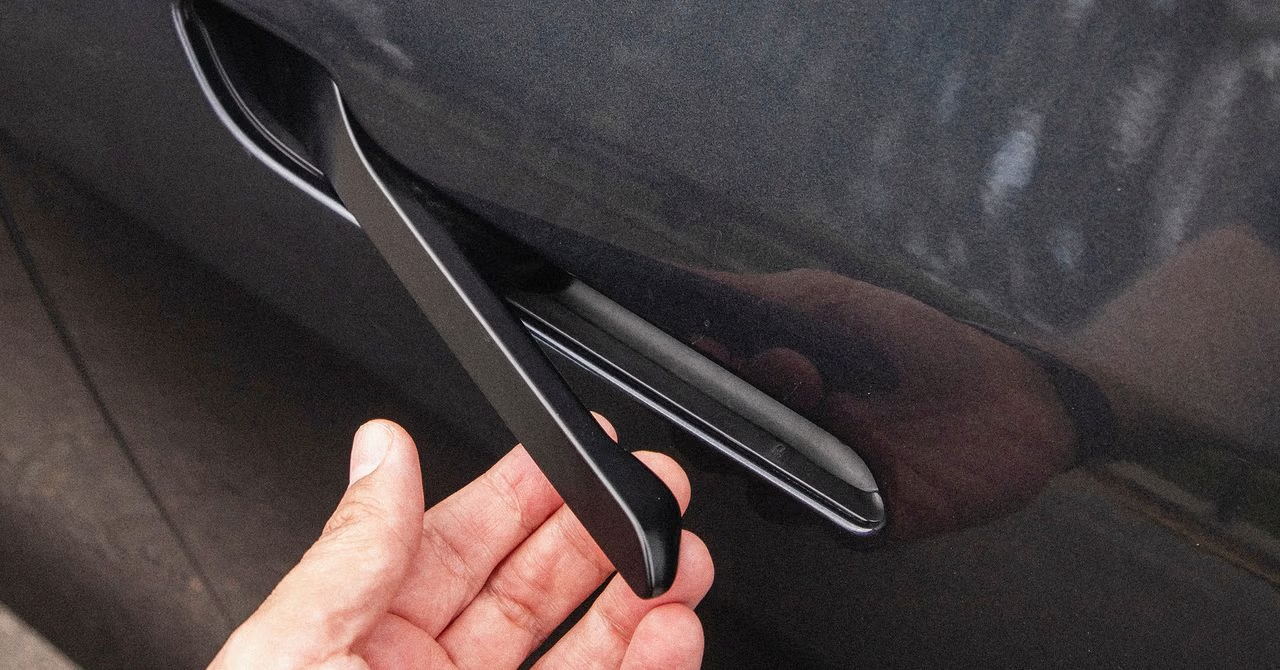
The Unexpected Battle Over the Humble Door Handle: When Sleek Design Meets Urgent Safety
In the relentless pursuit of innovation and aesthetic perfection, automakers have transformed nearly every aspect of the modern vehicle. One component, in particular, has undergone a subtle yet profound metamorphosis: the car door handle. For generations, this essential interface was a straightforward mechanical lever – pull, and the door opens. Simple, reliable, and universally understood. However, as the automotive world shifts towards electric powertrains, hyper-minimalist design philosophies, and advanced connectivity, the door handle has evolved into a sophisticated, often flush, and sometimes “smart” piece of engineering. This seemingly mundane detail now finds itself at the heart of a significant regulatory push, threatening to force major design overhauls across the industry, with iconic designs like Tesla’s flush handles squarely in the regulatory spotlight.
The tension arises from a fundamental conflict: the desire for cutting-edge design and aerodynamic efficiency clashing directly with the non-negotiable imperative of public safety. While modern door handles offer visual appeal and subtle functionality, they introduce new complexities, particularly in high-stakes, emergency scenarios. This regulatory scrutiny is not merely a bureaucratic hurdle; it represents a critical dialogue about balancing innovation with the bedrock principles of human safety and accessibility.

Emergency Access: The Core Safety Dilemma
The central concern underpinning this debate is deceptively simple but profoundly critical: emergency access. In the aftermath of a severe collision, every precious second can mean the difference between life and death. First responders—paramedics, firefighters, and police—operate under immense pressure, needing to quickly and reliably open car doors to extract occupants, regardless of the vehicle’s condition. This is where the evolution of the modern door handle poses an unforeseen challenge.
Many contemporary door handles, particularly those designed to pop out, retract flush with the body, or require a specific electronic sequence to operate, present significant hurdles in these critical situations. If a car’s electrical system is compromised or entirely down due to impact, these power-reliant mechanisms can become inoperable. Furthermore, even if functional, their non-standard operation isn’t immediately intuitive to someone unfamiliar with the vehicle – a common scenario for emergency personnel arriving at a chaotic crash scene. Precious minutes, vital for initiating life-saving medical care or preventing further harm, can be lost struggling with an unfamiliar door mechanism. The proposed changes in automotive safety standards aim to ensure that door latches and hinges remain robust and that doors can be opened with minimal effort and without requiring electrical power, from both the inside and outside of the vehicle, even after substantial impact forces.
Why Redesigning a Car Door Handle is “Harder Than It Sounds”
For a pioneering company like Tesla, whose sleek, flush, pop-out handles have become a hallmark of its aerodynamic efficiency and distinctive aesthetic, these design elements are integrated into the very DNA of their vehicles. Changing a seemingly minor component like a door handle is far from a trivial undertaking; it represents a complex, multi-faceted challenge with significant implications across the entire vehicle design and manufacturing process.
Aerodynamics and Vehicle Range
In the world of electric vehicles (EVs), every fraction of a percentage point in aerodynamic efficiency translates directly into valuable miles of range. Flush door handles are not merely an aesthetic choice; they are a critical engineering decision that contributes to a lower drag coefficient. A smoother vehicle profile allows air to flow more cleanly over the car, reducing air resistance and subsequently requiring less energy to move the vehicle forward. Any redesign that forces handles to protrude more, even slightly, could incrementally increase aerodynamic drag. For EV manufacturers like Tesla, where range anxiety is a primary consumer concern and a key competitive metric, even a minor reduction in range could be a non-starter for many consumers, undermining years of engineering optimization.
Aesthetics and Brand Identity
Beyond the functional benefits, those sleek, seamless lines are a core part of Tesla’s design language and, by extension, its brand identity. The minimalist, futuristic aesthetic is a significant draw for its customer base, symbolizing technological advancement and sophistication. A move back to more conventional, protruding handles could be perceived as a step backward, compromising the brand’s distinctive and highly recognizable look. Design is not just about form; it’s about emotional connection, perceived value, and brand loyalty. Changing such an integrated design element risks alienating a portion of the existing customer base and potentially altering the brand’s unique market position.
Manufacturing and Supply Chains
Changing a component as fundamental and integrated as a door handle isn’t just about redesigning the handle itself. It triggers a cascade of costly and time-consuming modifications across the entire manufacturing ecosystem. This includes:
- Retooling Factories: Production lines must be adapted, requiring significant investment in new machinery and tooling for stamping body panels, assembly processes, and painting.
- Redesigning Body Panels: The surrounding body panels must be re-engineered to accommodate new handle designs, affecting structural integrity, panel gaps, and mounting points.
- Altering Wiring Harnesses: For “smart” or power-assisted handles, the intricate wiring harnesses that run throughout the vehicle might need to be re-routed or redesigned to support new electrical connections.
- Securing New Suppliers: Establishing new relationships with suppliers for redesigned components, or re-negotiating terms with existing ones, adds complexity and potential delays.
- Crash Testing and Certification: Any significant structural change necessitates extensive re-testing to ensure compliance with all existing safety regulations, a process that is both lengthy and expensive.
This massive undertaking represents a significant drain on resources and can disrupt production schedules for months, if not years.
Software Integration
For “smart” door handles, there’s an intricate software layer involved. These handles are often integrated into the vehicle’s central nervous system, controlled by complex algorithms that manage everything from proximity sensing and automatic unlocking to manual override sequences. Any physical redesign must also account for its digital twin, requiring significant software development, rigorous testing, and over-the-air update capabilities. Ensuring seamless integration, cybersecurity, and fail-safe operation of the new hardware through updated software adds another layer of complexity and potential cost.
Cost Implications
Ultimately, all of the aforementioned challenges—re-engineering, retooling, supply chain adjustments, software development, and re-certification—translate into substantial development and production costs. These expenses could ultimately be passed on to consumers in the form of higher vehicle prices, potentially impacting market competitiveness. For a company like Tesla, which operates on relatively thin margins for some of its models, absorbing such a massive unexpected cost could have a significant financial impact.
Beyond Tesla: A Broader Industry Reckoning
While Tesla’s prominent flush handles make it an obvious example, this isn’t solely a “Tesla problem.” Many automakers, from luxury EV brands like Lucid and Rivian to established manufacturers experimenting with futuristic designs, have adopted similar concealed or power-assisted door handle mechanisms. Lucid’s Air, for instance, features handles that sit flush and extend electronically, much like Tesla’s. Rivian’s R1T and R1S also employ flush handles, though with a different tactile activation. Even traditional marques have explored integrated designs to varying degrees, aiming for a cleaner aesthetic and improved aerodynamics across their newer models.
This regulatory push serves as a crucial, timely reminder that innovation, while absolutely vital for progress, must always be tethered to fundamental safety and usability principles. The pursuit of sleekness and advanced technology cannot come at the expense of human life or the ability of emergency services to perform their duties effectively. It underscores the ongoing responsibility of automotive engineers and designers to anticipate unforeseen scenarios and design for the worst-case, rather than just the ideal operating conditions. This industry-wide reckoning forces a re-evaluation of design priorities, prompting all automakers to consider how their cutting-edge features stand up against the most basic, yet most critical, safety requirements.
What Does This Mean for the Future of Automotive Design?
The implications of this regulatory shift for the future of automotive design are significant and potentially transformative:
A Recalibration of Design Priorities
We might see a fascinating pendulum swing in automotive design. The trend towards ultra-sleek aesthetics and hidden functionalities, while appealing, may be tempered by a renewed, non-negotiable emphasis on “fail-safe by design” for critical components. This doesn’t necessarily mean a return to bulky, conventional handles, but rather a more pragmatic approach where fundamental safety considerations are baked into the initial design brief, not bolted on as an afterthought. Designers will be challenged to integrate safety and functionality seamlessly into futuristic aesthetics.
Intuitive and Robust Manual Overrides
Expect to see universal, highly visible, and mechanically robust manual override mechanisms become standard, regardless of the primary handle design. These overrides will likely be color-coded, tactile, and require minimal force or instruction to operate, ensuring that even a panicked occupant or an unfamiliar first responder can gain access quickly. The focus will be on clear, unambiguous interfaces that function perfectly even if the vehicle has lost all power or is severely damaged.
Standardization of Emergency Protocols
This push could spur greater collaboration between automakers, regulatory bodies, and emergency services organizations. The goal would be to develop universal standards for vehicle access points and emergency release mechanisms. This includes potential training protocols for first responders on how to quickly identify and operate manual overrides on various vehicle types, reducing crucial response times and improving occupant outcomes.
Less Radical Handle Designs
While we might not return entirely to the chunky, utilitarian handles of yesteryear, the trend towards entirely hidden, power-only handles may be curtailed. Future designs might find a more pragmatic balance between form and function, perhaps exploring hybrid solutions that offer sleek integration but always feature an obvious, mechanically linked manual component. This could lead to a new generation of door handles that are both aesthetically pleasing and undeniably safe under all conditions.
Ultimately, this unexpected debate over the humble door handle highlights the constant, delicate dance between technological advancement, consumer desires for novel features, and the indispensable role of regulation in ensuring public safety. It reminds us that even the most seemingly insignificant components can have profound impacts, and that sometimes, the simplest, most resilient solutions are the most effective when lives are on the line.
Read the original story at Wired.
What do you think is the best way for automakers to balance cutting-edge design with critical safety requirements like emergency access?