The Unseen Politics of Your Dinner Plate: What the Humble Fork Reveals About Power, Progress, and Us
In the relentless churn of the 24-hour news cycle, where global conflicts and domestic power plays dominate our screens, it’s easy to miss the deeper currents that shape our world. We track the movements of armies and the signing of treaties, scrutinize legislative battles and economic forecasts, but often overlook the quiet, persistent forces of cultural change that subtly rewire our societies. These are the battles fought not in parliaments or on battlefields, but in the intimate spaces of our daily lives, influencing our habits, our perceptions, and ultimately, our collective identity. Yet, sitting on your dinner plate right now is a silent testament to a thousand-year saga of diplomacy, suspicion, and the slow, grinding mechanics of social transformation: the humble fork.
Before you dismiss this seemingly innocuous utensil as a mere historical curiosity, consider the profound implications of its journey. The story of how this simple implement conquered the Western world is a masterclass in how societies adopt, reject, and ultimately absorb new ideas and foreign influences. It’s a narrative replete with lessons that echo loudly in our most urgent modern debates—from the anxieties surrounding immigration and cultural assimilation to the profound ethical dilemmas posed by artificial intelligence and advanced biotechnology. The fork’s odyssey offers a lens through which to examine our inherent resistance to change, our deep-seated need for belonging, and the often-unseen power dynamics that dictate what becomes acceptable, even indispensable.

The Unwelcome Guest: Foreign Technology and Cultural Resistance
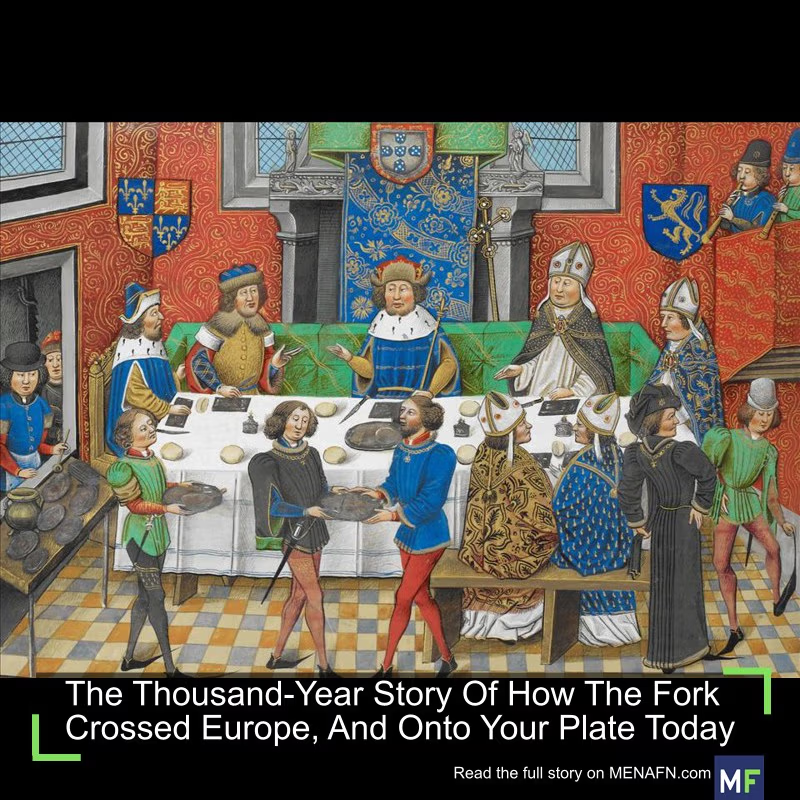
The fork, in its earliest incarnations, was certainly not a welcome guest at the European table. Its origins trace back to the sophisticated Byzantine Empire, where for centuries it had been a common tool among the aristocracy, symbolizing a refined and hygienic approach to dining. It arrived in Europe around the 11th century, often accompanying Byzantine princesses who married into European nobility, bringing with them their advanced courtly customs. But rather than being met with curiosity or open-mindedness, this elegant utensil was greeted with fierce resistance and even outright hostility. To the dominant European establishment, particularly in the more conservative northern kingdoms, it was not merely a foreign affectation; it was seen as a symbol of effeminate weakness and excessive luxury that stood in stark opposition to the robust, “manly,” and seemingly God-given tools of fingers and a knife.
The backlash was pervasive and often rooted in religious doctrine. Church leaders, ever vigilant against perceived moral decay, went so far as to label the fork a diabolical instrument, an affront to a deity who, they argued, had perfectly equipped man with fingers for eating for a reason. Cardinal Peter Damian, a prominent figure of the 11th century, famously condemned a Byzantine princess for her use of “a certain two-pronged implement for eating” during a state visit to Venice, lamenting her “extravagance.” This wasn’t merely about table manners; it was about asserting a particular moral and spiritual order against perceived foreign decadence. It encapsulated a deep-seated suspicion of anything that deviated from established tradition, particularly if it emanated from cultures viewed with a mixture of awe and contempt. The resistance stemmed from a desire to preserve traditional masculine ideals and communal dining practices, which were seen as virtues, in contrast to the perceived self-indulgence and separation implied by a personal utensil.
This is the first, crucial takeaway for understanding modern socio-political dynamics: new things are often seen as an existential threat to identity. The initial resistance to the fork wasn’t primarily about its utility—or lack thereof—in conveying food to mouth. It was fundamentally about culture, identity, and the preservation of established norms. It was an alien technology that challenged centuries of dining custom and, in doing so, was perceived as a direct threat to the moral fabric and social order. Consider how this mirrors contemporary reactions to transformative shifts: the initial fear surrounding the printing press, which was accused of spreading heresy and undermining established religious authority; the moral panic ignited by the advent of novels, radio, cinema, and later television; or, more recently, the anxieties over social media’s impact on public discourse and individual well-being, often framed as a threat to societal cohesion and mental health. Every major technological and social innovation, from genetic engineering to globalized culinary trends, has faced a similar backlash from those who perceive it as a corrupting foreign influence or an assault on traditional values. The underlying fear is often that the “new” will erode what defines “us,” destabilizing the very foundations of society and challenging cherished beliefs about how life ought to be lived, leading to political polarization and culture wars over seemingly mundane shifts.
The Trickle-Down of Taste: Elite Adoption as a Catalyst for Change
So, how did this “diabolical” implement, once so vehemently rejected, manage to not just survive but eventually dominate the Western table? Its victory was not achieved through a popular uprising or a grassroots movement advocating for better hygiene. Instead, the fork’s fortunes turned when it became a powerful symbol of status and refinement, an instrument of elite adoption that slowly but surely shifted cultural perceptions. Its most famous and impactful champion was the Italian noblewoman Catherine de’ Medici, who arrived in the French court in the 16th century to marry the future King Henry II. A product of the sophisticated Florentine Renaissance, Catherine brought with her not only a retinue of chefs and unprecedented culinary practices but also her personal set of forks, introducing them to a French aristocracy largely accustomed to eating with fingers and knives.
For Catherine, the fork was more than just a dining implement; it was a political statement. It was a tangible emblem of the advanced culture and elegant manners of Italy, a subtle yet powerful diplomatic tool used to assert Italian superiority and refinement in a court that, while powerful, was often perceived as less cultivated. For the French aristocracy, gradually exposed to Catherine’s customs, using a fork became a highly visible way to signal refinement, wealth, and a connection to a more “civilized,” modern, and continental world. It was a declaration of being fashion-forward, sophisticated, and superior to the common rabble. Dining with a fork separated the elite from the masses, conferring a veneer of distinction and cultural capital that was highly coveted in the hierarchical societies of early modern Europe. This wasn’t just about avoiding messy fingers; it was about projecting an image of power and prestige, a subtle yet effective form of social engineering at the dinner table, influencing courtly etiquette and solidifying social hierarchies.
Here lies the second crucial lesson in the political economy of change: fundamental shifts are often driven from the top down. What begins as an exclusive practice of the powerful, adopted for reasons of prestige, status, or perceived superiority, eventually trickles down, becoming an aspirational norm for the masses. The fork’s slow, deliberate march across the continent and, eventually, to America, wasn’t a rapid revolution sparked by popular demand. It was a centuries-long process of cultural osmosis, where an object of elite distinction slowly transformed into an article of everyday necessity. The process involved several stages: initial imitation by aspiring gentry, then wider adoption by the burgeoning middle class eager to emulate their social betters, and finally, its mass production and widespread acceptance as an indispensable part of everyday life. This pattern is not unique to table manners; it is observable in countless societal shifts, from fashion trends to technological innovations and even political ideologies. Consider how initially niche luxury goods or specialized technologies (like early automobiles, personal computers, or smartphones) gradually become mainstream, driven first by early adopters among the wealthy, whose choices set new standards of desirability and utility that others eventually aspire to and adopt. This top-down influence highlights the enduring power of aspirational politics, where the choices of the influential dictate the trajectory of broader societal norms.
Even then, the adoption was far from uniform or swift. England, for instance, remained skeptical of the fork for much longer than France or Italy, reflecting its distinct cultural conservatism and emphasis on traditional values. It was often seen as effeminate and pretentious well into the 17th and even 18th centuries, with many gentlemen preferring to carve meat with a knife and eat with their fingers, considering it more masculine and practical. Thomas Coryat, an English traveler who extensively documented Italian life in the early 17th century, marveled at the widespread use of forks in Italy but faced ridicule upon attempting to introduce them to his countrymen, earning him the nickname “Furcifer” (fork-bearer or gallows-bird). This illustrates how ingrained cultural habits and national identities can delay or even reject elite trends for significant periods, demonstrating that even top-down change is not immune to existing social inertia and traditional resistance, especially when deeply tied to national character or perceived moral rectitude. The journey of the fork was a battle for cultural supremacy, fought through subtle shifts in etiquette, fashion, and social aspiration rather than overt political declarations.
Our Modern Forks: Navigating the Future of Culture and Power
What does this ancient story of a humble utensil mean for our complex, rapidly evolving future? It serves as a powerful reminder that the most profound and defining battles of our time are not always fought on a battlefield or in a legislative chamber, nor are they always broadcast with sensational headlines. They are fought in our homes, on our screens, in our workplaces, and yes, at our dinner tables. The fork’s arduous journey from diabolical implement to indispensable tool reveals a fundamental, enduring pattern of human behavior: our deep-seated suspicion of the “other,” whether it be a new technology, a different cultural practice, or an unfamiliar ideology; our simultaneous, often conflicting, desire for status, convenience, and progress; and the incredibly long, often unseen, arc of cultural change. It underscores that what we perceive as “natural” or “normal” is often nothing more than the ossified outcome of past political and cultural struggles, shaped by power, influence, and the relentless march of time, impacting everything from our personal ethics to our collective policies.
Today, we are grappling with our own “forks”—technologies that feel alien, ideas that challenge centuries of tradition, and global connections that relentlessly blur old boundaries and societal structures. Consider the ongoing debates around gene editing, which promises medical miracles but raises profound ethical questions about human nature and identity; the rise of remote work, which challenges traditional office structures, urban planning, and the very concept of community; plant-based meats and lab-grown alternatives, which provoke strong reactions from traditional agriculture and culinary purists, sparking debates over food security and cultural heritage; or the evolving norms of gender identity and expression, which confront established societal binaries and fuel intense political and social friction. Each of these represents a “new fork,” initially met with skepticism, moral panic, or outright rejection from various segments of society, yet each holds the potential to become an unremarkable, integrated part of our future, driven by a combination of elite adoption, perceived utility, economic forces, and gradual cultural acceptance. The political skirmishes over these modern “forks” are not just about policy; they are about competing visions of humanity and progress.
The story of this humble utensil suggests that the things we fiercely resist today, labeling them as fads, threats, or abominations, may well become the unremarkable, indispensable tools, norms, and practices of our descendants tomorrow. The question is not whether change will come—for change is the only constant in the ever-shifting landscape of human civilization—but rather, who will be the pioneers to drive it, who will be the traditionalists to resist it, and what invisible struggles and subtle shifts in power will shape the mundane, everyday world of the future. Understanding the fork’s political history offers us a valuable framework for navigating our present and anticipating our future, reminding us that even the smallest cultural artifacts can contain profound lessons about who we are and where we are heading, as individuals and as a global society.
Read the original story at Menafn.
What “new forks” in our modern society do you believe are currently facing the most significant resistance, and which ones do you predict will eventually become universally accepted?