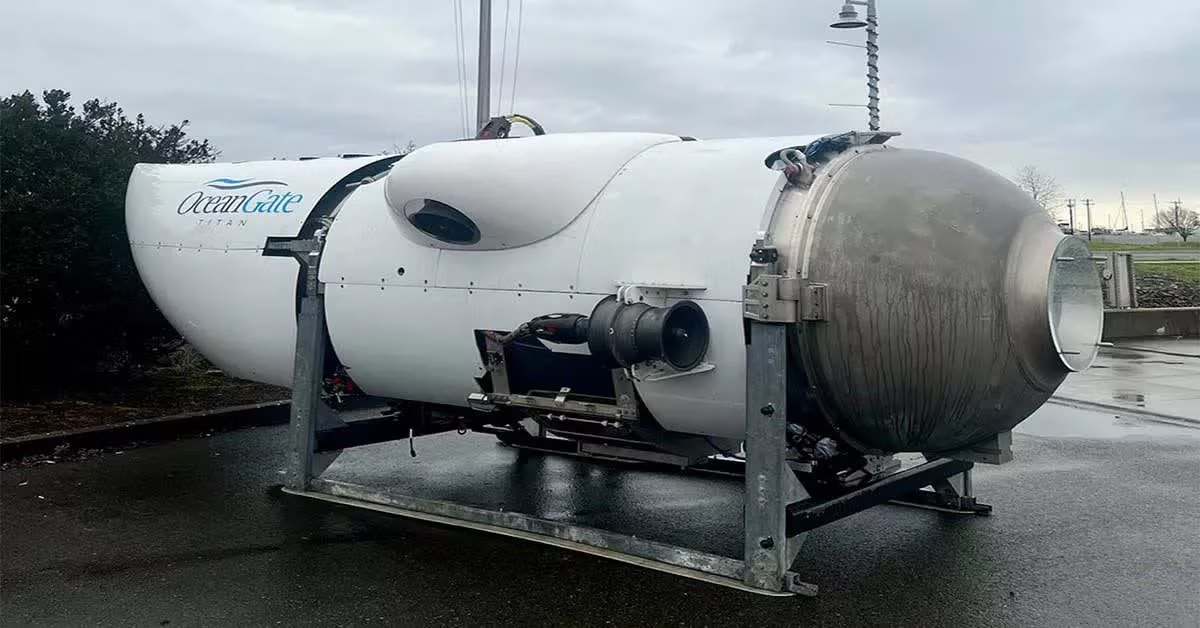
The Silent Witness: What the Titan Sub’s Surviving Camera Tells Us About Tech and Tragedy
The depths of the ocean hold an almost mystical power, a realm of immense pressure, profound mystery, and often, unforgiving danger. For those of us fascinated by technology and its limits, the story of the OceanGate Titan submersible remains a somber chapter, a stark reminder of the extreme environments humanity attempts to conquer. Yet, amidst the wreckage and the tragedy that captivated the world, a recent discovery has emerged that offers a surprising and almost poetic testament to the resilience of our digital age: a camera, reportedly found mostly intact, with its SanDisk SD card potentially still holding images and videos from the ill-fated expedition.
This isn’t just a discovery; it’s a profound, almost paradoxical moment for anyone who marvels at how much our technology can endure. Think about the stark contrast: a highly specialized submersible, designed and built to withstand crushing pressures unfathomable to most, ultimately succumbed to those very forces, imploding catastrophically in milliseconds. Yet, a relatively common piece of consumer electronics—a camera and its tiny memory card—surfaced from the abyss, having potentially survived the very same forces that annihilated its host vessel. This unexpected survival pushes the boundaries of our understanding of material science and data integrity in extreme conditions.

The Unyielding Data Stream: A Testament to Digital Resilience
The fact that a SanDisk SD card, a component we often take for granted in our phones, cameras, and drones, could endure such an event is nothing short of astounding. While the world eagerly awaits confirmation on the recoverability of its contents, the mere possibility speaks volumes about modern engineering. It highlights the incredible design and manufacturing processes that go into these minute storage devices, engineered not just for vast capacity and blazing speed, but for surprising physical durability. Inside these tiny rectangles, layers of flash memory chips are protected by robust encapsulation, often designed to resist not just minor impacts and water splashes, but also significant temperature fluctuations and static electricity. This inherent robustness, born from the demands of everyday consumer use and mass production, inadvertently equipped these devices for an environment far beyond their intended scope.
In an era where data is increasingly king, valued as much as or even more than physical assets, this serves as a powerful reminder that our information, when stored correctly on well-engineered media, can often outlast the hardware around it, even in the face of unimaginable destruction. The resilience of NAND flash technology, coupled with the protective casings of modern SD cards, creates a surprisingly robust digital archive. This incident underlines that while the physical vessel may fail catastrophically, the digital memory within could offer a lifeline of information, proving that data integrity is not just a luxury, but a critical component of technological design and disaster recovery planning across all sectors, especially in high-risk ventures.
Future Forensics and Extreme Environment Engineering: Lessons from the Abyss
What does this unprecedented discovery mean for the future of deep-sea exploration, forensic analysis, and extreme environment engineering? Plenty, and the implications are far-reaching across multiple scientific and technological domains.
Deep-Sea Forensics and Accident Investigation: A New Paradigm
Firstly, for deep-sea forensics and accident investigation, this discovery is nothing short of a game-changer. The potential for recovering high-quality visual data, directly from inside a vessel during its final moments, could offer invaluable and unprecedented insights into the precise sequence of events leading to the Titan’s implosion. Traditional investigations often rely on wreckage analysis, sonar imagery, submersible observations, and telemetry data (if recoverable). However, these methods provide fragmented pieces of a puzzle, often leaving critical questions unanswered about the immediate internal environment, crew reactions, or the exact point of structural failure.
Imagine being able to piece together a narrative not just from twisted metal and acoustic signatures, but from actual footage—a silent, digital witness to the unfolding disaster. Such information could be critical in understanding the precise environmental conditions, identifying any potential overlooked structural flaws in the Titan’s design, documenting operational procedures, or even revealing human factors that may have contributed to the tragedy. This capability moves beyond the traditional “black box” flight recorder concept, demonstrating that even consumer-grade technology can serve as an unexpected and powerful forensic tool, fundamentally changing how we approach accident reconstruction in the most challenging environments on Earth. The visual data could provide undeniable evidence that no amount of theoretical modeling or wreckage examination could ever fully replicate, paving the way for safer future designs and protocols in deep-sea technology.
Extreme Environment Engineering Challenges: Rethinking Robustness
Secondly, the camera’s survival presents fascinating and challenging questions for extreme environment engineering. If relatively off-the-shelf (or near-off-the-shelf) components, designed for terrestrial use, can survive pressures that obliterate purpose-built deep-sea vessels, does it challenge our fundamental assumptions about what truly needs to be “hardened” in bespoke designs for hostile environments? While the Titan itself failed, the camera’s survival might point towards specific material sciences, manufacturing techniques, or design philosophies inherent in certain consumer electronics that could be leveraged, adapted, or even simply better understood for future deep-sea, space, or other extreme-condition exploration vehicles.
This incident encourages engineers to delve deeper into the often-underestimated robustness of modern electronics. Perhaps the specific plastics, epoxies, or metals used in the camera’s casing and the SD card’s construction possess an intrinsic resistance to compression that was never explicitly designed for, but proved effective under unimaginable stress. It suggests that miniaturization and the dense packing of components, alongside advanced encapsulation techniques, might inadvertently contribute to structural integrity under immense external pressure, making these devices tiny, unexpected pressure vessels. This is a compelling case study on how unexpected performance from a seemingly common device can provide revolutionary insights, potentially leading to more resilient designs, optimized material selection, and more cost-effective solutions for future generations of exploration technology, from submersibles exploring ocean trenches to rovers venturing into the extreme cold of lunar poles or the corrosive atmospheres of other planets. It forces us to reconsider the fundamental principles of “hardening” components and to explore the latent strengths within everyday technologies.
The Human Element and Digital Legacies: A Poignant Glimpse
Beyond the purely technical marvels and engineering implications, there’s a deeply human and profoundly poignant aspect to this discovery. The possibility of recovering images or videos from the Titan’s final voyage offers an unparalleled, if somber, glimpse into the aspirations, experiences, and final moments of those aboard. It reminds us that our digital creations—photos, videos, personal messages—are not just transient files or ephemeral data points, but potential historical records, capable of carrying narratives, emotions, and legacies far beyond their immediate creation. These digital artifacts can become powerful windows into the past, preserving memories and offering closure in the face of unimaginable loss.
In a world increasingly saturated with digital content, where billions of images and videos are uploaded daily, this incident underscores the profound significance and enduring power of the data we generate, even in the most tragic circumstances. These potential images represent more than just data; they are a direct link to the human spirit of exploration, the courage of the passengers, and their ultimate sacrifice. They could offer families a final, intimate connection to their loved ones’ last journey, providing a narrative that words alone cannot convey, a silent farewell from the deep. It’s a testament to the fact that technology, even in its most mundane forms, can serve as a profound keeper of human history and personal memory, transcending the destructive forces of nature to deliver a silent, enduring message from the deep, reminding us of the profound value of digital legacies.
The discovery of the Titan sub’s surviving camera and SD card isn’t just a quirky news item or a fleeting moment of technical intrigue. It’s a powerful testament to the unexpected resilience of everyday technology, a potential goldmine for future investigations into extreme failures, and a thought-provoking prompt for engineers designing the next generation of extreme-environment vehicles. It’s a profound reminder that even when the grandest designs fail and ambitions are tragically cut short, the smallest components can sometimes tell the most enduring and vital stories.
Read the original story at TechSpot.
What are your thoughts on the unexpected durability of consumer electronics in extreme conditions, and how might this discovery reshape our approach to deep-sea or space exploration technology?