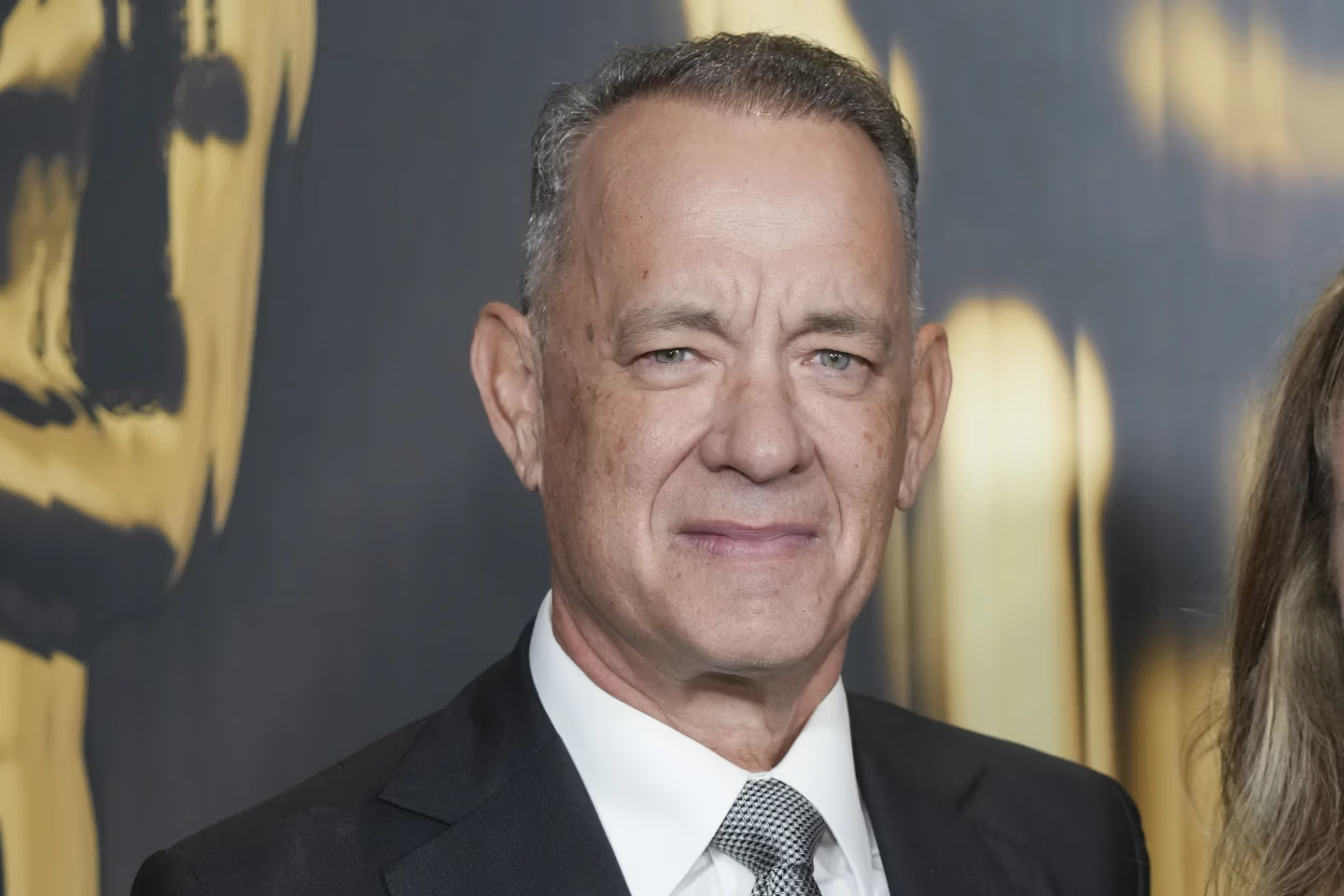
In an age increasingly defined by rapid technological shifts and ever-accelerating information cycles, it’s easy to focus on the next big AI breakthrough or the latest social media trend. But sometimes, a seemingly small news item, far removed from the tech world, offers a profoundly insightful glimpse into the underlying dynamics shaping our society. The recent decision by the West Point Association of Graduates (WPAOG) to cancel an award ceremony honoring Tom Hanks is precisely one such moment, a stark indicator of how deeply political polarization has permeated even the most traditionally unifying institutions and figures.
For those unfamiliar, the WPAOG had intended to bestow the prestigious Thayer Award upon Tom Hanks, an actor widely celebrated for roles embodying American ideals of heroism and steadfastness. The Thayer Award itself is given to a U.S. citizen whose service and accomplishments exemplify West Point’s motto: “Duty, Honor, Country.” Previous recipients are a veritable who’s who of American leadership, from Dwight D. Eisenhower to Condoleezza Rice.

Yet, this honor was abruptly withdrawn. The reason? Intense backlash from a segment of alumni and the public, fueled by Tom Hanks’s perceived political leanings and past support for figures like President Biden. The cancellation, notably, was then celebrated by former President Donald Trump. The WPAOG, in their explanation, cited a need to “remain apolitical” and avoid “distraction,” essentially confirming that the very act of recognizing a broadly respected figure had become a political hot potato.
This isn’t just a story about an award or an actor; it’s a symptom of a larger, more concerning trend.
The Erosion of Common Ground
Tom Hanks, for many, represents a rare breed of public figure: widely beloved, seemingly non-controversial, and a symbol of American decency. If even he can be deemed too politically divisive to receive an award rooted in the universally acclaimed values of “Duty, Honor, Country,” what does that say about our collective ability to find common ground? It suggests that our societal fabric is so frayed that even shared admiration and foundational civic principles are now subject to partisan scrutiny.
The Expanding Reach of “Culture Wars”
The incident underscores how the “culture war” has metastasized beyond traditional battlegrounds. It’s no longer confined to debates over specific policies or social issues. It now infiltrates institutions that traditionally stood above the fray – military academies, charitable organizations, and even the very concept of civic honor. Everything becomes politicized, and neutrality, or even widespread appeal, is increasingly difficult to maintain.
Institutional Vulnerability in the Digital Age
The pressure leading to the cancellation likely didn’t materialize in a vacuum. Online discourse, social media echo chambers, and organized campaigns can rapidly amplify dissent and apply immense pressure on organizations. For institutions like the WPAOG, built on tradition and a mission to unite, navigating this hyper-partisan, digitally-charged environment presents a unique challenge. Do they succumb to the loudest voices, or stand firm on their principles? The implications of either choice are significant for their long-term integrity and public perception.
The Weaponization of “Cancel Culture”
While “cancel culture” is often associated with the left, this incident demonstrates its evolving and increasingly bipartisan application. Here, the “cancellation” was instigated by a conservative segment, illustrating that the tactic of applying public pressure to de-platform or de-recognize individuals due to their perceived ideological alignment is now a tool wielded across the political spectrum. It’s less about moral failings and more about political purity.
What This Means for the Future
This episode serves as a powerful cautionary tale. In a world craving unity and shared purpose, our capacity to celebrate common heroes and uphold shared values is diminishing. It highlights a critical challenge for leaders and institutions across all sectors, including technology: how do we foster environments where diverse viewpoints can coexist without resorting to the wholesale rejection of those who don’t perfectly align with our own? How do we build platforms and communities that encourage dialogue rather than deeper divisions?
The ability to look beyond immediate political differences and recognize outstanding contributions to society is essential for a healthy democracy. When that capacity erodes, when even “Duty, Honor, Country” becomes a battle cry rather than a unifying ideal, we lose more than just an award ceremony – we lose a piece of our collective identity.
Read the original story at Mark Anderson Updated 7:21 PM PST, February 2, 2024 Updated 7:21 Pm.
What are your thoughts on this incident? Do you believe institutions can truly remain apolitical in today’s polarized environment?