The Trump Doctrine, Revisited: A Combative Blueprint for a Post-Globalist Future
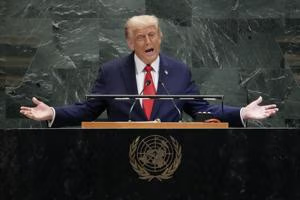
The podium at the United Nations General Assembly is traditionally a stage for carefully calibrated diplomacy, a place where world leaders typically speak in measured tones about shared challenges and collective aspirations. However, when Donald Trump returned to that global stage, he brought not a diplomatic statement, but a resounding declaration of intent—a fiery, unfiltered, and deeply combative preview of the foreign policy that would undoubtedly define a potential second term in office. This was far from a nostalgic reflection on his past presidency; it was an unequivocal blueprint for an “America First” doctrine, now amplified, entrenched, and utterly unchastened by past criticisms or geopolitical shifts. For anyone across the globe wondering what a Trump restoration might truly mean for the existing international order, his address served as an unambiguous, potent warning shot. It signaled a profound recalibration of America’s role, challenging decades of conventional diplomatic engagement and multilateral cooperation.
The implications of his message extend far beyond mere rhetoric. It foreshadows a United States that is prepared to fundamentally reshape its engagement with the world, prioritizing national interests above all else and casting a skeptical eye on the very institutions designed to foster global stability. This renewed articulation of his foreign policy vision is not just a political stance; it is a philosophical challenge to the foundational principles that have guided international relations since the end of World War II. It demands that world leaders, diplomats, and international organizations alike critically re-evaluate their strategies and prepare for a potentially seismic shift in global dynamics.

The Core Conflict: Patriots vs. Globalists
At the very heart of Trump’s address, and indeed his enduring worldview, was a familiar but increasingly potent ideological battle: the sovereign nation-state pitted against what he frequently terms the “unelected, unaccountable, global bureaucracy.” He drew a stark, uncompromising line in the sand, echoing a sentiment he has long championed with unwavering conviction: “The future does not belong to globalists. The future belongs to patriots.” This declaration is more than a slogan; it is the central organizing principle of his entire foreign policy framework. It frames traditional international cooperation not as a necessary tool for tackling complex, interconnected global issues like climate change, devastating pandemics, or economic instability, but rather as an insidious threat to national sovereignty, cultural identity, and domestic decision-making.
For Trump, venerable institutions like the United Nations, the World Health Organization, or even the World Trade Organization aren’t perceived as vital forums for collective progress and shared solutions; instead, they are often characterized as impediments to the national will, siphoning off resources and diluting the unique interests of individual nations. This framing strongly suggests a future where the United States would likely withdraw even further from multilateral international agreements, disengage from various international bodies, and perhaps even challenge the legitimacy of others. The preference would clearly shift towards a transactional model of foreign relations, prioritizing direct bilateral deals and ad-hoc agreements tailored purely to American self-interest, rather than engaging in the often cumbersome but consensus-building processes of collective action. Such an approach would inevitably lead to a more fragmented global landscape, where the traditional mechanisms for resolving disputes and coordinating responses to shared crises would be significantly weakened, if not entirely bypassed. This nationalist resurgence, with its emphasis on strong borders and unbridled national prerogative, represents a direct challenge to the interconnected, interdependent vision of global governance that has gradually taken shape over the last seventy-five years.
The philosophical underpinnings of this “patriot vs. globalist” dichotomy run deep, tapping into anxieties about economic displacement, cultural erosion, and a perceived loss of control in an increasingly globalized world. By championing the “patriot,” Trump positions himself as the ultimate defender of national identity and the champion of the common citizen against what he portrays as an amorphous, unaccountable global elite. This narrative resonates powerfully with a specific segment of the electorate, both domestically and abroad, who feel left behind by the forces of globalization. The real-world implications of this stance are vast and complex. A U.S. foreign policy guided by such principles would not only challenge the efficacy of existing international organizations but could also inspire a cascade of similar nationalist movements globally, further complicating efforts to address universal challenges that inherently require cross-border cooperation. The very concept of shared responsibility and universal human rights could find itself under renewed scrutiny, as national sovereignty becomes the paramount concern.
The Transatlantic Ultimatum
Nowhere was this deeply transactional and challenging approach to international relations clearer, or potentially more impactful, than in his broadside against America’s long-standing European allies. Revisiting a core grievance that defined much of his first presidency, Trump forcefully called out numerous NATO members for consistently failing to meet the defense spending target of 2% of their GDP – a benchmark agreed upon by all alliance members. He portrayed the United States not as the unwavering anchor of a shared security alliance, forged in the crucible of post-World War II global order, but rather as an over-burdened patron, underwriting the defense of wealthy nations who, in his view, refuse to pay their fair share. This narrative casts doubt on the very notion of collective security, reframing it as an unfair financial burden on American taxpayers.
The implication of this renewed emphasis for the future of the North Atlantic Treaty Organization is profound and potentially destabilizing. This isn’t merely about budgetary squabbles or an audit of defense expenditures; it represents a fundamental challenge to the 75-year-old transatlantic security pact, a cornerstone of Western stability. A second Trump term would likely see the United States treat NATO less as a sacred, inviolable commitment rooted in shared values and mutual defense, and more as a conditional arrangement, subject to renegotiation and dependent on strict financial adherence. Allies would be judged not primarily by their strategic importance, their commitment to democratic principles, or their shared history, but predominantly by their financial contributions to the alliance’s collective defense. This tectonic shift could have catastrophic consequences, destabilizing European security at a time of heightened geopolitical tensions, particularly with an emboldened and aggressive Russia. It could force European nations to rapidly re-evaluate their defense postures, potentially leading to a fragmentation of security policies or a hurried search for alternative arrangements, all while undermining the unified front that has historically deterred adversaries.
The prospect of a weakened or conditional NATO sends a clear message to adversaries that the alliance’s resolve might be fractured. For decades, the collective security guarantee enshrined in Article 5 has been the ultimate deterrent against aggression, ensuring that an attack on one member is considered an attack on all. If this commitment becomes transactional, based on budgetary performance rather than strategic imperative, it could invite adventurism from powers keen to exploit divisions within the alliance. Furthermore, the constant public criticism of allies and the questioning of the alliance’s foundational principles could erode trust and solidarity, which are crucial for effective deterrence and coordinated responses to crises. European leaders would face immense pressure to either comply with Trump’s demands or seek greater strategic autonomy, potentially leading to increased defense spending and closer military cooperation among European nations, possibly even pursuing their own nuclear deterrents, radically altering the global strategic landscape.
What This Means for Tomorrow
Trump’s UN appearance was undeniably more than just a typical speech; it strategically functioned as a campaign rally on the world stage, meticulously crafted to serve a dual purpose. Domestically, it aimed to energize his base by casting him as the sole, uncompromising defender of American interests against a nebulous, corrupt global elite, further cementing his image as an anti-establishment outsider. Internationally, it served as an explicit notice to the world that the era of predictable American leadership, characterized by multilateral engagement and a commitment to established alliances, is unequivocally on the ballot. This message was not subtle; it was a blunt assertion of a radically different approach to global affairs.
Should Donald Trump return to the White House, the world can anticipate a foreign policy driven by a deep, almost ingrained skepticism of traditional alliances and a fervent, unwavering belief in nationalistic self-interest as the primary, if not sole, guiding principle. The post-World War II international order, meticulously constructed over decades and already strained by myriad contemporary crises ranging from climate change to persistent regional conflicts, would face its most direct and fundamental challenge from its primary architect. This would entail not just a withdrawal from certain agreements, but a potentially systemic dismantling of the structures and norms that have underpinned global stability for generations. The implications would resonate far beyond NATO or the UN, affecting trade relations, climate diplomacy, human rights advocacy, and approaches to global health crises.
Leaders in Brussels, Beijing, Tokyo, and beyond are now left to ponder not merely if he means what he says, but, more critically, how they will respond and adapt when he once again possesses the power to act on these profoundly disruptive intentions. The message from New York was undeniably clear, delivered with characteristic Trumpian bluntness: the world that existed before Donald Trump, with its assumptions of American leadership and multilateral cooperation, may not be the world that follows him into a second term. Nations would need to strategize for a potential future where the U.S. is a less reliable partner, a more transactional actor, and a potent disruptor of the established international system. This requires profound contingency planning, a rethinking of global alliances, and a fresh assessment of national interests in a potentially more volatile and less predictable global environment.
How do you believe world leaders should prepare for a potential second Trump term and its stated “America First” foreign policy, especially concerning established alliances and global cooperation?
Read the original story at Postguam.
How do you believe world leaders should prepare for a potential second Trump term and its stated “America First” foreign policy, especially concerning established alliances and global cooperation?