Trump’s ‘Going to Hell’ Prophecy for Europe Offers a Stark Preview of His Worldview
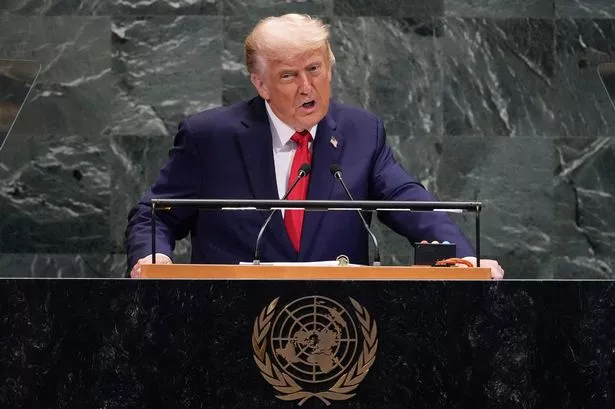
In the fiery crucible of a campaign rally, a political speech can be more than just rhetoric; it can be a mission statement. For Donald Trump, his recent blistering attack on the United Nations and his stark warning to European allies—”Your countries are going to hell”—is a scorched-earth preview of a potential second term, one that promises to dismantle, not just disrupt, the post-war global order. This isn’t merely political hyperbole; it’s a window into a consistent and deeply held worldview that sees traditional international frameworks as impediments rather than pillars of stability.
This was not the nuanced language of diplomacy, typically crafted to soothe tensions and build consensus among partners. Instead, it was the apocalyptic framing of a leader who views the world not through the lens of shared values and collective security, but as a zero-sum battle for national survival where every nation is primarily an economic or security competitor. The former president’s pronouncements reveal a profound skepticism, if not outright disdain, for the multilateral institutions and intricate alliances that have defined international relations since World War II, signaling an intent to dramatically recalibrate America’s place on the global stage and fundamentally redefine its relationships with its oldest allies.

The core of Trump’s tirade, aimed squarely at Europe, centered on his signature issue: immigration. By declaring that migration is “destroying” the continent and linking it directly to crime and internal instability, Trump is globalizing his domestic playbook. He is signaling that an “America First” doctrine would not only govern trade and security policies but would also extend to serving as a moral and operational judgment on the internal, sovereign policies of America’s closest and most steadfast allies. This approach goes far beyond traditional diplomatic pressure, veering into an ideological condemnation that fundamentally challenges the premise of sovereign nationhood within an alliance framework.
Trump’s Zero-Sum Worldview: Immigration as a Global Battleground
Delving deeper into Trump’s pronouncements, the concept of a “zero-sum battle for national survival” becomes abundantly clear. In this framework, one nation’s gain is perceived as another’s loss, and international cooperation is often viewed with suspicion, as potentially compromising national sovereignty or economic interests. When applied to immigration, this perspective frames any influx of migrants as an existential threat, rather than a complex social, economic, or humanitarian challenge that could be managed through international cooperation or compassionate policies. His rhetoric suggests that Europe’s embrace of more open immigration policies, or even its struggle to manage massive migration flows, is a sign of inherent weakness and self-destruction, rather than a reflection of democratic values or complex geopolitical realities.
His domestic playbook, honed over years of political campaigning and policy implementation, relies heavily on linking immigration to societal decline, increased criminality, and cultural erosion—a narrative often disputed by empirical data but potent in political discourse. Transferring this narrative onto the international stage, particularly to advanced democratic nations in Europe, suggests a profound lack of empathy for their unique historical contexts, demographic challenges, and ongoing efforts to integrate new populations. It positions the United States not as a supportive ally in addressing these complex issues, but as a severe critic, ready to withdraw its partnership if its allies do not conform to a singular, hardline vision of border control and national identity. This effectively weaponizes immigration policy, transforming it from a domestic concern into a condition of international alliance and even a moral litmus test for partnership.
Shattering the Foundation: Conditional Alliances and the Rejection of Globalism
The key takeaway from this rhetoric is the profound shift in what a U.S. president might demand of the international community. For decades, the transatlantic alliance, alongside other key global partnerships, was built on a foundation of mutual respect for sovereign domestic policy. While allies might offer counsel or express concerns through diplomatic channels, direct condemnation of internal governance as a condition for partnership was largely unheard of, particularly from a nation historically championing democratic self-determination and the principle of non-interference. Trump’s comments shatter that foundation, suggesting a future where American partnership is explicitly conditional on other nations adopting policies he personally endorses, particularly those related to immigration, trade, and national security.
His lament that the U.S. is “not going to be a stupid country anymore” is a clear, echoing reference to his first-term withdrawals from international agreements and bodies that he deemed detrimental to American interests or sovereignty. This includes landmark decisions like the withdrawal from the Paris Climate Accord, which he argued placed an unfair economic burden on the U.S. while doing little to curb global emissions effectively. Similarly, his funding threats to the World Health Organization during the COVID-19 pandemic were framed as a necessary correction against an inefficient and potentially biased international body, despite the critical need for global health cooperation during a pandemic. These were not isolated actions, but part of a consistent pattern of disengagement from multilateral frameworks.
Other significant withdrawals, such as from the Iran Nuclear Deal (JCPOA), which aimed to curb Iran’s nuclear ambitions, and the Trans-Pacific Partnership (TPP) trade agreement, further underscore this ideological commitment. In each instance, Trump’s administration articulated a belief that these agreements either disadvantaged the United States, infringed upon its sovereignty, or failed to adequately protect its national interests. This latest outburst suggests he sees those actions not as mere corrections to flawed agreements, but as the opening salvos in a much larger ideological war against what he defines as “globalism” itself—an often-pejorative term used to describe interconnectedness, multilateral institutions, and transnational agreements that, in his view, dilute national power, erode cultural distinctiveness, and benefit other nations at America’s expense. His vision paints a future where adherence to American policy preferences becomes the ultimate litmus test for international friendship, fundamentally altering the nature of alliances.
A Dire Warning to Europe: Unraveling Multilateral Cooperation
Looking ahead, this rhetoric serves as a direct and unambiguous warning to leaders in Brussels (the administrative capital of the European Union), Berlin (Germany, Europe’s economic powerhouse), and Paris (France, a key diplomatic and military player)—the heartbeats of European cooperation and major players in the transatlantic relationship. A second Trump presidency would likely see an accelerated and more aggressive effort to unravel the very fabric of multilateral cooperation that has underpinned European stability and global peace for decades. While his first term was characterized by challenging institutions like NATO, demanding increased financial contributions from member states, and questioning the alliance’s fundamental relevance, his current language suggests a more profound contempt for the alliances themselves, rather than just their operational efficiency or cost-sharing mechanisms.
The implications for NATO are particularly stark. Should Trump escalate his criticisms beyond financial demands to questioning Article 5—the cornerstone of collective defense, which states an attack on one is an attack on all—the very credibility and deterrence capability of the alliance would be severely undermined. For the European Union, an institution Trump has previously shown little affinity for, even cheering Brexit, a second term could mean a continued preference for bilateral dealings over engaging with the EU as a bloc. This approach would further strain transatlantic ties, potentially empowering anti-EU forces within member states and undermining European unity. The United Nations, too, would likely face sustained pressure, defunding threats, and a diminished U.S. role, impacting its ability to address global challenges from humanitarian crises and climate change to peacekeeping missions and international justice.
Perhaps most chilling is the contrast between his open condemnation of democratic Europe and his casual boasts of strong relationships with autocrats like Vladimir Putin of Russia and Kim Jong Un of North Korea. Delivered in the same breath, this juxtaposition paints a picture of a world order turned on its head—where loyalty among democratic allies is questioned, and adversaries are openly courted or even praised. This shift would not only embolden authoritarian regimes by weakening the united front of democracies but also introduce an unprecedented level of uncertainty into global diplomacy. It fundamentally redefines who America considers a friend and who it considers a foe, based less on shared democratic values and more on transactional interests or perceived personal deference, creating a highly unpredictable and potentially volatile international landscape.
The Future of Global Stability: A Chilling Reminder
Ultimately, Trump’s speech wasn’t just a rant against the UN or a passing critique of European policies; it was a clear and forceful articulation of his foreign policy vision. It’s a world where alliances are transactional, international bodies are treated as obstacles to national sovereignty rather than facilitators of global solutions, and allied nations are judged by a single, unforgiving metric: their adherence to an “America First” ideology, especially on issues like immigration and economic policy. This vision fundamentally redefines the parameters of international engagement, moving away from shared ideals, collective security, and democratic solidarity towards a more isolationist, unilateral, and transactional approach.
This worldview carries significant risks for global stability. It could lead to a fragmentation of long-standing alliances, a weakening of international law and norms, and a scramble for power among nations as the traditional American stabilizing influence potentially wanes or becomes unreliable. For Europe, it suggests a future where they might be forced to forge greater independent security and economic strategies, potentially leading to a more multipolar world with less predictable outcomes and increased regional tensions. As the world watches the U.S. election unfold, this moment serves as a chilling reminder that the future of global stability may hinge not on conventional diplomatic strategies or a continued commitment to the post-war order, but on a worldview that sees traditional allies not as partners in a common endeavor, but as cautionary tales on the road to ruin, deserving of scorn rather than collaboration and mutual respect.
Read the original story at Mirror.
What are your thoughts on Trump’s “going to hell” prophecy for Europe, and how do you believe such rhetoric might reshape international alliances and global stability in the coming years?