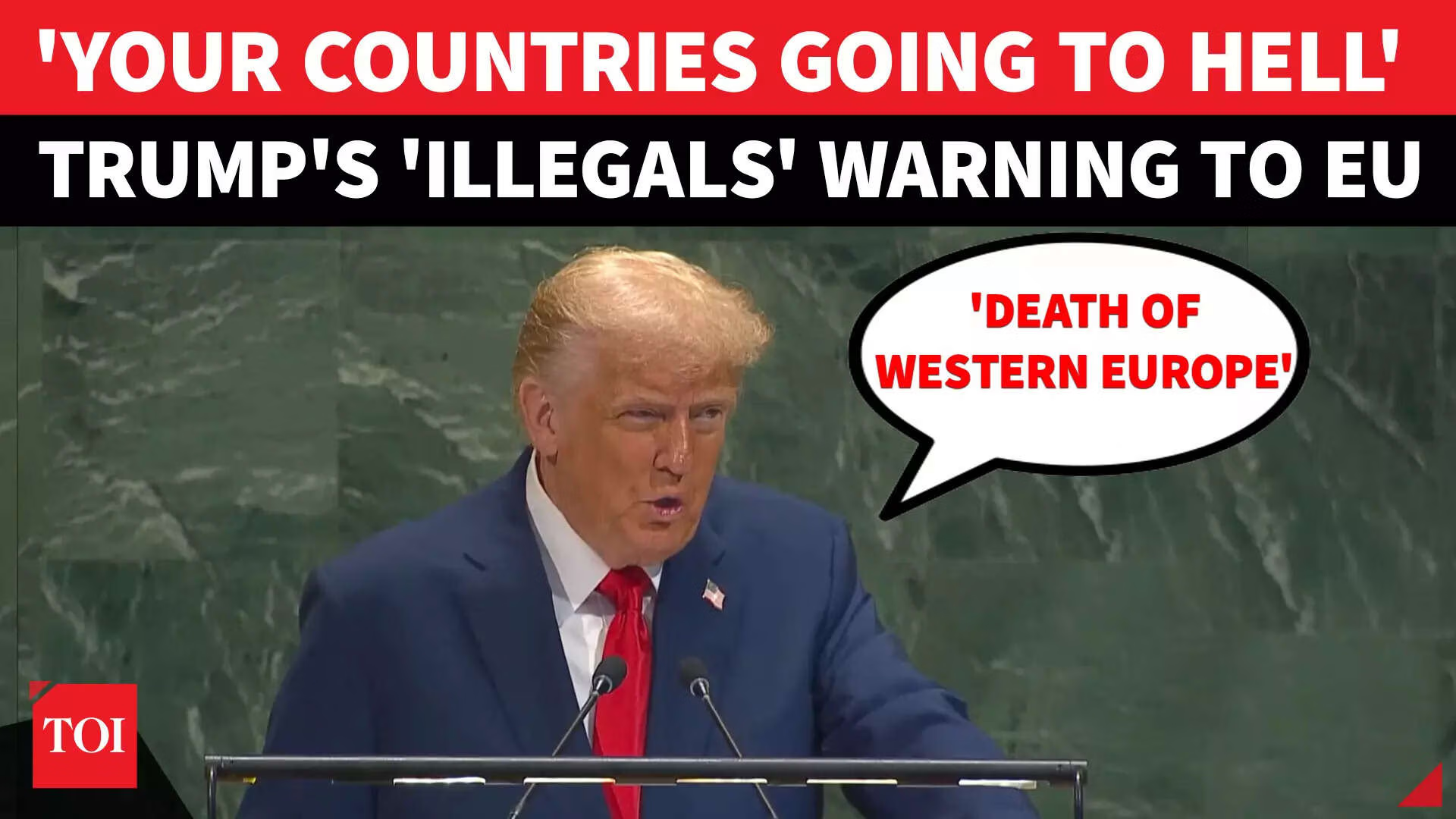
Trump’s Grim Prophecy: Unpacking the Strategy Behind His Warning to Europe
Former President Donald Trump, in a rhetorical surge reminiscent of his 2016 campaign, has once again directed a stark, apocalyptic warning towards Western Europe. His declaration that the continent’s approach to immigration is a form of “suicide” is not merely a fleeting critique. It represents a deeply calculated message, revealing the foundational elements of his core worldview and offering an unambiguous preview of his potential foreign policy trajectory should he reclaim the White House. This uncompromising stance on a pivotal global issue underscores a broader strategic communication aimed at both his domestic base and the international community, signaling profound shifts in transatlantic relations.
Trump’s pronouncements often strip complex international challenges down to their rawest, most emotionally charged elements. By framing Europe’s migration policies not as a multifaceted political or humanitarian endeavor, but as inherently “suicidal ideas,” he masterfully bypasses any nuanced discussion. He sidesteps intricate debates surrounding economic integration, humanitarian responsibilities, demographic shifts, or the historical context of global migration. Instead, he casts the issue in dramatic, life-or-death terms, deploying language designed to evoke visceral reactions rather than reasoned discourse. This tactic is vintage Trump: a complicated international dynamic simplified into a powerful, emotionally resonant narrative of impending civilizational collapse, appealing directly to anxieties about national identity and security.

The strategic brilliance of this rhetoric lies in its dual targeting. Domestically, it energizes his base, who perceive his bluntness as a refreshing and necessary truth-telling, a courageous stand against perceived globalist elites and political correctness. For these supporters, Trump articulates their own anxieties about border integrity and cultural change. Internationally, it sends an unmistakable signal to global leaders: a second Trump administration would not only deviate from traditional transatlantic cooperation but would actively challenge and potentially dismantle existing multilateral frameworks. This message is designed to position America, under his leadership, as the unequivocal antithesis to what he portrays as European weakness, naivety, and a willingness to compromise national sovereignty. It draws a clear line in the sand, contrasting his hardline, “America First” stance on border security with a continent he views as willingly eroding its own cultural fabric and security apparatus.
The “America First” Doctrine and its Transatlantic Implications
Trump’s “America First” doctrine, a cornerstone of his political identity, extends far beyond trade disputes and burden-sharing within NATO. It fundamentally redefines the parameters of international engagement, prioritizing national interests, as he perceives them, above multilateral obligations or long-standing alliances. His criticisms of Europe’s immigration policies are not isolated incidents but rather extensions of this doctrine. He views robust border control and cultural preservation as non-negotiable pillars of national strength, an ideology he believes Europe has tragically abandoned. This perspective positions the United States not as a partner in solving global challenges, but as a watchful, often critical, observer, prepared to act unilaterally when its perceived interests are at stake. The implications for transatlantic relations, which have historically been robust and collaborative, are therefore profound, suggesting a future where shared values are overshadowed by divergent national priorities.
Historical Context and Europe’s Migration Realities
To fully grasp the impact of Trump’s rhetoric, it’s essential to consider the multifaceted reality of migration in Europe. The continent has a long and complex history of receiving migrants, both from former colonies and as a result of global conflicts, economic disparities, and demographic needs. Post-World War II, guest worker programs fueled economic reconstruction, and in more recent decades, conflicts in the Middle East and Africa have led to significant refugee flows. European nations have grappled with the twin challenges of integrating newcomers while preserving social cohesion. Policies range from strict border enforcement in some countries to more liberal asylum systems in others. Debates over integration, unemployment, housing, social services, and the rise of parallel societies are real and complex, often dominating national political discourse. Trump’s “suicide” narrative, however, deliberately ignores these complexities, opting for a simplistic, fear-driven diagnosis that resonates with a segment of the population struggling with these very issues.
A Blueprint for a Second Term: Deepening Rifts and Shifting Alliances
Looking forward, these comments serve as more than just campaign rhetoric; they offer a precise blueprint for a potential second Trump term’s foreign policy. Should he be re-elected, it is highly improbable that his administration would engage in collaborative, multilateral solutions to global migration challenges alongside European partners. Instead, his rhetoric strongly suggests he would weaponize Europe’s perceived struggles as a cautionary tale, using them to justify and reinforce even more stringent isolationist and nationalist policies within the United States. This could manifest in heightened border security measures, reduced humanitarian aid, and a decreased willingness to participate in international refugee agreements. Such an approach would inevitably deepen the existing rift between the United States and its historic European allies, straining institutions like NATO and potentially leading to a fragmentation of Western solidarity on critical global issues, from climate change to security threats.
Amplifying Global Nationalist Sentiment
Beyond the direct impact on U.S.-E.U. relations, Trump’s words also provide a powerful, high-profile endorsement to right-wing populist movements across Europe. Parties such as Marine Le Pen’s National Rally in France, Geert Wilders’ Party for Freedom in the Netherlands, or Viktor Orbán’s Fidesz in Hungary frequently employ identical or strikingly similar language to warn of cultural decay, unchecked immigration, and the erosion of national identity. By echoing these sentiments on a global stage, Trump is not merely speaking to an American audience; he is actively amplifying and legitimizing a global nationalist sentiment. He provides a symbolic, and potentially practical, boost to these movements, creating a transnational network of like-minded political actors who champion similar ideologies of national sovereignty, cultural preservation, and strict border control. This dynamic could further destabilize the European political landscape, empowering factions that seek to dismantle the European Union from within.
Economic and Social Dimensions of Europe’s Migration Debates
While Trump’s rhetoric focuses on the existential threat of “suicide,” the reality of European migration encompasses significant economic and social dimensions. Many European nations face aging populations and declining birth rates, leading to labor shortages in critical sectors. Migrants often fill these gaps, contributing to the workforce and tax base. However, challenges persist regarding skills recognition, unemployment rates among migrant populations, and the strain on public services in areas with high concentrations of newcomers. Socially, the integration process is uneven, with successes in cultural exchange and diversity alongside difficulties in community cohesion and identity formation. These complexities are often overlooked by the broad-brush, alarmist narratives, both from Trump and certain European populist leaders, who prefer to highlight the perceived negatives without acknowledging the potential benefits or the multifaceted nature of the issue.
The Domestic Political Calculation: Resonating with the Base
It is crucial to understand that Trump’s dire prophecy for Europe is less about the continent itself and more about his own unwavering political ideology and his domestic political strategy. These pronouncements serve as a powerful signal to his voter base in the United States, reinforcing his image as a strong leader unafraid to speak “uncomfortable truths” and challenge the globalist establishment. For many American voters, particularly those who feel economically left behind or culturally disenfranchised, Trump’s focus on border security and national identity resonates deeply. His critique of Europe functions as a cautionary tale: “Don’t let America become like Europe.” This narrative solidifies his credentials as the only candidate capable of safeguarding American sovereignty and culture, framing the upcoming U.S. election not just as a choice of president, but as a fundamental verdict on this very vision for America’s place on the world stage – a vision built on national self-interest, cultural preservation, and robust, often militarized, border control as the only viable paths to survival in an increasingly turbulent world.
Navigating a Potential Second Term: European Responses and Strategic Autonomy
European leaders and institutions are acutely aware of the implications of a potential second Trump presidency. Memories of his first term, marked by criticisms of NATO, trade disputes, and an unpredictable foreign policy, are fresh. While public rhetoric from Brussels and national capitals often emphasizes the strength of transatlantic ties, there is an underlying current of preparation for greater “strategic autonomy.” This involves increasing European defense capabilities, reducing reliance on the U.S. in certain security matters, and forging stronger partnerships with other global actors. Trump’s continued criticisms of European migration policies only reinforce the perception among some European policymakers that they must be prepared for a U.S. administration less inclined to engage collaboratively or support traditional alliance structures. The pursuit of European sovereignty, once a more abstract concept, gains renewed urgency in the face of such consistent and pointed American skepticism.
Conclusion: A Defining Vision for America and the World
Ultimately, Donald Trump’s grim prophecy for Europe is far more than an observation on another continent’s challenges. It is a defining statement of his own political ideology and a clear declaration that, in his view, the principles of national sovereignty, cultural preservation, and stringent border control are not merely policy preferences but the unequivocal prerequisites for national survival in a tumultuous and interconnected world. As the United States election approaches, the implications of his rhetoric extend beyond national borders. Voters are not simply casting ballots for a president; they are rendering a profound verdict on America’s future role and its place on the global stage, deciding whether this vision of a more isolationist, nationalist America, skeptical of international cooperation and wary of external influences, will become the guiding principle for the nation’s engagement with the world.
Read the original story at The Times Of India.
What are your thoughts on Trump’s dire warnings for Europe and their potential impact on international relations?