The Ryder Cup: Where Golf Met Gridlock Politics
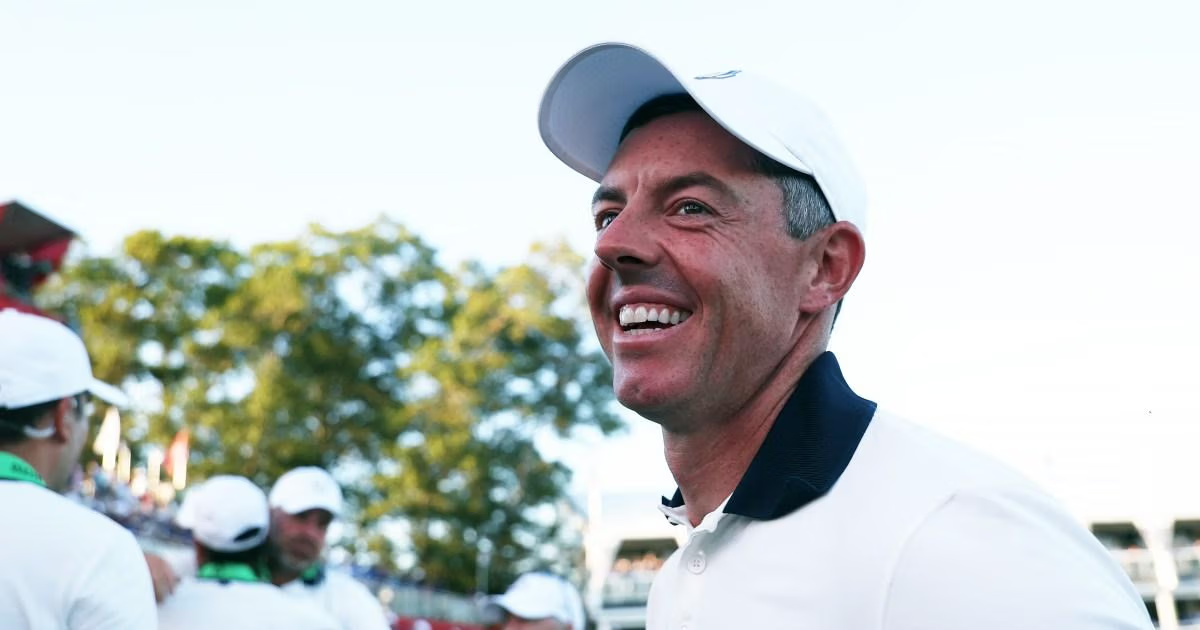
The final putt had dropped, the champagne corks were popping, and the European team, against the odds, had once again claimed the Ryder Cup on American soil. The air at Bethpage Black, renowned for its passionate and often boisterous crowds, crackled with a mix of elation and disappointment. Yet, amidst the celebratory chaos for the victors and the respectful applause for the defeated, a singular moment transpired that transcended the typical sporting narrative. It was a moment that served not just as a memorable post-script to a thrilling tournament but as a profound commentary on the indelible mark of contemporary American politics on every facet of public life. A fan, seizing the opportunity, bellowed at European stalwart Rory McIlroy, “Two more years, Donald!” and in McIlroy’s subsequent, genuine laughter, an entire discourse on political ubiquity unfurled.
This wasn’t a spontaneous outburst aimed at a specific golfer’s performance or a general expression of national pride; it was a targeted political declaration, injecting a specific partisan sentiment into an international athletic contest. The Ryder Cup, by its very nature, thrives on nationalistic fervor, pitting continents against each other in a display of skill and patriotism. But this chant broke the traditional mold, shifting from a generic “USA! USA!” to a very specific political endorsement. It highlighted how deeply ingrained Donald Trump has become in the American psyche, transforming from merely a political leader into an inescapable cultural phenomenon whose name can evoke strong reactions—from fervent support to weary exasperation—even in the most unexpected arenas.

For McIlroy, the moment was likely a surreal blend of humor and recognition. Here he stood, a key architect of a stunning European victory, basking in the glory of athletic achievement, only to be confronted with the specter of American partisan politics. His reaction—a burst of authentic, hearty laughter—was telling. It wasn’t an endorsement of the sentiment, nor was it a sign of anger or confrontation. Instead, it was the laughter of a man who, having navigated the intricate political landscape himself, understands the sheer absurdity and inescapable nature of the “Trump effect” in modern public discourse. It conveyed a wry acknowledgment that some figures are so culturally pervasive that their influence permeates even the most seemingly apolitical moments.
Bethpage Black: A Fertile Ground for Political Expression
The choice of venue for this particular political interjection, Bethpage Black in Farmingdale, New York, is far from incidental. Located on Long Island, Bethpage is celebrated for its demanding course and equally demanding, outspoken fans. Unlike the hushed reverence often associated with other elite golf courses, Bethpage crowds are known for their raw energy, vocal support, and willingness to express themselves without reservation. This working-class ethos and passionate local identity make it a particularly ripe environment for strong political sentiments to surface, especially those resonating with populist movements. The chant, therefore, wasn’t just a random event; it was an echo from a region that has often been a bellwether for American political leanings, particularly those leaning conservative and populist in recent cycles.
Moreover, golf itself has long held a unique and often complicated relationship with the political establishment, particularly with Donald Trump. His ownership of numerous high-profile golf courses, his frequent presence at major tournaments, and his well-documented passion for the sport have inextricably linked his public and political persona with the world of professional golf. This connection means that invoking his name at a golf event, while perhaps surprising at the Ryder Cup, is not entirely out of context. Golf, for many, is no longer just a game; it is another stage upon which political affiliations and cultural identities can be subtly or overtly expressed, adding another layer of complexity to its traditional image as a genteel sport.
The Ryder Cup’s Inherently Political Nature
While the “Two more years, Donald!” chant represented a specific political injection, the Ryder Cup is, by its very design, an inherently political event. It pits national or continental pride against each other, evoking deep-seated patriotism and competitive spirit. Flags are waved, anthems are played, and the narrative is often framed in terms of national honor and supremacy. This foundation of national identity makes it a prime candidate for the broader currents of a nation’s political temperature to seep in. When a country is as polarized as the United States, it becomes increasingly difficult to contain such intense emotions to purely sporting contexts. The crowd’s identity as Americans is indivisible from their political leanings, making events like the Ryder Cup unwitting canvases for political expression.
The heightened emotions and fervent atmosphere of the Ryder Cup often strip away pretenses, allowing for raw expressions of sentiment. In an era where political identity is often seen as a fundamental aspect of personal identity, it’s perhaps unsurprising that such sentiments would surface in a context that celebrates national pride so openly. The chant, therefore, can be viewed not just as a rogue heckle but as a manifestation of a deeply politicized public discourse that sees no clear boundaries between sport and civic life. It signals a shift where even moments of pure athletic competition are viewed through a political lens, reflecting the intensity with which political affiliations are now held and expressed.
Rory McIlroy’s Complicated Dance with Donald Trump
Rory McIlroy’s reaction to the “Two more years, Donald!” chant is particularly nuanced given his personal history with the former President. The Northern Irish golf sensation famously played a round of golf with Trump in 2017, an event that generated significant media attention and a degree of controversy. At the time, McIlroy defended his decision, stating he was merely honoring an invitation from the sitting President of the United States. He expressed that he was there to play golf, not to make a political statement. However, in subsequent years, as Trump’s presidency unfolded, McIlroy’s perspective evolved significantly. He later expressed regret over the game, stating it was “something I wouldn’t do again” and that he “probably wouldn’t do it again.” He became more vocal in his criticism, particularly regarding Trump’s handling of the COVID-19 pandemic, describing Trump as a “divisive” figure and someone he would no longer want to socialize with.
This evolving stance adds depth to his laughter at Bethpage. It wasn’t the laughter of a supporter, nor was it the scorn of an antagonist. Instead, it represented a profound understanding of Trump’s enduring cultural footprint, even among those who might disagree with his policies or leadership. McIlroy, as a global athlete with a significant platform, has had to navigate the increasing expectation for public figures to take stances on political issues. His initial reticence to engage politically, followed by his later, more outspoken criticisms, reflects the broader challenge faced by many celebrities and athletes: how to maintain professional focus while also acknowledging or responding to the charged political atmosphere that now permeates almost all public interactions. His laugh was a release valve, a recognition of the unavoidable intersection of sport, celebrity, and deeply entrenched political identity, even for an international athlete playing on foreign soil.
The Athlete as a Political Figurehead
The era of the “apolitical athlete” is rapidly fading. From LeBron James to Megan Rapinoe, contemporary sports figures are increasingly using their platforms to voice political opinions, advocate for social justice, and challenge established norms. This trend has shifted public perception, making it harder for athletes to simply “stick to sports.” Rory McIlroy, despite his initial reluctance to delve into American politics, found himself drawn into the discourse by virtue of his celebrity and the political climate. His journey from playing golf with a president to openly criticizing him highlights the growing pressure on athletes to engage with the world beyond the playing field.
This development adds another layer to the “political caddie” phenomenon. Athletes are not just performers; they are often seen as role models, spokespeople, and cultural influencers. When they encounter political statements, their reactions—whether through words, actions, or even laughter—are magnified and scrutinized. McIlroy’s laughter, therefore, becomes a form of communication itself, signaling his awareness of the political undertow without necessarily endorsing or condemning the specific chant. It underscores the new reality where every public action of a prominent athlete is open to political interpretation and commentary, making their roles far more complex than ever before.
The Erasure of Neutral Ground: Sport as a Political Battlefield
The incident at the Ryder Cup serves as a potent microcosm of a larger societal trend: the progressive erosion of genuinely neutral public spaces. Where once sporting events, concert halls, or even family gatherings might have offered a temporary respite from partisan bickering, the lines between entertainment, celebrity, and politics have not merely blurred; they have, for all intents and purposes, been erased. Public arenas are no longer just venues for competition or performance; they are extensions of the political battlefield, sites where cultural allegiances are affirmed, challenged, and often weaponized. This phenomenon reflects an increasingly polarized society where identity politics dominates discourse, making it nearly impossible for any major public event to escape political scrutiny or overt expression.
This “Trump effect” extends far beyond polling numbers or cable news debates. It has permeated the very fabric of American public life, turning almost every major gathering, every celebrity endorsement, and every sporting moment into a potential litmus test of allegiance. From athletes kneeling during the national anthem to musicians making political statements at awards shows, the expectation for public figures to engage with or react to political currents is at an all-time high. For athletes, particularly those with global reach like McIlroy, navigating this new reality is a delicate and often surreal balancing act. They must contend with the pressures of their sport, the expectations of their fans, and the unavoidable reality that their platforms will inevitably be used as sounding boards for broader societal debates, whether they intend them to be or not. This creates a perpetual state of political awareness that constantly influences perception and reception.
Historical Precedents and the Modern Intensification
While the intertwining of sports and politics is not entirely new—think of Jesse Owens at the 1936 Berlin Olympics, Tommie Smith and John Carlos’s Black Power salute in 1968, or the various Olympic boycotts throughout the Cold War—the current environment feels different. The intensity and pervasiveness of political expression in sports today are arguably unprecedented, driven by hyper-partisan media landscapes and the instant, global reach of social media. A single chant or gesture can now go viral within minutes, sparking international debate and commentary that far outlasts the sporting event itself. This amplification means that every potential political moment carries greater weight and has broader implications, turning isolated incidents into significant cultural touchstones.
The modern political caddie is not merely observing; it is actively shaping the game. It influences how fans perceive athletes, how sponsors engage with events, and even how leagues craft their messaging. The sheer volume of information and the constant push for engagement in the digital age means that political sentiment is harder to contain and quicker to spread, making truly apolitical spaces a relic of the past. The demand for athletes to be more than just players, but also engaged citizens, has permanently altered the landscape of public life, ensuring that the political conversation is always just a swing or a cheer away.
The Enduring “Trump Effect” and Its Implications for Public Discourse
The chant at Bethpage is more than just an anecdote; it’s a powerful indicator of how the political landscape has fundamentally shifted. Donald Trump’s presidency, and his continued influence post-presidency, has profoundly altered public discourse, making it more personal, more pervasive, and more polarizing. He transformed politics from a realm of policy debates into a spectacle of personality and cultural warfare, and this shift has irrevocably changed how Americans interact with public figures and events. The idea of a “political caddie”—an ever-present political undercurrent guiding or influencing every shot, every cheer, every moment in public life—is no longer a metaphor; it is the lived reality.
For individuals and institutions alike, understanding and adapting to this new normal is crucial. Sporting organizations, event planners, and public figures must increasingly anticipate and manage politically charged moments, realizing that attempts to remain “apolitical” are often interpreted as a stance in themselves. Fans, too, are confronted with a transformed experience, where their passions for sport may intersect with, or even be overshadowed by, their political identities. This deep intertwining of sport and politics means that conversations about the game are rarely just about the game anymore. They are often proxies for deeper discussions about national identity, cultural values, and political allegiances, further cementing the notion that no public space is truly insulated from the ongoing political drama.
As the United States gears up for another intense political cycle, the incident at the Ryder Cup serves as a compelling reminder of the indelible mark Donald Trump has left on the national consciousness. His presence, whether physical or symbolic, continues to loom large over American life, influencing interactions in spaces traditionally thought to be immune to partisan strife. The laughter of Rory McIlroy wasn’t just about a specific moment; it was a universal acknowledgment that in today’s America, the political caddie is not just on the bag—it is the bag, shaping every shot and influencing every outcome in the grand game of public opinion.
What are your thoughts on the increasing politicization of sports events? Do you believe these arenas should remain neutral, or are they inevitable platforms for broader societal discussions?