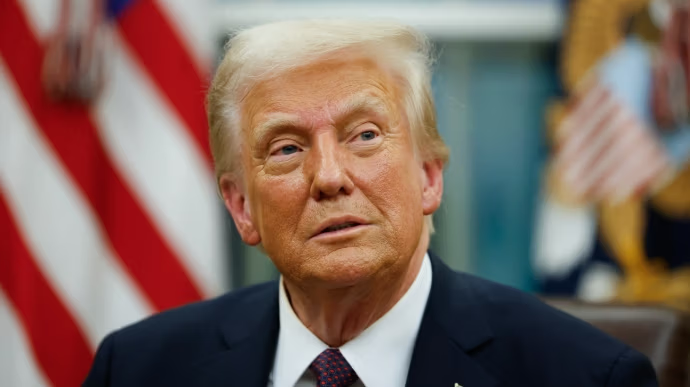
In a conflict defined by grinding trench warfare and complex international diplomacy, Donald Trump has just thrown a geopolitical grenade into the conversation. His proposed solution to the war in Ukraine is not about more sanctions on Russia or more weapons for Kyiv. Instead, it’s a characteristically audacious bank shot that targets a different global superpower entirely: China.
The former President’s strategy, laid out in recent remarks, is a masterclass in his transactional, strong-arm view of foreign policy. The idea is simple in its premise but staggering in its implications: if Europe were to threaten China with crippling tariffs—Trump suggests a figure of 100% or more—the economic shock would be so severe that Beijing would have no choice but to force its partner in Moscow to the negotiating table.

This isn’t just an off-the-cuff remark; it’s a profound insight into the foreign policy doctrine of a potential second Trump administration. It shatters the mold of traditional statecraft, which has focused on directly pressuring Russia and arming Ukraine. Trump’s gambit reframes the conflict as a three-player chess game, identifying China not just as a Russian ally, but as Moscow’s economic lifeline and, therefore, its greatest vulnerability.
Future Implications of Trump’s Unconventional Peace Strategy
The implications of this ambitious and largely untested strategy, were it ever to be pursued by a future Trump administration, would be seismic, reshaping not only the conflict in Ukraine but the entire global geopolitical and economic landscape. This plan represents a radical departure from established Western foreign policy and carries with it profound risks and potential rewards that demand careful consideration.
Transatlantic Relations Under Strain: Europe’s Tariff Dilemma
First and foremost, Trump’s peace plan represents a monumental test for transatlantic relations, which have historically formed the bedrock of Western security and economic stability. The former President is essentially telling Europe to adopt his own “America First” playbook of aggressive economic warfare, a tactic many European leaders have viewed with skepticism, if not outright opposition, during his previous term. The core of this challenge lies in the demand for European nations to threaten China with crippling tariffs, potentially reaching 100% or more, on Chinese imports.
But would European leaders, particularly in economic powerhouses like Germany, France, and Italy, be willing to risk a catastrophic trade war with China, one of their largest and most vital trading partners, purely to exert pressure on Russia regarding Ukraine? The economic ramifications within the EU could be immense, potentially leading to significant job losses, supply chain disruptions, and inflationary pressures. European industries, from automotive to luxury goods, are deeply integrated into the Chinese market, both as consumers and suppliers. A sudden imposition of massive tariffs could trigger retaliatory measures from Beijing, severely harming European economies.
The political fallout within the European Union could be equally profound. Such a move would require unprecedented unity among member states, many of whom have differing economic interests and levels of dependence on China. It could potentially create a rift far deeper than any seen during Trump’s first term, challenging the very cohesion of the EU and its commitment to a unified foreign policy. The allure of “America First” tactics, when applied to European interests, may prove a hard sell, particularly if it means sacrificing immediate economic stability for a speculative geopolitical outcome. This strategy tests Europe’s resolve and its willingness to align with a U.S. approach that prioritizes assertive economic leverage over traditional diplomatic avenues, potentially leading to significant strains on the transatlantic alliance.
Xi-Putin Partnership on the Brink: Economic Pragmatism vs. Geopolitical Ambition
Second, the plan is a high-stakes bluff aimed squarely at the “no-limits” partnership between Chinese President Xi Jinping and Russian President Vladimir Putin. It operates on the bold assumption that Beijing’s deeply ingrained economic pragmatism will ultimately trump its evolving geopolitical ambitions and its strategic alignment with Moscow. Since the invasion of Ukraine, China has been a crucial economic lifeline for Russia, mitigating the impact of Western sanctions by increasing trade, particularly in energy, and providing alternative financial mechanisms. This support has allowed Moscow to continue its war effort despite considerable economic pressure.
Trump’s proposed strategy forces Beijing into an unenviable and stark choice: maintain its strategic alignment with Russia against the West, accepting the economic devastation of a full-blown trade war with Europe, or protect the vast European market that fuels its export-oriented economy and underpins its domestic stability. For China, Europe is not just a market; it’s a critical source of high-tech components, investment, and a counterweight to U.S. economic influence. Losing access to this market, or having it severely curtailed, could have profound domestic consequences for Beijing, potentially undermining the Communist Party’s legitimacy through economic instability and social unrest.
Forcing Beijing’s hand in such a direct and aggressive manner carries a significant element of unpredictability. Trump predicts this pressure would break the Sino-Russian axis, compelling China to mediate a peace favorable to Ukraine in order to restore its economic ties with Europe. However, there is an equally strong possibility that this gambit could backfire spectacularly. Rather than yielding, Beijing might view such an ultimatum as an unacceptable act of economic coercion and a direct assault on its sovereignty and strategic autonomy. This could, ironically, cement their alliance with Russia in defiance of Western pressure, hardening their resolve to build an alternative, non-Western-centric global order. It could accelerate de-dollarization efforts, foster closer military and technological cooperation, and push them even further into a bloc explicitly opposed to the West, creating a more dangerous and bifurcated world order.
Ukraine’s Shifting Sands: From Battlefield to Boardroom
Finally, for Ukraine, this strategy dramatically shifts its fate from the blood-soaked battlefields of the Donbas to the sterile boardrooms of Brussels and Beijing. It fundamentally sidelines military aid as the primary tool for achieving peace and territorial integrity, replacing it with a grand, and deeply uncertain, economic power play. For a nation that has fought valiantly for its survival, relying on the steadfast supply of Western armaments and financial assistance, this proposed pivot introduces an entirely new layer of risk and dependency.
Ukrainian leaders would find themselves in an unprecedented position, with their future contingent on complex economic maneuvers undertaken by distant powers, rather than their own military prowess or direct diplomatic negotiations. The focus would shift from the immediate needs of front-line defense and counter-offensives to the agonizing wait for a potential, indirect intervention by China. This introduces significant instability and uncertainty, potentially eroding morale and creating a sense of being a pawn in a larger, more abstract geopolitical game.
Furthermore, this approach offers no guarantees for Ukraine’s territorial integrity or long-term security. Even if China were to pressure Russia, the terms of any forced negotiation might not align with Ukraine’s core demands, such as the full withdrawal of Russian troops and reparations. The danger is that Ukraine becomes a leverage point rather than a sovereign actor in its own right, with its destiny decided in a high-stakes economic gamble between global powers. The strategy, while unconventional, could either lead to an expedited, albeit potentially imperfect, peace or leave Ukraine in an even more precarious position, caught between great power competition with no clear path forward. It’s a strategy that places immense trust in the efficacy of economic coercion, a trust that may not be shared by a nation fighting for its very existence.
An Unpredictable Departure in Foreign Policy
Donald Trump’s unconventional peace plan for Ukraine is far more than a casual suggestion; it is a meticulously calculated, albeit profoundly risky, geopolitical strategy that challenges decades of established foreign policy. It represents a radical departure from traditional approaches, moving away from direct confrontation and military support to an indirect, economically coercive gambit aimed at China.
This approach highlights Trump’s consistent belief in the power of transactional leverage and his willingness to upend diplomatic norms to achieve what he perceives as a desired outcome. His focus on using economic pressure, particularly tariffs, as a primary tool of foreign policy, aligns perfectly with his “America First” ideology and his past trade disputes with both China and Europe. However, the scale and implications of this proposed action are unprecedented, even for Trump.
As the 2024 election cycle heats up, this proposal serves as a stark reminder that a potential Trump return to the White House would not be a continuation of current policy, but a radical and unpredictable departure from the status quo. The world, it seems, is being put on notice that a second Trump administration would be prepared to pursue highly unconventional and potentially destabilizing strategies to address global conflicts.
Whether this is a stroke of unconventional genius that could finally break the deadlock in Ukraine or a reckless gamble that could destabilize the entire global economy and deepen existing geopolitical rifts remains a subject of intense debate and speculation. Its success hinges on a multitude of unpredictable factors, from European unity and economic resilience to China’s ultimate strategic calculations.
Read the original story at Українська Правда.
Considering the immense risks and potential rewards of such an audacious strategy, do you believe the global economic system is robust enough to withstand a full-scale trade war between Europe and China, or would the fallout create a deeper, more pervasive global crisis?