In a move that signals a seismic shift in European defense strategy, Ukraine has been formally invited to join talks with a coalition of Eastern European nations to construct a “drone wall” along their borders with Russia and Belarus. This groundbreaking initiative, spearheaded by the Baltic states and strongly supported by Poland, Finland, and Norway, represents more than just a new security measure; it’s a profound acknowledgment of the new realities of 21st-century warfare and a testament to Ukraine’s hard-won expertise in drone technology and tactics.
The concept of a “drone wall” may conjure images of a science-fiction dystopia, but its purpose is rooted in the gritty, present-day threats posed by Moscow. This isn’t a physical barrier of concrete and razor wire, but an invisible, high-tech fortress designed to provide unprecedented border security. The ambitious plan envisions a seamless, integrated network of unmanned aerial vehicles (UAVs), sophisticated ground-based and airborne sensors, advanced radar installations, and cutting-edge anti-drone systems stretching from the frigid northern reaches of Finland down to the strategic plains of Poland. Its primary goal is to effectively detect, identify, and neutralize a wide array of threats, ranging from Russian spy drones conducting reconnaissance and organized smuggling operations to the Kremlin’s cynical and destabilizing use of weaponized migration across its borders.

What makes this development truly significant, however, is not merely the advanced technology itself, nor the sheer scale of the proposed project, but the pivotal guest of honor at the planning table: Ukraine. This inclusion underscores a fundamental recalibration of European defense priorities and partnerships.
Ukraine’s Unparalleled Battlefield Drone Expertise
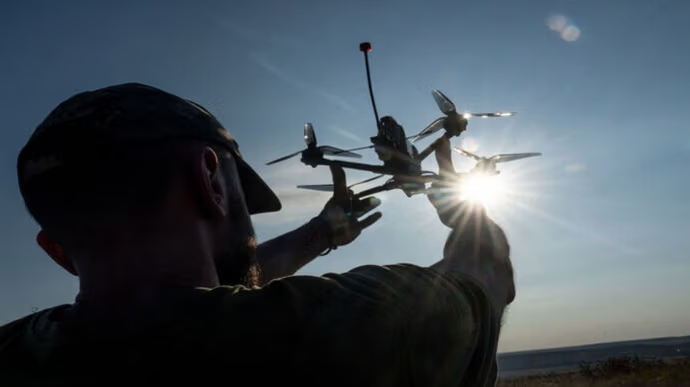
For over a decade, and with brutal, accelerating intensity since the full-scale invasion in February 2022, Ukraine has served as the world’s most intense, high-stakes laboratory for modern drone warfare. Its military has not only embraced but actively transformed drone operations from a niche, supplementary capability into a central, indispensable pillar of its national defense. Ukrainian forces have pioneered innovative tactics in a multitude of critical areas, including real-time reconnaissance, precise artillery targeting, surgical strikes against high-value targets, and complex electronic warfare countermeasures that have consistently stunned military analysts and experts worldwide.
Operating under the most extreme pressure imaginable, facing a technologically advanced adversary, Ukrainian soldiers and engineers have learned invaluable lessons. They have developed sophisticated methods to counter Russian jamming efforts, effectively identify enemy drone signatures amidst complex electronic environments, and deploy their own drone swarms with devastating tactical and strategic effect. This includes adapting commercial off-the-shelf drones for military purposes, creating rapid manufacturing pipelines, and integrating AI-driven analytics for faster threat detection and response. This isn’t theoretical knowledge; it is wisdom paid for in blood and forged in the crucible of constant, existential battle.
Inviting Kyiv to these high-level discussions is therefore a clear, unequivocal statement from its European neighbors. They see Ukraine not merely as a recipient of vital aid, nor solely as a front-line defender of democratic values, but as an indispensable strategic partner and a leading authority on 21st-century defense. Ukraine is now perceived as a security provider, not just a consumer of security. The practical knowledge held by Ukrainian commanders, tactical operators, and defense engineers is unparalleled; it has been validated in real combat scenarios that no NATO training exercise, however realistic, could ever truly replicate.
The Architecture of the “Drone Wall”: A High-Tech Shield Against Hybrid Threats
The proposed “drone wall” represents a multi-layered, interconnected defense system designed to counter the complex spectrum of modern threats emanating from Russia and Belarus. It moves far beyond traditional border surveillance, integrating a sophisticated array of technologies to create a truly intelligent barrier. At its core, the system will leverage a diverse fleet of UAVs, ranging from long-endurance surveillance drones capable of persistent observation to smaller, agile tactical drones for immediate threat assessment and interdiction. These drones will be equipped with high-resolution optical cameras, thermal imaging sensors for night operations, and advanced synthetic aperture radar (SAR) for all-weather detection.
Complementing the aerial component will be an extensive network of ground-based sensors. This includes seismic sensors to detect ground vibrations from approaching vehicles or personnel, acoustic sensors to pick up engine noises or footsteps, and magnetic sensors to identify metallic objects. These sensors will be seamlessly integrated with strategically placed radar installations, providing early warning and tracking capabilities over vast distances. Crucially, the entire system will be underpinned by an advanced artificial intelligence (AI) platform. This AI will be responsible for processing enormous volumes of data from all sensors in real-time, identifying anomalies, classifying potential threats, and providing actionable intelligence to human operators. It will learn to distinguish between legitimate border crossings, wildlife, and hostile incursions, reducing false positives and accelerating response times.
Furthermore, the “drone wall” will incorporate sophisticated anti-drone systems. These might include electronic warfare (EW) jammers capable of disrupting enemy drone communications and navigation, kinetic interceptors, and even high-energy laser systems for neutralizing hostile UAVs at a distance. The goal is to establish an unbreachable detection and interdiction zone, making it exceedingly difficult for any unauthorized entity to cross or even approach the border undetected. This proactive defense architecture is specifically designed to address not only conventional incursions but also the insidious “grey zone” tactics, such as the weaponization of migration, which Russia has repeatedly employed to destabilize its neighbors.
Strategic Implications for European Security
This initiative represents a pivotal moment for European security, with several far-reaching implications that will shape the geopolitical landscape for decades to come.
The Proactive Defense Paradigm: Redefining Border Security
Europe is officially moving beyond a reactive defense posture, one that historically waited for threats to manifest before responding. The “drone wall” is a definitive attempt to get ahead of Russian aggression, making the “grey zone” of hybrid warfare significantly more difficult, if not impossible, for the Kremlin to exploit. This new paradigm acknowledges that traditional border guards and static patrols, while essential, are no longer sufficient to counter a sophisticated state actor like Russia, which is determined to sow chaos, test alliances, and probe vulnerabilities. This proactive approach includes persistent surveillance, immediate threat assessment, and the capability for rapid, localized response, transforming the border from a passive line into an active, intelligent defense perimeter. It’s a clear signal that the era of ambiguous incursions and deniable provocations is over.
Ukraine’s Deepening Integration within European Security Architecture
Even without formal NATO membership, this unprecedented collaboration embeds Ukraine deeply within the fabric of Europe’s evolving security architecture. It’s a practical, on-the-ground integration that builds profound trust, fosters interoperability, and standardizes procedures and equipment among participating nations. This move explicitly treats Ukraine as a de facto ally on the continent’s critical eastern flank, recognizing its vital role and responsibilities for a shared defense. This kind of operational integration often precedes formal political and military alliances, laying the groundwork for future NATO membership by demonstrating Ukraine’s indispensable value and capacity to contribute actively to collective security, rather than merely being a beneficiary.
A New “Iron Curtain” is Technological: Securing the Digital Frontier
The Cold War was defined by imposing physical walls, heavily fortified borders, and vast divisions of tanks and artillery. The new era of containment against Russian expansionism will be fundamentally defined by data links, cutting-edge artificial intelligence, and sophisticated unmanned systems. This “drone wall” is the first major, concrete step in creating a 21st-century barrier against Russian expansionism—one that is smarter, more flexible, more persistent, and far more adaptable than its concrete and steel predecessor. This new “Iron Curtain” is less about preventing physical movement (though it will do that) and more about establishing an impenetrable information and surveillance perimeter, safeguarding not just physical borders but also the digital and informational integrity of the nations involved. It signals a future where European defense will increasingly rely on technological superiority and data-driven decision-making to maintain peace and stability.
Challenges and the Path Forward
While the vision for a “drone wall” is ambitious and strategically vital, its implementation will not be without challenges. Significant hurdles include securing the substantial funding required for development, procurement, and ongoing maintenance of such an extensive system. Ensuring seamless interoperability between the diverse systems and national forces of participating countries will be paramount, requiring standardized protocols and unified command structures. Ethical considerations regarding autonomous systems and data privacy will also need careful navigation and robust regulatory frameworks. Furthermore, the rapid pace of technological advancement means that the “drone wall” must be designed with continuous upgradeability and adaptability in mind, capable of evolving to counter new threats and incorporate emerging technologies.
Despite these complexities, the collective resolve of the participating nations, bolstered by Ukraine’s battle-hardened expertise, underscores the determination to see this project through. This collaboration is set to become a blueprint for future pan-European defense initiatives, fostering a stronger, more resilient continent.
As officials from these nations gather, the discussions will undoubtedly be about more than just procurement lists and logistical frameworks. They will be about profoundly absorbing the harsh, invaluable lessons from Ukraine’s desperate fight for survival and meticulously applying them to safeguard the security and sovereignty of the entire continent. This isn’t just about building a sophisticated wall; it’s about building a future where Europe’s eastern border is no longer perceived as a vulnerability, but rather as a technologically fortified shield, with Ukrainian expertise serving as its indispensable cornerstone.
Read the original story at Українська Правда.
What are your thoughts on Europe leveraging Ukraine’s unique drone warfare experience for its collective defense? Share your insights in the comments below!