The Gavel of Justice Swings Towards Moscow: Europe Lays Groundwork for a Special Tribunal
In the stark, dramatic landscape of Reykjavik, Iceland, a decision of historic and monumental consequence has been forged. The Council of Europe, the continent’s leading human rights organization, in a move that signals a seismic shift in the international response to Russia’s unprovoked and brutal invasion of Ukraine, has declared its readiness to establish a special tribunal to prosecute the crime of aggression. This isn’t just another diplomatic statement, another round of condemnations; it’s the meticulous laying of a legal foundation stone, painstakingly designed to hold Russia’s highest leadership accountable for the ultimate international crime: the decision to wage an illegal war.
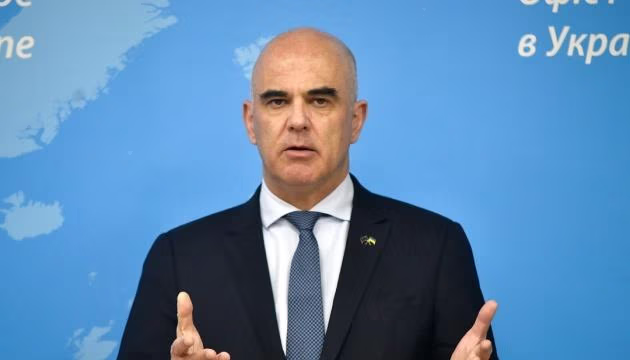
Speaking at a summit that Swiss President Alain Berset rightly labeled “historic,” the palpable message emanating from the gathering was clear, unequivocal, and resonated with a newfound urgency: mere condemnation and economic sanctions, while vital, are no longer deemed sufficient. The international community, galvanized by the ongoing atrocities and the blatant disregard for established international norms, is now actively and systematically building the intricate machinery for justice. This commitment extends beyond punitive measures, aiming instead for a comprehensive framework that includes robust legal accountability for the architects of this devastating conflict.

The Reykjavik Summit, bringing together leaders from 46 member states, represents a pivotal moment in global governance, showcasing a collective determination to fortify international law against those who seek to undermine it through force. The consensus achieved marks a significant escalation in the pursuit of justice for Ukraine, signaling a transition from reactive measures to proactive legal mechanisms tailored to address the unique challenges presented by this modern aggression. The implications of this development are far-reaching, promising to reshape the landscape of international criminal justice and set a powerful precedent for future conflicts.
Closing the “Impunity Gap” for the Crime of Aggression
The most crucial and strategically significant takeaway from this development is the deliberate, concerted move to close a glaring and historically problematic loophole in international law: the “impunity gap” concerning the crime of aggression. While the International Criminal Court (ICC), based in The Hague, is actively and commendably investigating war crimes, crimes against humanity, and the crime of genocide committed in Ukraine, its jurisdiction over the “crime of aggression” itself presents a complex challenge. The ICC, under its Rome Statute, cannot prosecute the leaders of a non-member state like Russia for the initial act of invasion without a specific referral from the United Nations Security Council—an insurmountable impossibility, given Russia’s own permanent seat and veto power within that very council. This jurisdictional limitation has historically left the perpetrators of aggression, particularly powerful states, largely shielded from direct international prosecution for the very act of starting a war.
This new “special tribunal,” therefore, is designed specifically and precisely to plug that fundamental gap. It is a bespoke legal instrument, meticulously crafted and aimed squarely at the architects of the war – the political and military leaders who conceived, authorized, and gave the orders to launch the full-scale invasion of Ukraine. By creating a dedicated court focused explicitly on the ultimate crime of starting an illegal war – an act that underpins all subsequent war crimes and humanitarian abuses – Europe is signaling with unwavering resolve that no one, no matter how powerful their state, no matter how high their political office, should be considered above the reach of international law. This initiative directly confronts the historical pattern where aggression, particularly by nuclear powers or Security Council members, has often gone unpunished at the highest levels of international justice, perpetuating a dangerous sense of immunity.
The distinction between the ICC’s mandate and this proposed special tribunal is critical. While the ICC focuses on individual atrocities, the special tribunal targets the decision-making at the highest echelons, aiming to dismantle the very legitimacy of the war itself. This two-pronged approach ensures a comprehensive legal response to the conflict, addressing both the symptoms (war crimes) and the root cause (the crime of aggression). The establishment of such a tribunal represents a profound commitment to legal innovation, adapting international justice mechanisms to confront contemporary geopolitical realities and hold leaders accountable for initiating unlawful conflicts, thereby strengthening the foundational principles of the UN Charter and customary international law against aggressive war.
What This Means for the Future: A Blueprint for Accountability
The Council of Europe’s endorsement of this special tribunal, alongside the parallel establishment of a “register of damages” to meticulously document the devastation, losses, and suffering inflicted upon Ukraine, marks a truly comprehensive and robust two-pronged strategy for the future: the pursuit of justice and the realization of reparations. This integrated approach acknowledges that true accountability requires not only identifying and prosecuting those responsible for the crime of aggression but also ensuring that the victims receive recompense for the catastrophic harm endured.
A Powerful Precedent is Set for Future Accountability
The very creation of such a tribunal sends an extraordinarily powerful and unequivocal message, not only directly to Moscow but also, perhaps more importantly, to potential aggressors worldwide. It represents a profound erosion of the long-held and often unchallenged assumption that the act of launching a war, particularly if perpetrated by a powerful state with significant military and political influence, can go unpunished at the international level. This initiative endeavors to establish a modern, adaptive precedent, meticulously building upon the foundational legacy of historical tribunals like Nuremberg and Tokyo, but with a critical difference: it demonstrates that international law possesses the flexibility and the moral imperative to adapt and confront contemporary geopolitical challenges that threaten global peace and security. It signals that the international legal order is not static but capable of evolving to meet the demands of justice in an ever-changing world, reinforcing the principle that aggressive war is a crime, regardless of the perpetrator’s power.
By explicitly targeting the crime of aggression, this tribunal seeks to reinforce the core principles of the UN Charter and customary international law, which prohibit the use of force against the territorial integrity or political independence of any state. The psychological and diplomatic impact of such a precedent cannot be overstated. It transforms the calculations for leaders contemplating similar acts of aggression, introducing a tangible risk of personal legal accountability. This move underscores a global determination to uphold the rule of law over the rule of might, fostering a more stable international environment where accountability, rather than impunity, becomes the expected norm for those who initiate illegal wars.
The Long, Arduous Road to the Courtroom
While the declaration of intent is monumental, the path ahead will undoubtedly be fraught with significant legal and political hurdles. The practical challenge of physically bringing high-level Russian officials into a courtroom remains immense. This will involve navigating complex issues such as state immunity, the absence of an international enforcement mechanism for arrests in sovereign territories, and potential political resistance from various quarters. Moreover, the legal definition of “aggression” itself, while enshrined in international law, can be subject to intricate interpretation and rigorous evidentiary demands in a court of law. Establishing a clear chain of command and proving specific intent for the crime of aggression at the highest levels of leadership will require meticulous investigation and presentation of evidence.
However, the tribunal’s power and influence aren’t solely contingent on its immediate ability to secure physical custody and imprison individuals. Its very existence, its operationalization, and the process of investigation and indictment generate a permanent, irrefutable legal and historical record. Indictments issued by such a tribunal can lead to immediate and enduring consequences for those named: international arrest warrants, which severely restrict travel; asset freezes; and the inescapable reality of being designated a global pariah. It transforms powerful political leaders from respected figures into fugitives from international justice, forever tainted by the legal process, even if they remain beyond the physical reach of the court. This stigma can profoundly impact their legacy, influence, and the legitimacy of their regimes on the world stage, creating a powerful, albeit indirect, form of accountability. The process itself serves as a crucial mechanism for truth-telling and historical validation, ensuring that the narrative of aggression is cemented in legal precedent, not just political rhetoric.
From Rhetoric to Reality: A New Era of International Justice
For over a year since the full-scale invasion, the world has consistently spoken of the imperative to hold Russia accountable for its actions in Ukraine. The Reykjavik summit, therefore, represents not just another declaration, but a tangible, concrete moment where that rhetoric began its slow, deliberate, and determined transformation into a stark, operational reality. With the formal backing of over 40 nations within the Council of Europe, this is no longer a fringe idea, a distant aspiration, or a mere political talking point. It has now solidified into a central, indispensable pillar of the broader Western and international response to the conflict. The comprehensive blueprint for international justice is unequivocally on the table, meticulously drafted and awaiting implementation, and the long, arduous, but absolutely necessary work of constructing the courthouse—both literally and metaphorically—has officially and decisively begun. This commitment signals a new chapter in international law, one where the pursuit of justice for the gravest international crimes is prioritized with unprecedented resolve.
The path forward will demand sustained political will, significant financial investment, and intricate legal cooperation among states. Yet, the foundational decision made in Reykjavik serves as a potent reminder that the international community, when united, can forge powerful instruments of justice to confront even the most egregious violations of peace. It’s a testament to the enduring belief that accountability is not merely an ideal, but an achievable imperative, vital for maintaining a rules-based international order and preventing future acts of aggression.
Read the original story at Menafn.
What are your thoughts on the establishment of this special tribunal? Do you believe it will effectively deter future acts of aggression, or will the practical challenges prove too great?