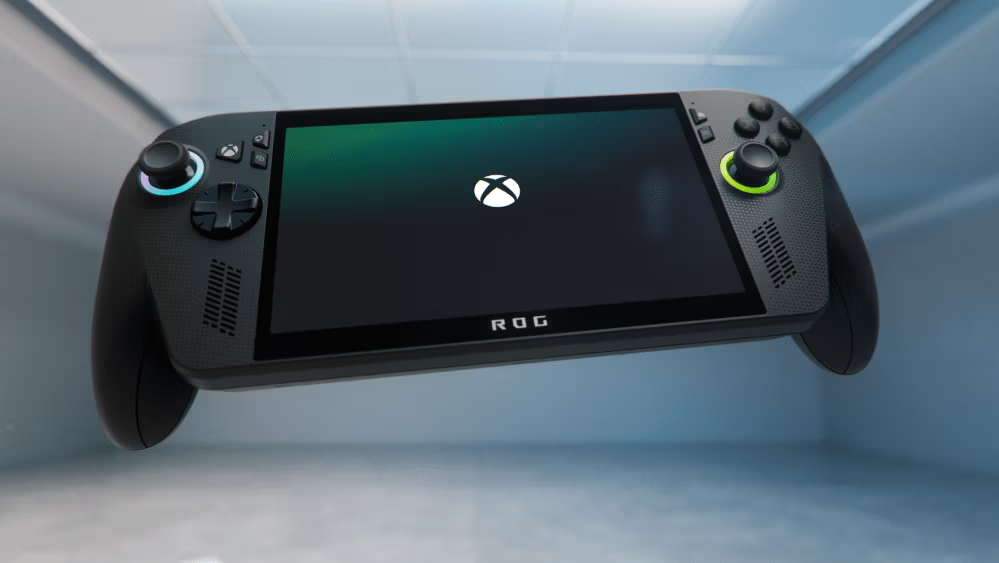
Let’s get the sticker shock out of the way first. News just dropped that Microsoft’s upcoming handheld, the “Xbox Ally,” will have models costing up to $1,000. If your first thought was, “A thousand dollars for a handheld?!” you’re not alone. This price point places it far outside the casual impulse-buy territory currently dominated by the Nintendo Switch, a console renowned for its accessibility and family-friendly appeal.
Historically, handheld gaming has been defined by affordability and convenience. Devices like the Game Boy, PlayStation Portable, Nintendo DS, and even the current Switch have generally occupied a price bracket that encourages widespread adoption. A four-figure price tag for a device designed to be held in your hands fundamentally challenges this long-standing perception. It immediately signals that the Xbox Ally isn’t playing in the same sandbox as its more budget-conscious predecessors or rivals. Instead, it positions itself firmly in the premium segment, a bold move designed to turn heads and redefine expectations for what a portable gaming device can be.

But to compare this to a Switch is to miss the point entirely. This isn’t Microsoft’s attempt to build a family-friendly console for the kids’ playroom or a casual gaming device for quick bursts of entertainment. This is a gauntlet thrown down in the rapidly maturing market of high-performance PC handhelds. The price isn’t a miscalculation; it’s a deliberate declaration of intent. It tells us that Microsoft is not just entering this space; it aims to dominate its upper echelon, setting a new benchmark for premium portable PC gaming.
Key Takeaway: This is a “No Compromises” Xbox PC
The naming convention—”Ally”—strongly suggests a continued and deepened partnership with ASUS, creators of the successful ROG Ally. This collaboration is strategic. ASUS brings years of expertise in designing and manufacturing high-performance gaming hardware, particularly in cooling solutions, ergonomic designs, and robust build quality for compact form factors. Microsoft, in turn, infuses this hardware with the essential DNA of Xbox: a unified software experience, deep Game Pass integration, and first-party game optimization that will be unparalleled in the handheld market. This synergy aims to create a device that is more than just a sum of its parts.
Forget the clunky workarounds of streaming Game Pass to a Steam Deck, which often relies on a Proton compatibility layer or a full, less-than-optimized Windows installation, or navigating a generic Windows interface on a Legion Go or other third-party PC handhelds. While those devices offer a taste of portable PC gaming, they often come with compromises in software optimization, user experience, and driver stability. The Xbox Ally promises to be the first device that is, from the silicon to the software, purpose-built to be the ultimate portable Game Pass machine. This means a seamless, intuitive interface designed specifically for handheld use, deeply integrated Xbox services, optimized drivers for top-tier performance, and a direct conduit to the entire Xbox ecosystem without friction. It’s about delivering a truly native and optimized experience, rather than a patched-together solution.
A $1,000 price tag tells us we can expect nothing less than top-tier specifications and a premium user experience. We anticipate a vibrant VRR (Variable Refresh Rate) display, likely 1080p or even 1440p, offering buttery-smooth visuals and exceptional responsiveness, possibly incorporating OLED technology for stunning colors, infinite contrast, and deep blacks. This display will ensure that every game looks its absolute best on the go. Powering this experience will be a next-gen AMD chipset—almost certainly a custom APU (Accelerated Processing Unit) designed collaboratively with AMD to balance raw processing power with thermal efficiency, crucial for sustained high performance in a handheld form factor. This isn’t just a powerful chip; it’s one optimized from the ground up to deliver a console-like experience with PC-level fidelity.
Beyond the core silicon, expect premium build quality that screams “enthusiast.” This includes high-fidelity haptics for immersive feedback, precise and durable analog sticks and triggers, robust and efficient cooling solutions that minimize thermal throttling even during extended gaming sessions, and potentially an all-metal or high-grade composite chassis that feels substantial and durable in hand. Storage will likely be ample, with fast NVMe SSDs to minimize loading times, and generous LPDDR5/X RAM configurations to handle demanding modern titles with ease. Microsoft isn’t trying to compete with the Steam Deck on price; that ship has sailed, and Valve has carved out an impressive niche for value-oriented PC handheld gaming. Instead, Microsoft is aiming to deliver a superior, seamless, first-party experience for those who are willing to pay for it, prioritizing performance and integration above all else.
This is for the dedicated gamer who wants to play graphically intensive titles like Starfield, Forza Horizon 5, Halo Infinite, or the next Gears of War at high settings, natively, without compromise, whether they’re on their morning commute, traveling across continents, or simply relaxing on the couch away from their main gaming rig. It’s about bringing the full power and fidelity of modern AAA gaming to a truly portable form factor, all integrated within the familiar and robust Xbox ecosystem. It’s a statement that high-performance portable gaming can and should be as polished and integrated as its console counterparts, offering an uncompromised experience for the discerning gamer.
What This Means for the Future: The Lines Have Officially Blurred
For years, the gaming industry operated under clear, distinct categories: console gaming, characterized by ease of use, exclusive titles, and a shared living room experience; PC gaming, offering unparalleled power, customization, and a vast game library; and handhelds, traditionally a separate, often less powerful category focused on mobility and unique, often simpler, game experiences. The Xbox Ally represents the final, emphatic blurring of those lines. Is it a console? With its focus on a curated Xbox experience and deep Game Pass integration, absolutely. Is it a PC? Given its underlying architecture, presumed Windows operating system, and ability to run PC games natively, unequivocally yes. It embodies the convergence, offering the best of both worlds in a single, portable device that redefines what a gaming platform can be.
This device is the ultimate physical manifestation of Xbox’s “play anywhere” strategy, a vision championed by Phil Spencer and the Xbox team for nearly a decade. For years, they’ve been telling us that the ecosystem is more important than the box under your TV. They want Game Pass on your phone via cloud streaming, on your smart TV through dedicated apps, on your traditional PC, and now, in its most powerful native form, directly in your hands. The Xbox Ally isn’t just a new piece of hardware to sell; it’s the most compelling Trojan horse for the entire Xbox ecosystem yet. It ensures that even if you never buy a traditional Xbox Series X or S console, Microsoft can still sell you a premium, native Xbox experience, complete with your Game Pass subscription, first-party titles, and online services. It expands the reach of Xbox beyond the living room in a way that mere cloud streaming, while convenient, cannot fully replicate in terms of fidelity and input latency.
This move also signals a seismic shift in the broader gaming landscape. The battle for gamers’ attention is no longer just for the living room, nor solely for the desktop. It’s for every moment in between—during commutes, on flights, during coffee breaks, or simply when another family member needs the TV. This ubiquity of access is where the next frontier of gaming growth lies, extending gameplay into previously underserved windows of opportunity. Valve’s Steam Deck proved beyond a shadow of a doubt that a substantial market for high-end portable PC gaming existed, despite its initial software hurdles and the challenges of running a Linux-based OS for some users. The Steam Deck validated the concept, showing millions of gamers were hungry for powerful games on the go, even if it meant a learning curve.
Now, Microsoft is stepping in, not to replicate the Steam Deck’s budget-friendly approach, but to legitimize and elevate the PC handheld category with the full weight of its first-party studios, its robust Game Pass library, and decades of operating system and hardware integration experience behind it. This isn’t just another competitor; it’s a major player bringing its entire arsenal to a nascent but rapidly growing segment. This will undoubtedly push innovation across the board, from chip manufacturers developing more efficient APUs to software developers optimizing games for handheld form factors, as the standard for portable performance and user experience is dramatically raised. The market now has a clear, premium leader to aspire to.
While the $1,000 price point will undoubtedly be a barrier for many, it serves a critical strategic purpose: it sets a “halo” precedent. It establishes the Xbox handheld brand as a premium player, a benchmark for quality, performance, and seamless integration. This initial high-end entry allows Microsoft to showcase the full potential of a purpose-built Xbox handheld, attracting enthusiasts and setting a new industry standard. Don’t be surprised if, down the line, perhaps in 18-24 months after the initial launch, we see a cheaper, more accessible, possibly cloud-focused model designed to bring the Xbox handheld experience to a wider audience, leveraging the brand equity established by this premium launch. This tiered approach is common in tech, allowing a company to capture both the enthusiast and mainstream markets over time.
For now, the message is clear. Microsoft isn’t just entering the handheld race; it’s aiming to lead the premium pack, defining what a top-tier portable Xbox experience should be. The war for your backpack, your commute, and every moment in between has officially begun, and Microsoft has just deployed its most formidable ground unit yet, signaling a new era for ubiquitous, high-fidelity gaming.
***
Read the original story at Variety.
What are your thoughts on the Xbox Ally’s ambitious price point? Do you believe a premium, no-compromises handheld is the future of portable gaming, or will affordability remain king for the masses?