The Smartphone Spec War is Over. The Era of Wild Ideas is Back.
For the last few years, the smartphone world has felt… predictable. Each new flagship cycle brings a familiar drumbeat: a faster chip, a slightly better camera, maybe a brighter screen. It’s been a war of inches, a a slow and steady march of incremental gains that, while appreciated, often left consumers yearning for something truly transformative. We’ve become accustomed to the subtle evolution, the refinement of existing ideas, but the hunger for genuine innovation, for a paradigm shift, has quietly grown.
But if a stunning new leak is to be believed, the next generation of phones is about to get delightfully weird again. This isn’t just about minor spec bumps; it’s about a fundamental rethinking of what a smartphone can truly be in an increasingly intelligent and connected world. We are on the precipice of a significant transformation, moving beyond the iterative advancements that have dominated the market for so long and into an era where audacious design meets groundbreaking technology.

A detailed look at what is reportedly the Xiaomi 17 Pro Max has just surfaced, and it’s more than just a spec sheet—it’s a statement. This isn’t just our potential first look at a new phone; it’s our first glimpse into a new philosophy, powered by a chip with a very telling new name: the Snapdragon 8 Elite Gen 5. This potent combination of revolutionary hardware and cutting-edge silicon promises to usher in an exciting and unpredictable new chapter for mobile technology, one that prioritizes both intelligence and identity.
What’s in a Name? “Elite” is More Than Marketing
Let’s start with the brains of the operation. Qualcomm dropping the “Elite” moniker into its flagship mobile chipset is no small detail. It’s a clear signal that the game has changed, moving beyond mere computational brute force. For years, the battle was almost exclusively about raw speed, who could boast the highest benchmark scores, and the highest clock speeds. While those traditional metrics certainly still matter, the “Elite” branding suggests a profound strategic shift: a laser focus on intelligence, efficiency, and a truly integrated, personalized user experience.
The Dawn of On-Device AI Supremacy
This isn’t about opening your apps a millisecond faster; it’s about fundamentally reshaping how you interact with your device and the digital world. The “Elite” in Snapdragon 8 Elite Gen 5 points directly to a major leap in on-device Artificial Intelligence (AI) and Neural Processing Unit (NPU) capabilities. While cloud-based AI has become ubiquitous and incredibly powerful, the future of truly personalized, secure, and seamless mobile experiences lies in bringing that intelligence directly to the device itself. This architectural shift is pivotal for unlocking the next generation of smart features.
Consider the inherent limitations of cloud-dependent AI: persistent latency delays that hinder real-time responsiveness, significant privacy concerns over sending personal and sensitive data to remote servers, and the non-negotiable necessity of a constant, robust internet connection. On-device AI, powered by a sophisticated NPU, circumvents these issues elegantly. It enables real-time processing of incredibly complex data locally, allowing for instantaneous responses and significantly enhanced privacy, as your most personal information remains securely on your device. This shift is critical for building truly responsive, private, and secure smart features that adapt seamlessly to your habits and preferences without compromise or delay.
Transformative AI Use Cases for the Elite Chip
The implications of such an “Elite” NPU are vast and genuinely exciting. This is about powering the next wave of advanced generative AI features, from instant content creation and sophisticated image/video manipulation directly on your phone, to real-time, context-aware language translation that truly feels like you’re speaking native tongues. Imagine instant video summaries, intelligent personal assistants that proactively understand your subtle cues and anticipate your needs, or computational photography that feels like magic – meticulously enhancing every pixel, every detail, and even creating new elements, all without needing a constant connection to the cloud.
This powerful new NPU could enable advanced natural language processing (NLP) for more intuitive voice commands and dictation, execute deep learning models for predictive user interfaces that truly anticipate your needs, and craft hyper-personalized experiences that genuinely learn from your daily routines, adapting the device to *you*. The Snapdragon 8 Elite Gen 5 isn’t just a successor; it’s being strategically positioned as the foundational bedrock for the post-AI smartphone era, where the device doesn’t just execute commands, but truly collaborates with you, becoming an indispensable, intelligent companion.
The Return of the Mad Scientist: Embracing Bold Design
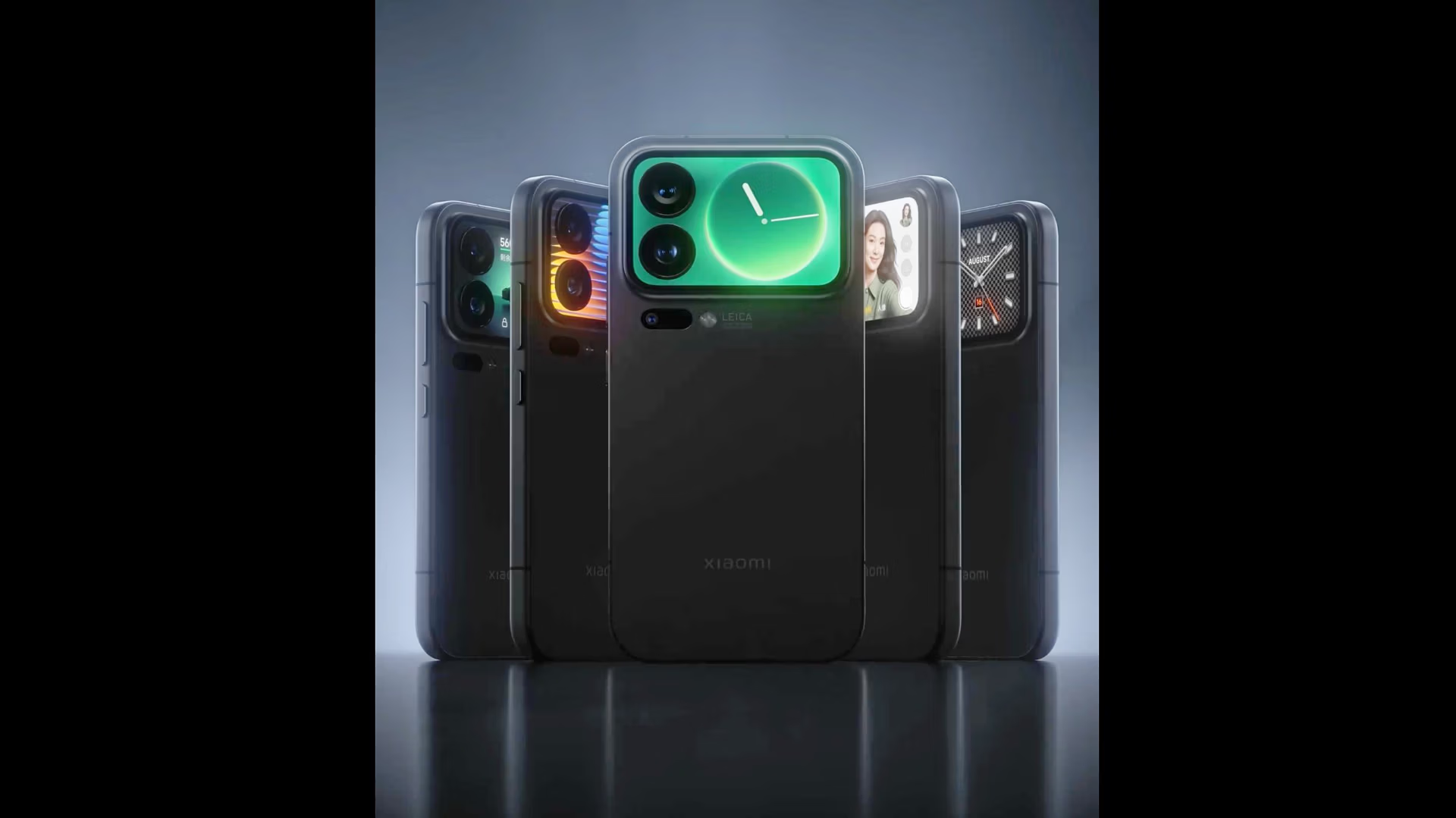
But a powerful brain needs a creative and distinctive body, and this is where the Xiaomi 17 Pro Max leak truly shines. Dominating the back of the device is a massive, circular camera housing that contains a wild blast from the past: a fully-functional secondary display. In an era where most smartphones have converged into sleek, indistinguishable glass rectangles, this bold design choice is a breath of fresh air, a defiant rejection of bland uniformity. It’s a statement that design innovation is not only alive but thriving.
A Legacy Reimagined: The Secondary Display’s Evolution and Purpose
We’ve certainly seen the idea of a secondary display before, most notably on Xiaomi’s own Mi 11 Ultra, which featured a smaller screen nestled next to its formidable camera array. Before that, devices like the YotaPhone experimented with e-ink displays on the back, and even early flip phones championed the concept of a small external screen for quick information. For a time, these were often written off as quirky gimmicks or niche features that failed to gain widespread adoption. But bringing it back now, in 2024, feels profoundly different. Why? Because its utility has matured and its integration promises to be seamless, impactful, and genuinely valuable in the modern mobile landscape.
In a world increasingly obsessed with capturing the absolute best selfie, a rear-facing screen is the ultimate, elegant solution. It allows users to leverage the phone’s primary camera sensors – typically far superior in resolution, aperture, and stabilization to any front-facing camera – for self-portraits, video calls, and high-quality vlogging. This means access to much larger sensors, robust optical image stabilization, vastly better low-light performance, and advanced lens systems, all previously unavailable for front-facing shots. The difference in quality for your social media content, professional video calls, or cherished memories could be monumental, elevating personal photography to an entirely new level.
Beyond the Selfie: Unlocking New Utilities and Identity
But the secondary display’s utility extends far beyond just perfect selfies. It offers a power-efficient way to see crucial notifications, quickly check the time, control music playback, or even screen calls without needing to wake up the massive, power-hungry main display. This “glanceable information” concept enhances discretion and significantly contributes to battery saving simultaneously. Imagine leaving your phone face down during a meeting, yet still being able to subtly check urgent messages, meeting reminders, or incoming calls on the secondary screen without interrupting your flow or appearing rude.
Moreover, it’s an unapologetic design choice that gives the phone a unique identity in a sea of increasingly identical devices. It’s a conversation starter, a visual statement that declares, “This phone is different, and proud of it.” In a competitive market where every brand is fighting fiercely for consumer attention and loyalty, such a distinctive feature can be an incredibly powerful differentiator, appealing strongly to users who crave both cutting-edge innovation and a strong sense of individuality in their personal tech.
The Total Package: No Compromises in the Ultimate Flagship
Beyond the headline-grabbing features of the “Elite” chip and the innovative secondary display, the rest of the rumored specs paint a comprehensive picture of a device meticulously designed to be an ultimate flagship. Xiaomi isn’t just trying out one new idea in isolation; it’s throwing every cutting-edge technology it has into a single, cohesive, and compelling package. This holistic approach signals a new era of flagship phones that staunchly refuse to compromise on any front, aiming to deliver a truly unparalleled user experience.
Premium Materials and Advanced Biometrics for a Refined Experience
We’re talking a titanium alloy frame, a material recently popularized by Apple’s latest iPhones, known for its exceptional strength-to-weight ratio, superior durability, and inherently premium feel. This doesn’t just add a layer of robust protection; it fundamentally elevates the tactile experience of holding the device, conveying an immediate sense of luxury, craftsmanship, and sophisticated engineering. Gone are the days of easily scratched aluminum or fragile glass frames solely defining the premium experience; titanium offers a new benchmark for flagship construction.
Furthermore, the inclusion of an advanced 3D ultrasonic fingerprint scanner is a significant and welcome upgrade. This means goodbye to the often smudgy, less reliable optical readers that frequently struggle with wet fingers, varying light conditions, or screen protectors. Ultrasonic technology offers superior security, significantly faster authentication, and greater reliability by scanning the unique ridges and pores of your finger in three dimensions, creating a much more accurate and robust biometric map. This is a crucial improvement for daily convenience, enhanced data security, and overall user satisfaction, placing it at the forefront of modern biometric technology.
Revolutionizing Mobile Photography and Global Connectivity
For photography enthusiasts, a powerful periscope telephoto lens is rumored to be integrated, enabling significantly enhanced optical zoom capabilities without the typical bulk and protrusion of traditional camera lenses. This sophisticated technology, combined with the “Elite” NPU’s formidable computational photography prowess, means users can expect breathtakingly detailed long-distance shots, incredible macro capabilities, and artistic portraiture previously exclusive to professional-grade cameras. It signifies a continued, relentless push towards making smartphones the only camera most people will ever truly need, blurring the lines between mobile and dedicated photography equipment.
And for those adventurers, remote workers, or anyone who values absolute connectivity, satellite connectivity is a genuine game-changer. Following in the footsteps of other premium devices, integrating satellite communication provides an invaluable lifeline in areas completely devoid of cellular coverage – crucial for emergencies, intrepid outdoor expeditions, or simply staying connected far off the grid. This feature transforms the smartphone from a mere communication device into a genuine survival and exploration tool, expanding its utility far beyond urban confines and into the true wilderness.
This comprehensive leak suggests that the future isn’t about choosing between raw power and interesting design, or between cutting-edge photography and robust, global connectivity. The next generation of flagships, powerfully exemplified by what the Xiaomi 17 Pro Max represents, will demand a seamless synthesis of all these elements. As the internal chips become almost incomprehensibly powerful with their advanced AI capabilities, we’re going to see manufacturers get brave again with the external hardware. They’ll need to build phones that not only think differently but also look and feel distinctly different to truly stand out and captivate consumers in a crowded market.
If this is truly our first look at what the Snapdragon 8 Elite Gen 5 enables, and how manufacturers like Xiaomi are willing to push the envelope on both internal intelligence and external design, then the future of smartphones is about to get a lot more interesting than just a bigger number on a spec sheet. It’s about a return to ingenuity, a fusion of intelligence and distinct identity, promising devices that are as smart as they are unique and as functional as they are beautiful.
Read the original story at Android Authority.
What are your thoughts on this potential shift? Are you ready for “weird” and innovative designs to make a comeback, or do you prefer the steady, incremental improvements we’ve seen in recent years? Share your opinions in the comments below!