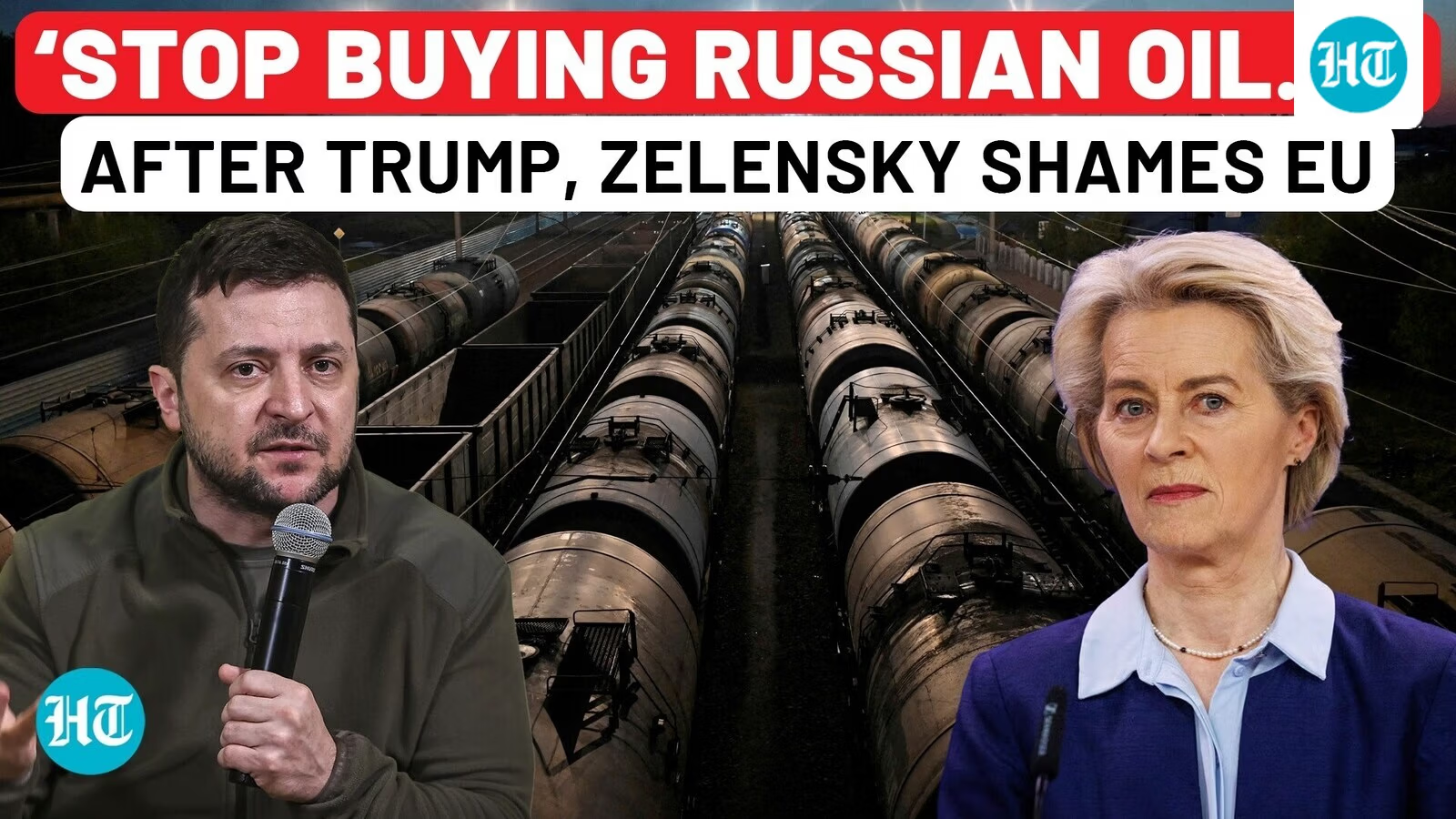
In the relentless calculus of war, President Volodymyr Zelensky is once again asking Europe to look beyond the immediate horizon of Ukraine’s embattled cities. His latest message is not merely a plea for aid but a chilling prophecy for the continent: what is happening in Ukraine today, he warns, is a test case for a much larger ambition. “Today it’s Russian drones,” he asserts, leaving the ominous conclusion hanging in the air—”tomorrow it could be…” something far closer to home for the rest of Europe. This isn’t abstract rhetoric; it’s a direct challenge delivered amidst escalating Russian aggression, characterized by relentless waves of Shahed attack drones and sophisticated missile strikes targeting Ukrainian infrastructure and civilian areas. Zelensky’s words serve as a stark reminder that the conflict’s geographic boundaries are fluid, and its implications extend far beyond Ukraine’s borders, directly threatening the long-term stability and security of the entire European continent.
This urgent appeal is more than just wartime rhetoric; it’s a calculated and deliberate effort to reframe the entire conflict in the minds of Western leaders and publics. For over two years, the narrative has often centered on Ukrainian survival, sovereignty, and its democratic aspirations. Zelensky is now deliberately shifting the focus to European self-preservation, arguing forcefully that the drones and missiles raining down on his country are not the endgame for Vladimir Putin, but rather a violent, brutal, and strategically significant rehearsal. By positioning Ukraine as the undisputed frontline of a continental struggle against an expansionist and authoritarian power, he aims to shatter any creeping complacency in Western capitals and make it unequivocally clear that a Russian victory would not create peace, but merely move the threat westward, closer to the heart of Europe. His message is designed to awaken Europe to the uncomfortable truth that their own security is inextricably linked to Ukraine’s fate.

The implications of this re-evaluation are profound. Zelensky is not just asking for more weapons; he is demanding a fundamental shift in perception—from viewing the war as a regional crisis to recognizing it as an existential threat to the democratic values and geopolitical order of Europe. He underscores that Russia’s tactics in Ukraine, from large-scale military invasions to sophisticated hybrid warfare, are being honed and perfected. These are lessons Putin’s regime is actively learning and preparing to apply elsewhere. Therefore, the immediate horizon of Ukrainian defense must expand to encompass the strategic defense of Europe as a whole, necessitating a united and robust response that transcends mere aid and embraces a comprehensive, long-term security strategy.
The Resurgence of the Domino Theory in European Geopolitics
At the core of President Zelensky’s warning is the modern revival of the domino theory, a concept that once defined Cold War strategic thinking. Historically, the domino theory suggested that if one country in a region fell to communism, neighboring countries would inevitably follow suit. Zelensky has skillfully adapted this geopolitical framework to the current European context, arguing that if Ukraine is allowed to falter and succumb to Russian aggression, it will embolden Vladimir Putin to test the resolve and collective defense mechanisms of other nations, particularly those on NATO’s eastern flank. This isn’t a speculative fear but a logical projection based on Putin’s historical actions, from Georgia in 2008 to Crimea and eastern Ukraine in 2014, culminating in the full-scale invasion of 2022.
The “tomorrow” Zelensky speaks of might not necessarily manifest as a full-scale, overt invasion of a NATO country, which would trigger Article 5 and a direct military confrontation with the entire alliance. Instead, the threat could manifest in a myriad of insidious ways, designed to exploit vulnerabilities, sow division, and incrementally erode European stability without crossing the explicit threshold of direct warfare. These include:
- Hybrid Warfare: Russia has extensively refined its toolkit for hybrid warfare, employing cyber-attacks, disinformation campaigns, and propaganda to destabilize societies. This could target critical infrastructure, election processes, or social cohesion in countries like the Baltic states (Estonia, Latvia, Lithuania), Poland, or even non-NATO EU members such as Moldova and Georgia. The goal would be to create internal chaos, undermine public trust in democratic institutions, and exploit existing societal cleavages.
- Political Destabilization: Beyond cyber means, Russia has a documented history of funding extremist political parties, cultivating sympathetic voices in media, and leveraging economic dependencies (especially energy) to exert political pressure. Post-Ukraine, an emboldened Russia could intensify these efforts to fracture EU and NATO unity, creating a more pliable geopolitical landscape in Eastern and Central Europe.
- “Limited” Incursions and Provocations: Putin could be emboldened to probe the alliance’s commitment to collective defense through “limited” incursions designed to be ambiguous, making it difficult for NATO to form a unified response. This might involve border provocations, short-term occupation of disputed territories (like the Transnistrian region of Moldova), or aggressive maneuvers in international waters and airspace that test the patience and response times of NATO members. The ambiguity is precisely the point; the threat is designed to be pervasive, unpredictable, and to keep Europe constantly on edge, sowing fear and division among allies.
- Economic Coercion and Energy Blackmail: While Europe has significantly reduced its reliance on Russian energy, an unhindered Russia could seek new avenues for economic leverage, potentially disrupting trade routes, manipulating global commodity markets, or weaponizing other resources to exert pressure on European economies.
The psychological impact of this pervasive ambiguity is a critical component of Russia’s strategy. By creating a climate of constant uncertainty and low-level threat, Moscow aims to exhaust European political will, deepen internal divisions within the EU and NATO, and ultimately weaken the resolve to mount a truly unified and robust defense. Zelensky’s warning serves to highlight that these are not theoretical scenarios but tangible risks that will dramatically increase if Ukraine’s defense is not adequately supported. The cost of preventing these “dominoes” from falling now, through robust support for Ukraine, is immeasurably lower than the colossal economic, political, and human cost of confronting a more aggressive and confident Russia on Europe’s doorstep later.
Europe’s Moment of Decision: From Crisis Management to Existential Defense
For the future of European security, President Zelensky’s message serves as a crucial political barometer, directly challenging European leaders to make a fundamental choice. He forces them to decide whether they view the ongoing war in Ukraine as a distant, albeit tragic, crisis to be managed with measured responses, or as an existential threat to be defeated with unwavering determination and comprehensive strategic planning. The implications of this distinction are immense, shaping not only the immediate response to Ukraine but also the long-term trajectory of European defense and foreign policy.
Viewing the conflict as a “distant crisis” allows for a piecemeal approach, providing just enough aid to keep Ukraine fighting but falling short of the decisive support needed for victory. This perspective risks prolonging the war, increasing human suffering, and ultimately leaving Europe vulnerable to an emboldened Russia. Conversely, recognizing the war as an “existential threat” necessitates a paradigm shift, demanding a proactive, unified, and expansive commitment to not only ensure Ukraine’s victory but also to fundamentally re-arm and reorganize European defense capabilities for a generation.
The Call for Long-Term Commitments and Industrial Mobilization
Zelensky’s warning is a strategic push for the kind of long-term commitments, advanced air defense systems, and industrial mobilization required not just to save Ukraine, but to secure Europe for decades to come. Long-term commitments mean moving beyond ad-hoc aid packages to establishing consistent, predictable, and substantial financial, military, and political support for Ukraine, irrespective of domestic political cycles in various European nations. This includes sustained military training programs, intelligence sharing at an unprecedented level, and a clear, unified pathway for Ukraine’s eventual integration into European structures.
Crucially, Zelensky emphasizes the need for a profound shift in Europe’s industrial capacity. For too long, European defense industries have operated on a peacetime model, unable to meet the demands of a high-intensity conflict. Industrial mobilization is now paramount, requiring a rapid ramp-up of production for essential war materials: artillery ammunition, crucial spare parts, modern armored vehicles, and especially advanced air defense systems. This means:
- Boosting Ammunition Production: The sheer scale of artillery use in Ukraine has exposed critical shortages in European stockpiles and manufacturing capabilities. A concerted effort to increase shell production is vital for both Ukraine’s needs and Europe’s own defensive posture.
- Expanding Defense Manufacturing: Investing heavily in European defense companies to expand factories, innovate technologies, and streamline supply chains. This fosters strategic autonomy, reducing reliance on external partners for critical military hardware.
- Ensuring Resilience: Building redundancy into supply chains and diversifying sources to prevent single points of failure, lessons learned from global disruptions and the immediate needs of war.
This industrial renaissance is not merely about equipping Ukraine; it’s about rebuilding Europe’s own capacity to deter and, if necessary, defend itself. It’s a recognition that peace cannot be taken for granted and requires continuous investment in robust defense capabilities, a significant undertaking for many European nations that have historically underinvested in their militaries.
Strengthening Air Defense Systems: A Critical Shield for European Skies
The relentless Russian aerial attacks on Ukraine, utilizing everything from Iranian-supplied Shahed drones to sophisticated ballistic and cruise missiles, have highlighted the indispensable role of modern, multi-layered air defense systems. Zelensky’s call for advanced air defense is particularly acute. Systems like the American Patriot, Franco-Italian SAMP/T, and German IRIS-T SLM have proven highly effective in Ukraine, but they are finite and expensive. For Europe, this translates into an urgent need to:
- Deploy More Advanced Systems: Increase the number of sophisticated air defense batteries across the continent, prioritizing vulnerable regions and NATO’s eastern flank.
- Integrate Defense Networks: Develop a more cohesive and integrated air and missile defense architecture across NATO and EU member states, allowing for seamless coordination and rapid response to threats. This includes shared intelligence, interoperable systems, and common training protocols.
- Counter Drone Threats: Invest heavily in developing and deploying effective anti-drone technologies, including electronic warfare systems, laser defenses, and drone interceptors, recognizing that unmanned aerial vehicles represent a growing and evolving threat.
The core of Zelensky’s argument is simple and stark: the price of defending Kyiv now, with robust and comprehensive military, financial, and political support, is infinitely lower than the catastrophic human and economic cost of defending another European capital later. This is not just about military expenditure; it’s about safeguarding democratic values, territorial integrity, and the very foundation of the post-WWII European order. The question he leaves unanswered, a challenge echoing across ministries and parliaments, is whether Europe is truly listening and prepared to meet this epochal moment with the unity, resolve, and resources it demands.
What immediate steps do you believe European leaders should prioritize to address Zelensky’s warnings and secure the continent’s long-term future?
Read the original story at Hindustan Times.