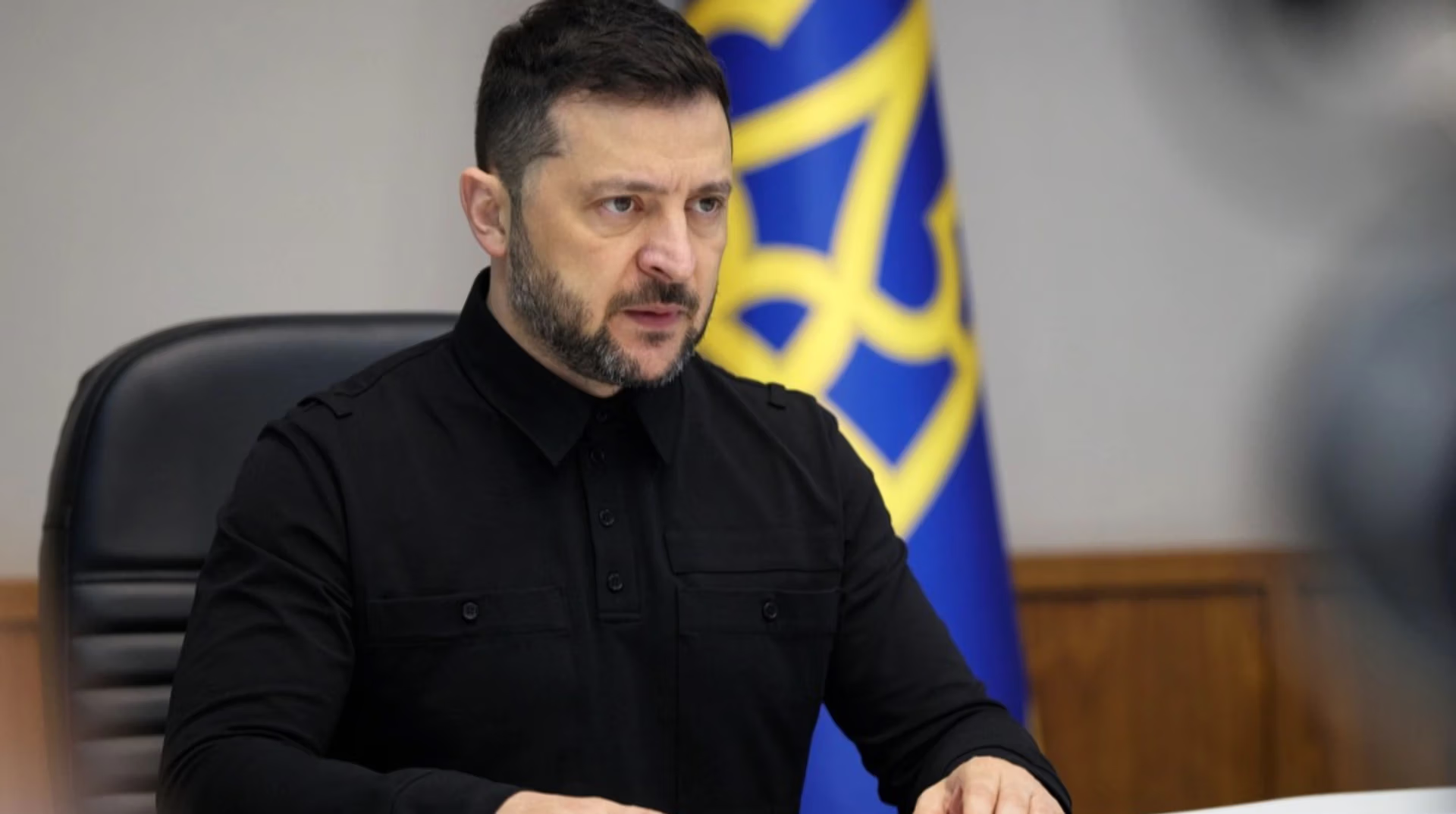
The End of the Grey Zone: Zelenskyy Unveils a New European Security Architecture
In a move that signals a tectonic shift in Europe’s post-Cold War security landscape, Ukrainian President Volodymyr Zelenskyy has announced a landmark security agreement with European partners. This is not another emergency aid package or a temporary pledge of support. This is the formalization of a new reality—a strategic pivot that aims to permanently erase the geopolitical “grey zone” that Russia has sought to exploit for decades across Eastern Europe.
Announced on Tuesday, the agreement represents the culmination of a long, arduous diplomatic effort to transform the ad-hoc, crisis-driven support for Ukraine into a durable, institutionalized commitment. While the full details are still emerging, the pact is understood to be a comprehensive framework of long-term security guarantees designed to equip, train, and sustain Ukraine’s military for the future, ensuring it can effectively deter and, if necessary, decisively defeat any future aggression. This marks a profound evolution in international engagement, moving beyond reactive crisis management to proactive, strategic partnership aimed at solidifying the European security architecture.

But what does this groundbreaking agreement truly signify beyond the immediate battlefield logistics and the necessary provision of military hardware? Its implications reverberate across strategic, political, and economic spheres, redefining relationships and expectations for years to come, profoundly impacting Ukraine, Europe, and Russia’s place in the international order.
Anchoring Ukraine: A Declaration of Permanence and Predictability
For Ukraine, this security agreement is nothing less than a declaration of permanence and a clear pathway out of a precarious geopolitical limbo. For over three decades since the collapse of the Soviet Union, Kyiv has existed in an unenviable “grey zone”—a strategic vacuum where its aspirations to join Western institutions like NATO and the EU were consistently undermined by the persistent, looming threat of Russian retaliation. This ambiguity fostered chronic instability, hindered economic development, deterred foreign investment, and created an environment ripe for Russian hybrid warfare and ultimately, full-scale invasion. The lack of clear, binding security guarantees made Ukraine a vulnerable target, constantly teetering on the brink of external aggression and internal upheaval.
This new pact, while carefully constructed to stop short of a full NATO-style Article 5 mutual defense clause, effectively and irrevocably anchors Ukraine within the Western security fold. It provides Kyiv with the crucial predictability it desperately needs not only to plan its long-term defense strategies but also to confidently embark on the monumental task of rebuilding its nation. The agreement formalizes and strengthens the operationalization of support, facilitating continuous military aid, intelligence sharing, joint procurements, and sophisticated defense industry collaboration. This enables Ukraine to standardize its forces with European counterparts, integrate advanced Western military doctrines, and build a robust, modern military capable of defending its borders and sovereignty against any future aggressor, transforming it into a formidable pillar of European defense.
The commitment outlined in the agreement extends far beyond just weaponry. It encompasses extensive joint training exercises, critical cyber security cooperation, and comprehensive reforms aimed at strengthening Ukraine’s defense institutions, governance, and democratic oversight in line with Euro-Atlantic standards. This holistic approach ensures that Ukraine’s military growth is not merely about quantitative increases in equipment but also qualitative advancements in doctrine, leadership, logistics, and operational capabilities, fostering true interoperability with European forces. This newfound certainty is absolutely crucial for attracting foreign investment, stimulating economic recovery, and stabilizing Ukrainian society, as businesses and international partners are far more likely to commit to a nation with guaranteed long-term security and a clear path toward European integration.
Moreover, this agreement solidifies a de-facto alliance that has already emerged through the crucible of war. It formalizes and institutionalizes the deep cooperation and trust built between Ukraine and its European partners, providing a framework for sustained collaboration that transcends individual political cycles. It’s a powerful message that Europe is no longer just a supportive neighbor offering ad-hoc aid; it is a committed, long-term strategic partner, recognizing Ukraine’s indispensable role in the continent’s collective security and stability. This shift is vital for Ukraine’s eventual path toward full EU and potentially NATO membership, enhancing its strategic value and readiness by integrating it more deeply into the broader Euro-Atlantic community.
Europe’s Strategic Maturity: Taking Decisive Ownership of Collective Security
Second, for Europe, this agreement marks a moment of profound strategic maturity and a decisive step towards greater self-reliance in defense. The continent is taking assertive ownership of its own security, moving beyond a post-Cold War “peace dividend” era characterized by underinvestment in defense and a historical reliance on external security providers, particularly the United States. The brutal reality of Russia’s full-scale invasion in 2022 served as an unequivocal wake-up call, demonstrating the urgent need for a stronger, more cohesive European defense posture that reflects the continent’s economic power and geopolitical aspirations.
The agreement signals a collective understanding among European leaders that peace and prosperity in their own capitals—be it Paris, Berlin, Rome, or Warsaw—are inextricably linked to sovereignty, territorial integrity, and stability in Kyiv. The economic consequences of instability in Eastern Europe, ranging from disrupted supply chains and soaring energy prices to massive refugee flows and humanitarian crises, have profoundly underscored this interconnectedness. By forging this pact, European leaders are making a calculated, forward-looking investment in deterrence, concluding that the significant, sustained cost of cementing Ukraine’s defense capabilities now is immeasurably less than the potential, catastrophic human and economic cost of facing a revanchist and unconstrained Russia directly on the European Union’s eastern border later. This represents a fundamental shift in strategic thinking, emphasizing proactive defense and collective security over reactive crisis management or historical appeasement.
This institutionalized commitment is a powerful testament to Europe’s growing strategic autonomy. It reflects a unified determination to bolster the continent’s defense industrial base, enhance interoperability among national forces, and develop a coherent European security strategy that directly addresses contemporary geopolitical threats. The long-term security guarantees to Ukraine are thus an integral part of a broader vision for a more secure and resilient Europe, capable of defending its values and interests in an increasingly volatile global landscape. This agreement is a practical application of the idea that a strong, secure Ukraine is a strong, secure Europe, cementing the foundation for genuine collective security and reinforcing the European pillar of NATO, ultimately strengthening the alliance as a whole.
Furthermore, this pact underscores a hard-learned historical lesson: appeasement and ambiguity only invite further aggression. The failures of past diplomatic efforts and the unfulfilled promises of agreements like the Budapest Memorandum, which failed to guarantee Ukraine’s security against Russian aggression in 1994, have profoundly shaped Europe’s renewed resolve. This new agreement signals a decisive break from that pattern, establishing clear red lines and backing them with substantive, long-term commitments. It demonstrates a unified European front, overcoming historical divisions and national self-interests to present a united response to a shared existential threat, solidifying a renewed sense of European purpose and collective identity in security matters for generations to come.
A Strategic Rebuke: Undermining Kremlin’s Geopolitical Ambitions
Finally, and perhaps most consequentially for the global order, this agreement constitutes a potent and irrefutable strategic rebuke to the Kremlin and its revisionist foreign policy. The primary, overarching goal of Russia’s full-scale invasion in February 2022 was explicitly to shatter Ukraine’s pro-Western trajectory, dismantle its sovereignty, and forcefully drag it back into a Russian sphere of influence. President Putin’s stated objectives, ranging from “denazification” to preventing NATO “encroachment,” were thinly veiled pretexts for subjugating a sovereign nation and reasserting Russia’s dominance over its neighbors, effectively challenging the post-Cold War order and undermining international law.
This comprehensive security pact achieves the exact opposite of Moscow’s desired outcome. By formally codifying Ukraine’s enduring position as a bulwark of European defense, firmly backed by the combined industrial, military, and diplomatic might of the continent, the agreement completely undermines Russia’s strategic aims. The very outcome Moscow sought to prevent—a well-armed, militarily capable, and increasingly Western-integrated Ukraine, aligned with European security standards and values—is now being enshrined in a binding, long-term international agreement. This demonstrates the profound and undeniable failure of Russia’s aggressive foreign policy and its attempts to redraw borders and spheres of influence by brute force, proving that such tactics are ultimately self-defeating.
The agreement sends an unequivocal message that territorial aggression, attempts to subjugate sovereign nations, and blatant disregard for international law will not be tolerated and will, in fact, solidify the international resolve against such actions. It validates Ukraine’s sovereign choice of alignment and underscores the international community’s unwavering commitment to upholding fundamental principles of international law, including national sovereignty, territorial integrity, and the right of self-determination. This strategic defeat for the Kremlin extends far beyond Ukraine’s borders; it diminishes Russia’s standing on the global stage, weakens its influence over its neighbors, and reinforces its isolation from the democratic world, particularly from Europe, for the foreseeable future.
Moreover, this institutionalized commitment challenges Russia’s long-term security doctrine, which often frames any Western alignment of its neighbors as an existential threat requiring military intervention. The agreement demonstrates that such aggressive posturing only accelerates the very integration Russia fears, making it a self-defeating strategy that has backfired spectacularly. The binding nature of these guarantees means that reversing Ukraine’s Western orientation will become exponentially more difficult, if not impossible, for any future Russian leadership, irrespective of who holds power. The chessboard is indeed being reset, not in Moscow’s favor, but in favor of a more stable, rules-based European security architecture, where aggression is met with unified and lasting deterrence, upholding the principles of international peace and security.
This is not the end of the conflict, nor does it guarantee an immediate cessation of hostilities. However, it is unequivocally the beginning of a new strategic chapter for both Ukraine and Europe. The pervasive ambiguity that has plagued Eastern Europe for a generation—where nations existed in a dangerous geopolitical vacuum, vulnerable to external pressures—is now being replaced with clarity and unwavering commitment. Europe is drawing a decisive line, not merely with rhetoric or temporary sanctions, but with a substantive, long-term commitment that fundamentally reshapes the continent’s future security landscape. Ukraine is no longer viewed or treated as a precarious buffer state, but as a key, integrated pillar in a new, more resilient, and self-reliant European security architecture, ensuring enduring peace through strength.
What do you believe will be the most significant long-term impact of this new European security architecture on global geopolitics, and how might it influence the strategies of other nations facing similar regional threats?
Read the original story at Українська Правда.